
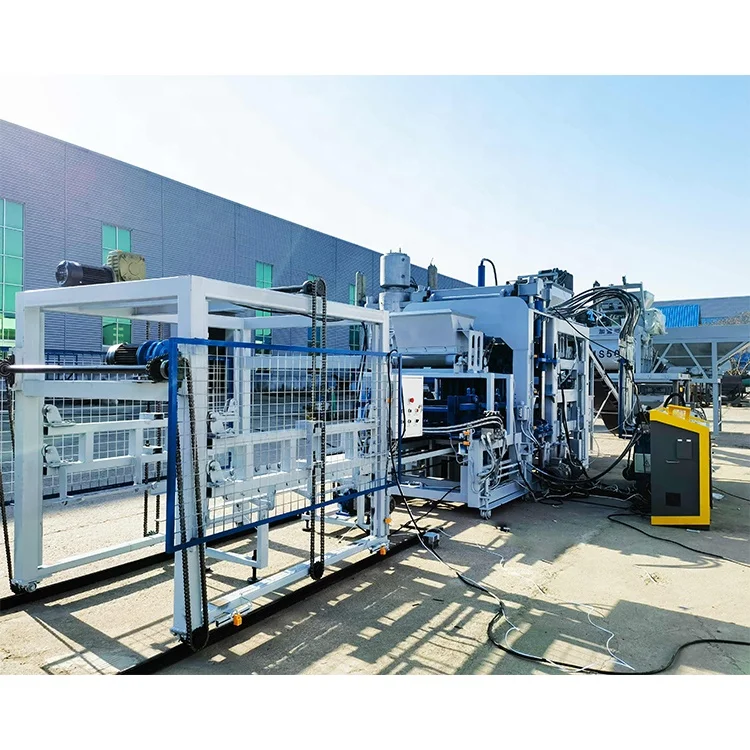
Matched Line Engineering — Every station from the mixer to the curing rack is sized against the QT8-15 cycle so the press never starves or blocks.
Technical Specifications
| Parameter | Value |
|---|---|
| Model | QT8-15 |
| Product Type | Hydraulic Block Making Machine |
| Overall Dimensions (L×W×H) | 8300 × 1860 × 3000 mm |
| Rated Pressure | 21 MPa |
| Main Vibration Form | Platform Vibration |
| Vibration Frequency | 2800–4500 r/min |
| Vibration Force | 60 kN |
| Pallet Size | 950 × 900 mm |
| Molding Cycle | 15–25 s (basis not stated in source — confirm block format, material, and thickness) |
| Overall Power | 55.5 kW |
| Total Mass | 9 T |
| Demolding Method | Hydraulic |
| General Water Consumption | 12 T/Day |
| Factory Area | 600 m² |
| Control System | PLC with human-machine interface |
| Applied Products | Concrete blocks, hollow/solid blocks, pavers, interlocking blocks, curbstone, colored pavers |
| Raw Material | Crushed stone, sand, cement, dust, fly ash, gravel, slag |
Application Suitability
| Application | Material or Output |
|---|---|
| Hollow and solid block production plants | Crushed stone, sand, cement, fly ash, slag |
| Paver and interlocking brick manufacturing | Fine aggregate, cement, pigment for colored pavers |
| On-site block supply for housing developments | Locally sourced gravel, sand, and cement |
| Curbstone and kerb production for infrastructure | Coarse aggregate with cement binder |
Why the Press Is Never the Real Bottleneck in a Block Line
A press quoted at 15–25 seconds per cycle only delivers that rate when every upstream and downstream station keeps pace.
I spent years flying to Latin American plants where the host machine sat idle while the mixer caught up or the stacker jammed. The Hydraulic Block Making Machine production line you buy is only as fast as its slowest supporting station. When the feeder cannot deliver a full charge before the press finishes its cycle, or when the pallet return loop falls behind, the quoted molding cycle becomes meaningless. The QT8-15 is specified here as the centre of a complete line, not as a standalone press [NEED_CITE: line synchronization principles in concrete block production].
How Each Station Must Match the 15–25 Second Press Cycle
The raw material batching and mixing station must deliver a fresh, homogeneous charge within the press cycle window. If the mixer discharge takes longer than the molding cycle, the QT8-15 sits empty. A semi-closed reticular rotational feeding unit forces material into the mould cavity evenly, reducing the time the press spends waiting for a complete fill. The Hydraulic Block Making Machine production line only reaches its rated rhythm when batching, mixing, feeding, and pressing are timed as one sequence.
Pallet Circulation and Curing Rack Alignment
The 950 × 900 mm pallet must travel from the press through the stacker, onto the curing rack, and back to the pallet feeder within a timeframe that does not stall the next cycle. If the curing area is too small or the forklift cannot move racks fast enough, pallets pile up at the stacker exit. The pallet specification must match both the curing rack dimensions already on site and the forklift fork width in use [NEED_CITE: pallet and curing logistics in stationary block plants].
Reading the Specs That Actually Shape Output
The 21 MPa rated pressure and 60 kN vibration force work together to compact the mix into a dense, consistent block. Higher vibration frequency (up to 4500 r/min) suits fine aggregate and thinner formats like pavers, while lower frequency with sustained pressure works better for large hollow blocks with coarse stone. The platform vibration form transmits force directly through the mould table rather than through the mould walls, which produces more uniform density across the pallet area. The 55.5 kW overall power rating covers the press itself; the full Hydraulic Block Making Machine production line will draw additional power for the mixer, feeder, stacker, and pallet return, so the site electrical supply must be sized accordingly. The PLC human-machine interface manages the full press cycle, but the control language and voltage must be confirmed before the cabinet is wired.
The Cost of Misaligned Line Stations
When the mixer output does not match the press appetite, operators begin hand-feeding material to keep the machine running — a practice that destroys the consistency the PLC was meant to guarantee. Undersized pallet circulation forces the stacker operator to manually pull pallets off the line, creating a safety hazard and slowing the entire output. A curing rack layout that ignores the 950 × 900 mm pallet size means pallets are stacked on the floor, consuming space and delaying return to the feeder [NEED_CITE: manual handling risks in block production].
Why This Line Configuration Exists
Block machinery is our single focus, which means the QT8-15 press, its moulds, pallets, and every handling station are specified as one matched system rather than assembled from unrelated suppliers. The line configuration is set against the buyer’s actual mix design and local aggregate, not a catalogue default. Mould design covers the formats the buyer’s market actually sells, with custom drawings available for non-standard shapes. The automation level is selectable, so a plant can begin with semi-automatic pallet handling and add stacking or cubing later. Installation includes operator training on the full line, not just the press [NEED_CITE: CE machinery directive requirements for industrial equipment].
Documentation & Verification
- Line layout drawing showing feeder, mixer, pallet loop, stacker, and curing rack with capacity per block format
- Machine specification sheet confirming 55.5 kW power draw and 21 MPa hydraulic pressure
- Mould drawing and format list for hollow, solid, paver, interlocking, and curbstone products
- Pallet specification matched to the 950 × 900 mm size and the buyer’s existing curing infrastructure
- Factory test record covering the press and all supporting stations running together before dispatch
Installation, Commissioning & Support
- Foundation plan based on the 8300 × 1860 mm press footprint and 9 T total mass with vibration isolation
- Electrical supply sized for 55.5 kW press load plus mixer, feeder, and stacker auxiliary power
- Machine arrives in dismantled state for container loading with reassembly supervised on site
- PLC human-machine interface configured to the buyer’s voltage, frequency, and display language before energizing
- Operator training covers the full line cycle from batching through pallet return, not press operation alone
- Wear parts list for hydraulic seals, vibration springs, and mould liners provided at handover
What to Include in Your Inquiry
To size the supporting stations around the QT8-15, share your target block format, required daily output, and the local raw materials available at your site. Confirm the voltage and frequency of your power supply, the PLC display language your operators need, and the dimensions of any existing curing area and forklift equipment.
Frequently Asked Questions
Q: How is daily output calculated across the full line, and which block format is assumed?
A: Daily output is calculated by multiplying the molding cycle per format by the number of blocks per pallet, then factoring in mixer discharge time, pallet return speed, and curing rack turnover. The QT8-15 molding cycle of 15–25 seconds varies by block format, thickness, and material. We state the assumed format in every capacity calculation so the figure reflects your actual product, not a generic catalogue number.
Q: Which supporting stations are included in the line quotation?
A: The line quotation covers raw material feeding, mixing, pallet feeding, the QT8-15 press, stacking, and curing rack handling. Each station is sized so its cycle does not exceed the press cycle. Stations omitted from the quotation are listed explicitly so you know what remains to be sourced or built on site before commissioning.
Q: How must cycle times at each station align so the press is not starved or blocked?
A: The mixer must discharge a full batch before the press completes its current cycle. The pallet feeder must present a clean pallet before the press opens. The stacker must clear the loaded pallet before the next one arrives. Each station’s cycle is calculated backward from the QT8-15 press rhythm to prevent idle time at any point.
Q: What pallet size is specified, and does it match my existing curing racks and forklift?
A: The standard pallet size for this line is 950 × 900 mm. Before production, we confirm that this dimension fits your curing rack spacing and that your forklift fork width can handle the loaded pallet. If your existing infrastructure requires a different size, the pallet specification is adjusted and all downstream stations are re-sized accordingly.
Q: What is the factory area requirement, and how is the layout adapted to my site?
A: The QT8-15 press line requires approximately 600 m² including raw material storage, press area, curing racks, and finished product staging. The layout drawing is adapted to your actual building dimensions, ceiling height, and door positions. We adjust the pallet return path and curing rack arrangement to fit within your available footprint without compressing station cycle times.


