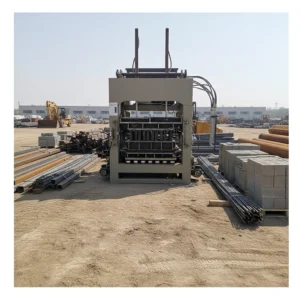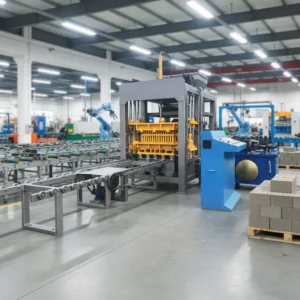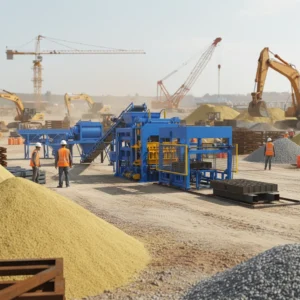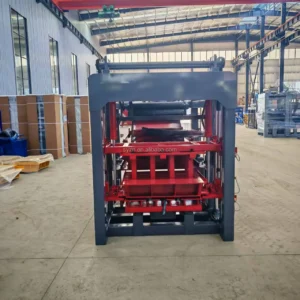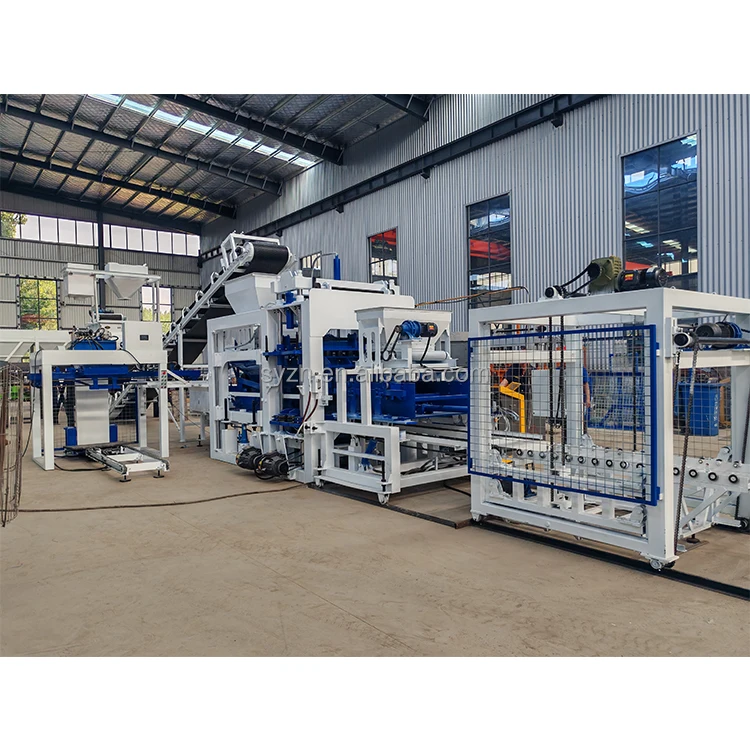
Matched System Integration — The QT8-15 block machine is configured alongside mixer capacity, pallet return speed and stacking stations so the press never idles between cycles.
Technical Specifications
| Parameter | Value |
|---|---|
| Model | QT8-15 |
| Product Type | Hydraulic Concrete Block Making Machine |
| Overall Dimensions (L×W×H) | 8300×1860×3000 mm |
| Rated Hydraulic Pressure | 21 MPa |
| Main Vibration Form | Platform Vibration |
| Vibration Frequency | 2800–4500 r/min |
| Vibration Force | 45 kN |
| Pallet Size | 950×900 mm |
| Molding Cycle | 15–20 s (basis to be confirmed per block format) |
| Overall Power | 55.5 kW |
| Total Mass | 8 T |
| Demolding Method | Hydraulic |
| Raw Materials | Crushed stone, sand, cement, fly ash, gravel, slag |
| Applied Products | Hollow blocks, solid blocks, pavers, interlocking blocks, curbstone, colored pavers |
| Voltage & Frequency | Configurable to target market standard |
| Control System | PLC-based, language options to be confirmed |
| Automation Level | Available from semi-automatic to fully automatic with stacking and cubing |
| Factory Area | 300 m² (basis not stated in source — confirm whether total plant footprint or machine operating area) |
| Output Capacity | Basis not stated in source — confirm block format, material and thickness |
Application Suitability
| Application | Material or Output |
|---|---|
| Hollow block production for residential and commercial walls | Crushed stone, sand, cement, fly ash blends |
| Solid block manufacturing for load-bearing structures | Gravel, cement and slag aggregates |
| Interlocking brick laying for driveways and walkways | Sand, cement and fine aggregate mixes |
| Paving block and colored paver runs | Crushed stone, cement with pigment additives |
| Curbstone and kerb production for road projects | Coarse gravel, sand and high-strength cement |
What "15–20 Seconds per Cycle" Actually Means for Your Daily Output
A cycle time is only real when every upstream and downstream station keeps pace with the press.
The QT8-15 block machine production line is rated at a 15–20 second molding cycle. That figure assumes the mixer discharges a full batch in time, pallets return from the curing rack without delay, and the stacker clears cured blocks before the next pallet arrives. In the field I have watched a perfectly tuned press lose a third of its shift output because the mixer discharge gate was too slow and the operator had to wait twelve seconds every cycle for material. The press was never the bottleneck — the line around it was. [NEED_CITE: line-level cycle time matching in concrete block production]
How Supporting Stations Define Real Throughput
A QT8-15 block machine production line starts long before the press itself. Raw material feeding must deliver a consistent batch weight to the mixer at intervals that match the press cycle. If the feeder runs on a timer independent of the press demand signal, the mixer either overfills or starves, and the resulting inconsistency shows up as block weight variation across the pallet. Synchronising the feeder, mixer discharge and press demand into one PLC sequence removes that drift.
Pallet Circulation as the Hidden Pace-Setter
The 950×900 mm pallet is the physical link between every station. After demolding, the wet block sits on the pallet and travels to the curing area. A forklift or automated rack handler must retrieve cured pallets and return them to the press infeed before the next cycle completes. If the curing rack spacing or forklift fork width was not checked against that 950×900 mm dimension, pallets jam at the rack entry and the entire line stops. Validating pallet logistics against existing site equipment is the first layout task, not an afterthought. [NEED_CITE: pallet handling standards in block manufacturing plants]
Reading the Numbers That Matter
The 21 MPa hydraulic pressure and 45 kN vibration force work together during compaction. Hydraulic pressure squeezes the mix into the mould cavity while platform vibration at 2800–4500 r/min settles fine particles around coarse aggregate. If vibration force is high but pressure is low, blocks emerge with surface cracks and weak cores. If pressure is high but vibration is weak, the mix does not flow into thin mould walls and interlocking brick edges break during demolding. The QT8-15 pairs both forces so that hollow blocks, solid blocks and thin-walled pavers all reach target density from the same platform.
The 55.5 kW overall power figure covers the press alone. Add the mixer motor, conveyor drives, pallet return system and stacker hydraulics and the total connected load can be considerably higher. Site transformer sizing must account for simultaneous starting current across all stations, not just the press nameplate.
The Cost of a Mismatched Line
When a buyer focuses on the press price and sources the mixer, conveyors and stacker from separate suppliers, no single vendor owns the cycle-time balance. The mixer may be rated for a batch size that takes 40 seconds to discharge — longer than the press cycle — so the press idles every second or third mould. The pallet return conveyor may run at a fixed speed that cannot keep up when the line switches from hollow blocks to heavier pavers. These mismatches do not appear on any spec sheet but they consume a significant share of every shift. [NEED_CITE: consequences of unsynchronised block production lines]
Why Source the Full Line from One Configuration Team
Block machinery is our single focus, which means the QT8-15 block machine production line is specified as one system. Machine, mould, pallet and handling equipment are matched against your target block format, local aggregate and available curing space rather than pulled from separate catalogues. Mould design covers the formats your market actually sells, with custom drawings available when standard options do not fit. Automation level is selectable — a buyer can begin with semi-automatic pallet handling and add stacking and cubing later without replacing the press. Installation support includes operator training on the full line, not just the press controls. Voltage, frequency and PLC display language are confirmed in writing before production begins so commissioning is not delayed on arrival.
Documentation & Verification
- Line layout drawing showing every station from raw material intake to cubing with cycle times stated per block format
- Mould drawing and format list covering hollow, solid, paver, interlocking and curbstone options
- Pallet specification cross-referenced to curing rack spacing and forklift capacity
- Hydraulic and electrical schematic for on-site fault tracing without remote support delays
- Voltage, frequency and PLC language confirmation sheet signed before production
- Factory test record run on the buyer’s selected block format before dispatch
Installation, Commissioning & Support
- Foundation plan accounts for the 8300×1860 mm footprint and 8 T operating mass of the QT8-15
- Dedicated power circuit sized for 55.5 kW press load plus all supporting station motors
- Machine arrives partially dismantled for container loading; reassembly supervised on site
- First-run parameter setting covers vibration frequency, hydraulic pressure and molding cycle for your mix
- Operator training addresses PLC navigation, mould change procedure and daily maintenance checkpoints
- Wear parts list identifies hydraulic seals, vibration springs and mould liners with reorder intervals
What to Share When Requesting a Line Proposal
Provide the block formats you plan to produce, target daily output per format, and the raw materials available locally including aggregate grading. Include your site voltage and frequency, the dimensions of any existing curing area, and details of forklifts or handling equipment already on site. If you are integrating the QT8-15 block machine production line into an existing plant, list the mixer model, conveyor lengths and pallet specifications currently in use so the new stations can be timed to match.
Frequently Asked Questions
Q: How is the QT8-15 cycle time matched to the mixer output and pallet return speed?
A: The PLC sequence links mixer discharge, pallet infeed and press cycle into one timed loop. If the mixer batch takes longer than the press cycle to discharge, the mixer capacity is increased or a holding hopper is added between mixer and feeder so the press never waits for material.
Q: What pallet size does the line assume and how is it validated?
A: The standard pallet is 950×900 mm. Before the line layout is finalised, this dimension is checked against the buyer’s curing rack slot width, rack height and forklift fork spacing to confirm smooth pallet entry and retrieval without manual adjustment.
Q: Which supporting stations are included in the quotation?
A: The quotation itemises every station from raw material feeder through mixer, pallet feeder, press, stacker and cubing system. Buyer-supplied items such as curing racks, site wiring and water supply are listed separately so there are no hidden scope gaps.
Q: How is the total line power requirement calculated?
A: Each station motor — mixer, conveyors, pallet return, stacker hydraulics — is added to the 55.5 kW press load. Simultaneous starting current is factored in to size the site transformer and dedicated circuit breakers correctly before equipment ships.
Q: What is the realistic daily output once the full line is accounted for?
A: Output is calculated per block format based on the confirmed molding cycle, mixer batch time, pallet return speed and stacking rate. The proposal states daily throughput for each format the buyer plans to run, not a single blanket figure.