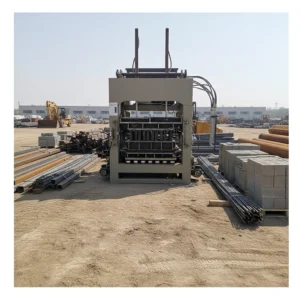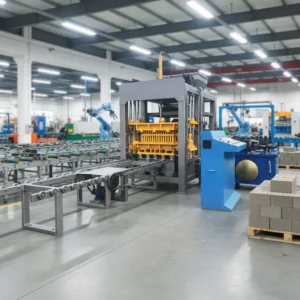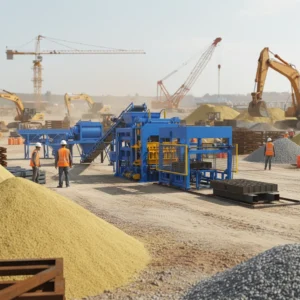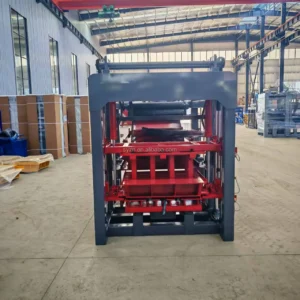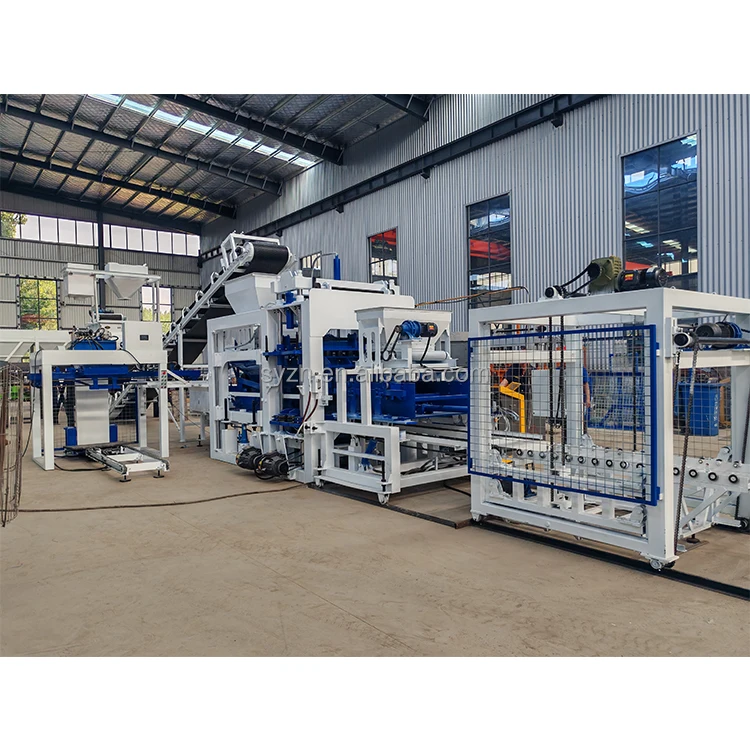
Matched Line Engineering — The QT8-15 block making machine production line is specified so feeding, mixing, pallet circulation and stacking are timed against the press cycle, preventing stations from idling while the host waits.
Technical Specifications
| Parameter | Value |
|---|---|
| Model | QT8-15 |
| Product Type | Hydraulic Concrete Block Making Machine |
| Overall Dimensions (L×W×H) | 8300×1860×3000 mm |
| Rated Pressure | 21 MPa |
| Main Vibration Form | Platform Vibration |
| Vibration Frequency | 2800–4500 r/min |
| Vibration Force | 45 kN |
| Pallet Size | 950×900 mm |
| Molding Cycle | 15–20 s (basis not stated in source — confirm block format / material / thickness) |
| Overall Power | 55.5 kW |
| Total Mass | 8 T |
| Demolding Method | Hydraulic |
| Factory Area | 300 m² (source value — verify against manufacturer catalog) |
| Applied Products | Concrete hollow/solid blocks, pavers, interlocking blocks, curbstone, colored pavers |
| Raw Materials | Crushed stone, sand, cement, dust, fly ash, gravel, slag |
| Warranty | 1 year (whole machine, excluding spare parts) |
Application Suitability
| Application | Material or Output |
|---|---|
| Hollow Block Production | Crushed stone, sand, cement, fly ash |
| Solid Block Manufacturing | Gravel, slag, cement mixtures |
| Paver and Interlocking Brick | Colored concrete, fine aggregates |
| Curbstone Forming | High-density concrete mixes |
Why the "Cycle Time" Quoted is Not Your Daily Output
A 15–20 second molding cycle only translates to daily volume when the mixer, pallet feeder and stacker keep pace.
Many buyers focus on the press speed without calculating the upstream and downstream bottlenecks. If the mixer takes 45 seconds to prepare a batch while the press cycles every 18 seconds, the QT8-15 block making machine production line spends half its shift waiting for material [NEED_CITE: concrete batching cycle synchronization]. This mismatch turns a high-speed machine into an expensive stationary asset.
Synchronization Across Feeding and Mixing Stations
The raw material feeding system must deliver aggregates to the mixer at a rate that matches the press consumption. For the QT8-15, the 55.5 kW total installed power budget must account for the mixer drive, conveyor belts, and hydraulic pumps simultaneously. If the electrical panel is not sized for the full line startup current, breakers trip during sequential motor engagement.
Pallet Circulation as the Line’s Pulse
The 950×900 mm pallet format dictates the speed of the return conveyor and the stacking station. A pallet that returns to the press late by even a few seconds creates a cascading delay. The QT8-15 block making machine production line design ensures the pallet return loop is timed so the press mold is never closed on an empty space, maintaining the integrity of the 15–20 s cycle reference.
Interpreting Pressure and Vibration for Local Aggregates
The 21 MPa rated pressure combined with 45 kN vibration force determines how well the machine compacts specific local materials. Fly ash mixes require different vibration frequencies compared to coarse gravel. The platform vibration form at 2800–4500 r/min allows adjustment to find the resonance point that maximizes density without cracking the green block [NEED_CITE: vibration frequency impact on concrete density].
The Hidden Cost of Ignoring Line Integration
Buying a press without specifying the stacking and curing rack handling often leads to manual labor bottlenecks. Fresh blocks are heavy and fragile; if they sit on the pallet too long because no automatic stacker is present, the bottom layer deforms. This results in waste that erodes the margin the machine was supposed to create [NEED_CITE: manual handling losses in block plants].
Why Sourcing the Line as a Single System Matters
We configure the QT8-15 block making machine production line against the buyer’s actual mix design and target format, not a catalog default. The pallet size is chosen based on the curing area dimensions and the forklift capacity already on site. Documentation includes a line layout with capacity calculations that state the block format assumed, ensuring the 300 m² factory area estimate covers the necessary curing yards.
Documentation & Verification
- Line layout drawing stating the block format used for the 15–20 s cycle calculation.
- Pallet specification matched to buyer’s curing rack dimensions and forklift capacity.
- Hydraulic and electrical schematics confirming voltage, frequency and control language.
- Factory test record showing each line station running at matched cycle time.
Installation, Commissioning & Support
- Foundation plan for the 8300×1860 mm footprint to ensure level installation.
- Electrical wiring diagram for the 55.5 kW load, specifying breaker ratings for the full line.
- Pallet return conveyor tensioning and alignment during on-site commissioning.
- Operator training on adjusting vibration frequency for different aggregate moisture levels.
- Wear parts list for the hydraulic demolding system and mold change components.
Information Needed for a Line Proposal
To provide an accurate configuration, we need your target block format, daily output requirement, and local raw material availability. Please also specify your site voltage, frequency, and the dimensions of your existing curing area.
Frequently Asked Questions
Q: How is the 15–20 s cycle verified per block format once my mix design is known?
A: The 15–20 s figure is a starting reference. Once you provide your local aggregate sample and target block density, we run trials to confirm the exact cycle time. The final proposal states the capacity based on that specific format and mix, ensuring the QT8-15 block making machine production line meets your daily targets without guessing.
Q: Which stations around the press must be matched in cycle time so the QT8-15 is never left waiting?
A: The mixer discharge, pallet feeder, and automatic stacker must all complete their tasks within the press cycle. If the mixer takes longer than the molding time, the press idles. We size the mixer capacity and conveyor speed to ensure a continuous flow of material and pallets to the host machine.
Q: Is pallet feeding, stacking and curing rack handling included in the quotation or quoted separately?
A: A complete QT8-15 block making machine production line quotation includes the press, mixer, pallet circulation, and stacking system. We quote these as a matched set so there are no gaps in the process. Curing rack handling equipment is also specified to match the pallet size and plant layout.
Q: What factory area does the complete line require, and does the 300 m² figure cover curing yards?
A: The 300 m² figure typically covers the machine hall and immediate pallet circulation. Curing yards require additional space depending on your daily output and curing time. We provide a detailed layout drawing that calculates the total footprint including raw material storage and finished block curing areas.