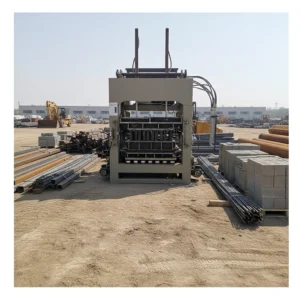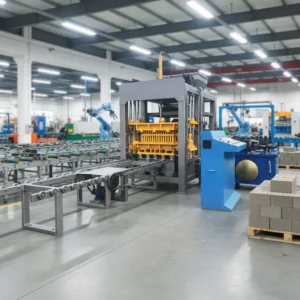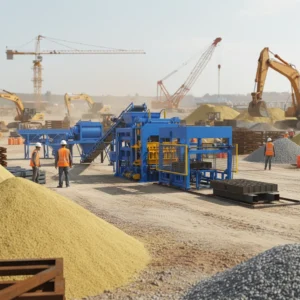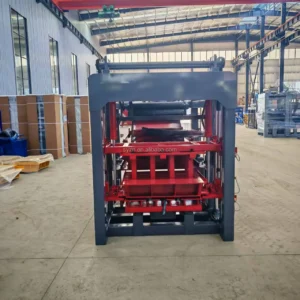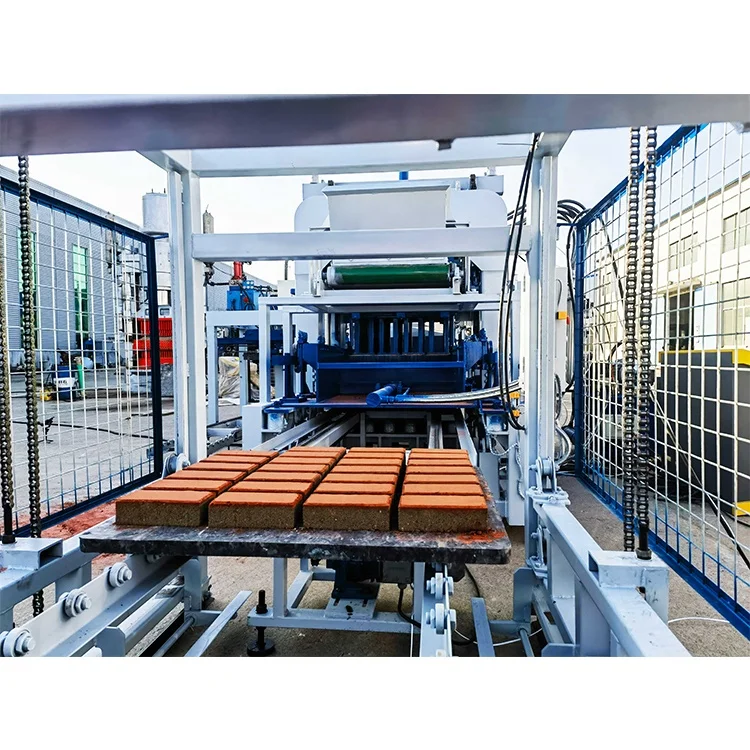
Coordinated Line Flow — the QT8-15 press station is specified alongside pallet handling, mixing and stacking so cycle times match across every station, not quoted as an isolated output figure.
Technical Specifications
| Parameter | Value |
|---|---|
| Model | QT8-15 |
| Product Type | Automatic Concrete Block Making Machine |
| Overall Dimensions (L×W×H) | 8300 × 1860 × 3000 mm |
| Rated Hydraulic Pressure | 21 MPa |
| Main Vibration Form | Platform Vibration |
| Vibration Frequency | 2800–4500 r/min |
| Vibration Force | 45 kN |
| Pallet Size | 950 × 900 mm |
| Moulding Cycle | 15–20 s |
| Overall Power | 55.5 kW |
| Total Mass | 8 T |
| Demolding Method | Hydraulic |
| Recommended Factory Area | 300 m² |
| Output Capacity | Capacity table provided in source image, specific figures per block format not extractable (basis not stated in source — confirm block format / material / thickness) |
| Voltage & Frequency | Not stated in source (basis not stated in source — confirm at inquiry) |
| Control System | Not stated in source (basis not stated in source — confirm at inquiry) |
| Warranty | 1 year for the whole machine (excluding spare parts) |
| Loading | 1×40HQ container (for basic equipment) |
Application Suitability
| Application | Material or Output |
|---|---|
| Hollow and solid block production for masonry walls | Crushed stone, sand, cement, fly ash |
| Paving block and colored paver runs | Gravel, sand, cement, pigment additives |
| Interlocking block and kerbstone manufacturing | Slag, dust, cement blends |
| On-site production for housing and infrastructure projects | Locally sourced aggregate and cement |
What "Cycles per Hour" Leaves Out of a Block Line Quote
A press that runs faster than its pallet feeder can supply is just an expensive idle station.
When I first started quoting block machines, I focused on the press cycle and treated everything upstream and downstream as secondary. That approach caused real problems on site — pallets backing up at the feeder, wet blocks waiting to be stacked, and daily output falling noticeably short of the number on the proposal. The concrete block making machine production line only delivers its quoted capacity when every station, from the mixer discharge to the stacker, is timed to the press. Buyers who skip this step often discover the bottleneck weeks after commissioning. [NEED_CITE: typical block line bottleneck analysis]
Synchronising Every Station Around the 15–20 Second Press Cycle
The QT8-15 completes a moulding cycle in 15 to 20 seconds, which means the pallet feeder must deliver a fresh pallet, the mixer must discharge a batch, and the stacker must clear a finished pallet — all within that same window. In a concrete block making machine production line, any station that takes longer becomes the governing bottleneck. We calculate the turnkey block plant layout so that upstream and downstream equipment is rated to keep pace with the press, not slower.
Pallet Flow as the Line’s Spine
Pallets move through the press, into the curing area, and back to the feeder in a continuous loop. The 950 × 900 mm pallet size on this model was selected to match common curing rack dimensions and standard forklift tine widths. If the pallet return conveyor cannot feed back as fast as the press consumes, the entire turnkey block plant stalls at the press infeed. Specifying the pallet handling system with the same care as the press itself prevents that idle time.
Reading the Specs That Matter for Line Balance
The 21 MPa hydraulic pressure and 45 kN vibration force work together to compact the mix during the 15–20 second moulding window. Vibration frequency between 2800 and 4500 r/min allows adjustment for different aggregate gradings — coarser crushed stone needs higher frequency for full compaction, while fine sand and fly ash blends respond better at the lower end. The platform vibration form transmits force directly through the mould table rather than through the frame, giving consistent density across the pallet surface. At 55.5 kW overall power for the press station, the supporting equipment must be sized on its own circuit so the combined draw does not trip the main breaker during start-up.
The Cost of Treating Supporting Equipment as an Afterthought
When pallet handling and stacking are excluded from the initial quotation, the buyer ends up pulling wet blocks off the line by hand. That introduces handling damage, slows the pallet return loop, and cuts actual daily output noticeably below the press-only figure. We have seen projects where the press ran fine but workers could not move pallets fast enough, creating a queue of uncured blocks on the workshop floor. [NEED_CITE: manual pallet handling impact on block plant output] The mismatch only becomes visible after the line is running, when changing a single station’s speed is expensive.
Why Procure the Full Line From One Source
Every station in this concrete block making machine production line is specified against the buyer’s actual mix design, target block format and curing area dimensions, not selected from a catalogue default. The pallet size, automation level and raw material feed configuration are confirmed before production starts. Hydraulic and electrical schematics cover the full line, not only the press, so maintenance procedures address every station. Moulds are designed for the formats the buyer’s market actually sells, and custom drawings are accepted. Installation and commissioning cover the complete turnkey block plant, with operator training on all stations. [NEED_CITE: CE machinery directive requirements for industrial equipment]
Documentation & Verification
- Line layout drawing with capacity calculation stated per block format at each station
- Pallet specification sheet matched to buyer’s curing rack and forklift dimensions
- Hydraulic and electrical schematics covering every station in the line
- Voltage, frequency and PLC display language confirmation before production
- Factory test record on the buyer’s selected block format before dispatch
Installation, Commissioning & Support
- 300 m² factory area required; concrete slab must be level within tolerance for the 8 T machine mass
- Dedicated power circuit sized for the 55.5 kW press plus supporting equipment draw
- Press ships in 1×40HQ container; dismantling and reassembly included in commissioning scope
- First-run parameter setting covers vibration frequency, hydraulic pressure and moulding cycle on buyer’s mix
- Operator training addresses mould change procedure, pallet feeder adjustment and daily maintenance points
- Wear parts and mould list provided so first replacement order can be placed before stock runs out
Before You Request a Quote
To size a concrete block making machine production line accurately, share the block formats you plan to produce, the target daily output per format, your local aggregate type and cement source, the available factory floor area and ceiling height, and your site’s voltage and frequency. If you already operate forklifts or curing racks, include their specifications so the pallet size and return system can be matched from the start.
Frequently Asked Questions
Q: How are cycle times balanced between the press, pallet feeder, mixer and stacker?
A: Each station is rated against the QT8-15’s 15–20 second moulding cycle. We calculate the turnkey block plant layout so that pallet feed, mix discharge and stacking all complete within that window, preventing any single station from becoming a bottleneck that holds up the press.
Q: What supporting equipment is included versus sourced separately?
A: The quotation covers raw material feeding, mixing, pallet feeding and stacking as part of the concrete block making machine production line. Items outside the block line, such as site civil works and external curing covers, remain the buyer’s scope and are listed clearly in the proposal.
Q: How is pallet size matched to my existing curing area and forklift?
A: The 950 × 900 mm pallet is confirmed against your curing rack spacing and forklift tine width before production. If your existing equipment uses a different dimension, the pallet specification is adjusted so the turnkey block plant integrates with what you already operate on site.
Q: Can the line start semi-automatic and upgrade later?
A: Yes. The automation level is selectable at the quotation stage. A buyer can begin with manual pallet handling and add automatic stacking and cubing later, provided the press station and pallet conveyor were originally specified with that upgrade path in mind.
Q: What raw material feed configuration do I need for my local aggregate?
A: The feed configuration depends on your aggregate grading and cement type. We specify the mixer and batching system against your actual mix design so the concrete block making machine production line produces consistent block strength from the materials you can source locally, not from a catalogue default recipe.