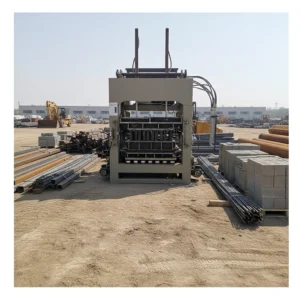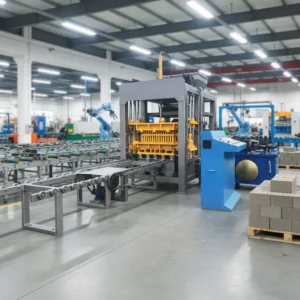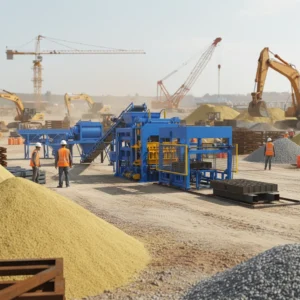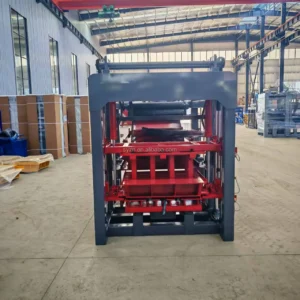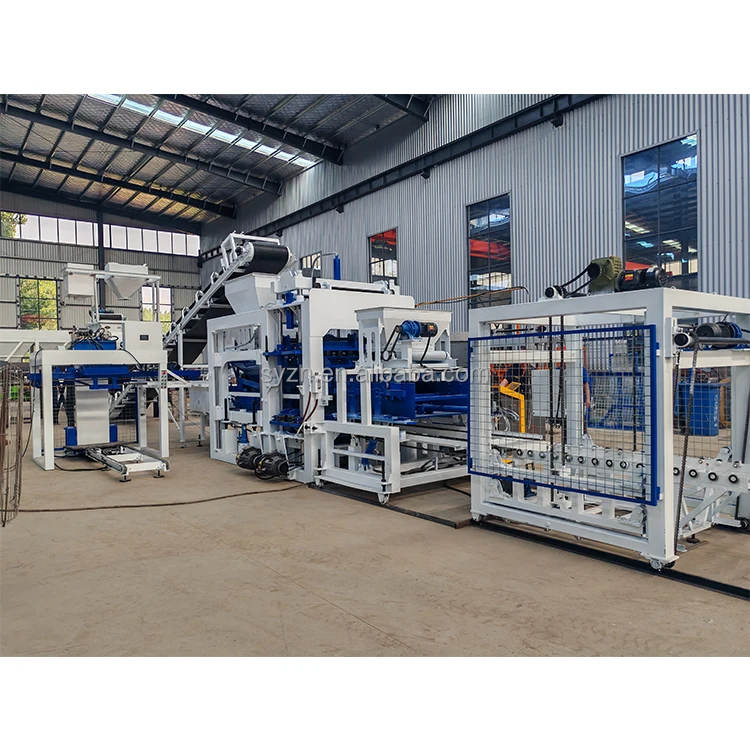
Matched Line Flow — Every station from the mixer to the stacking rack is timed to the 15–20 s press cycle so the QT8-15 never sits idle waiting for pallets or mix.
Technical Specifications
| Parameter | Value |
|---|---|
| Model | QT8-15 |
| Product Type | Hydraulic Concrete Block Making Machine |
| Overall Dimensions (L×W×H) | 8300×1860×3000 mm |
| Rated Pressure | 21 MPa |
| Main Vibration Form | Platform Vibration |
| Vibration Frequency | 2800–4500 r/min |
| Vibration Force | 45 kN |
| Pallet Size | 950×900 mm |
| Molding Cycle | 15–20 s |
| Overall Power | 55.5 kW |
| Total Mass | 8 T |
| Demolding Method | Hydraulic |
| Factory Area | 300 m² |
| Applied Products | Concrete blocks, hollow/solid blocks, pavers, interlocking blocks, curbstone, colored pavers |
| Raw Materials | Crushed stone, sand, cement, dust, fly ash, gravel, slag |
| Output Capacity | (basis to be confirmed — depends on block format, material, and thickness) |
| Voltage & Frequency | Configurable to site requirements — confirm before order |
| Control System | PLC-based — confirm brand and display language before production |
| Automation Level | Selectable from semi-automatic to fully automatic line configuration |
| Mould Change Time | (basis to be confirmed) |
| Stacking Method | (basis to be confirmed — manual or automatic available) |
Application Suitability
| Application | Material or Output |
|---|---|
| Hollow block production for commercial and residential construction | Crushed stone, sand, cement, fly ash |
| Solid block manufacturing for load-bearing walls | Gravel, sand, cement, slag |
| Paving block and colored paver runs for roads and walkways | Fine aggregate, cement, pigment |
| Interlocking block production for retaining walls and landscaping | Crushed stone, sand, cement |
| Curbstone forming for municipal and highway projects | Coarse aggregate, cement |
What a "Cycle Time" Figure Hides About Your Real Daily Output
The molding cycle only tells you how fast the press closes — not whether the mixer, pallet feeder, and stacker can keep up.
I have watched lines where the press finished its 15–20 s cycle and then sat waiting because the mixer discharged too slowly or the pallet return conveyor bottlenecked. The quoted cycles-per-hour number looked impressive on paper, but the actual daily throughput fell noticeably short once every station was accounted for [NEED_CITE: line synchronization losses in concrete block production]. When you evaluate the QT8-15 block making machine production line, the question is never just about press speed. It is about whether the raw material batching, mixing, pallet circulation, and stacking stations are all specified to the same rhythm, so the press never starves for material and wet blocks never pile up on the table waiting for a forklift.
Upstream Feeding and Mixing Synchronization
The QT8-15 block making machine production line starts well before the press itself. Raw material feeding and mixing must deliver a consistent batch to the hopper within the molding cycle window. If the mixer discharges a batch that takes longer than the press cycle to prepare, every subsequent station slows down. We size the mixer capacity and batching speed against the press output so the hopper never runs empty mid-shift, and we confirm the aggregate moisture content and mix design before locking the line configuration.
Downstream Pallet Circulation and Stacking Integration
After demolding, the pallet carrying wet blocks must travel to the curing area and return to the press fast enough to accept the next cycle. The 950×900 mm pallet size is confirmed against your existing curing rack dimensions and forklift capacity before the line is built [NEED_CITE: pallet handling standards in block plant layout]. If pallet return is too slow, blocks sit exposed and begin to dry unevenly. Automatic stacking and cubing can be added to remove manual handling entirely, but the stacking station cycle must match the press output or it becomes the new bottleneck.
Platform Vibration and Hydraulic Pressure Balance
The platform vibration system delivers 45 kN of force across a 2800–4500 r/min frequency range, working together with 21 MPa of hydraulic pressure to compact the mix into the mould. The vibration frequency is adjusted depending on the block format — lower frequencies for large hollow blocks where aggregate settlement matters more, higher frequencies for dense pavers where surface finish is critical. The hydraulic pressure ensures the mould is clamped firmly during vibration and that demolding is clean without cracking green blocks.
The Cost of Underspecifying the Supporting Stations
When a buyer focuses only on the press and treats mixing, pallet handling, and stacking as afterthoughts, the line develops hidden bottlenecks that show up only after commissioning. A mixer that is too small forces the press to idle between batches. Pallets that do not match the curing racks require a forklift upgrade. Missing stacking equipment means workers carry blocks by hand, which limits throughput and increases breakage [NEED_CITE: manual handling losses in block production]. These costs are not visible in the initial quotation but appear every single shift.
Why Specify the Full Line Here
Block machinery is our single focus, so the QT8-15 press, moulds, pallets, and handling equipment are specified as one matched system rather than assembled from separate suppliers. Configuration is set against your actual mix design and local aggregate, not a catalogue default. Mould design covers the formats your market sells, including custom drawings to your specifications. Automation level is selectable — you can start with semi-automatic pallet handling and upgrade to full stacking and cubing later. Installation and commissioning support includes operator training so your team understands the line flow from day one.
Documentation & Verification
- Line layout drawing showing every station from batching to stacking with cycle time annotations
- Capacity calculation document stating the exact block format and mix assumed for each output figure
- Pallet specification sheet matched to your curing rack dimensions and forklift load rating
- Hydraulic and electrical schematics for on-site troubleshooting and spare part ordering
- Factory test record run on your selected block format before dispatch
- Voltage, frequency, and PLC display language confirmed in writing before production begins
Installation, Commissioning & Support
- Foundation plan for the 8300×1860×3000 mm press footprint with anchor bolt layout and load distribution
- Electrical connection guide for the 55.5 kW total line power, specifying dedicated circuit and breaker rating
- Machine arrives dismantled for container loading; reassembly sequence provided with torque specifications
- On-site commissioning includes press cycle tuning, vibration frequency adjustment, and hydraulic pressure calibration
- Operator training covers mould change procedure, PLC navigation, and emergency stop protocols
- Wear parts list covering hydraulic seals, vibration springs, and mould liners with recommended replacement intervals
- Daily maintenance checklist for the 8 T machine including pallet surface inspection and guide rail lubrication
What to Share With Your Inquiry
To configure a QT8-15 block making machine production line that actually meets your daily output target, we need to know the block formats your market demands, your available raw materials and their moisture content, and the dimensions of your curing area and existing forklift capacity. Confirm your site voltage and frequency along with the preferred PLC display language. If you are adding this line alongside existing equipment, share the upstream and downstream stations already in place so we can match the cycle times across the entire plant.
Frequently Asked Questions
Q: How is daily output calculated for the full line, and which block format is assumed?
A: Daily output is calculated per block format, not as a single number. The capacity document states which block size, wall thickness, and mix design each figure is based on. A hollow block run will show different throughput than a solid paver run on the same press because molding cycle, pallet occupancy, and curing time all vary by format.
Q: Are pallet feeding, stacking, and curing rack handling included or quoted separately?
A: Every station from raw material feeding through stacking and curing rack handling can be included in the line quotation. We specify each station so no handling gap is left unquoted. If you prefer to start with manual pallet handling and add automatic stacking later, the line is designed to accept that upgrade without replacing the press.
Q: How do cycle times across stations match so the press is never left waiting?
A: Each station — batching, mixing, pallet feeding, pressing, stacking — is sized so its cycle completes within or before the press molding cycle. If the mixer discharge takes longer than the press cycle, we increase mixer capacity or add a buffer hopper. The goal is continuous flow where no station creates idle time for another.
Q: What voltage, frequency, and control language will be configured for my site?
A: Voltage and frequency are confirmed in writing before production begins. The PLC display language is also locked at that stage. This avoids delays during commissioning when the machine arrives and the electrical supply or operator interface does not match local requirements [NEED_CITE: common commissioning delays from voltage mismatch].
Q: What is the factory area requirement for the complete line including curing and stacking?
A: The press alone requires a portion of the 300 m² factory area, but the full line including raw material storage, mixing station, curing racks, and stacking zones needs additional space. We provide a line layout drawing showing the total footprint so you can plan the building or plot before equipment arrives.