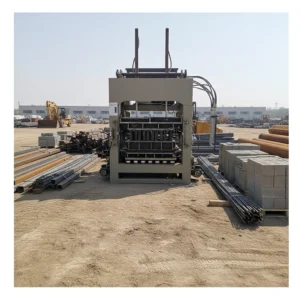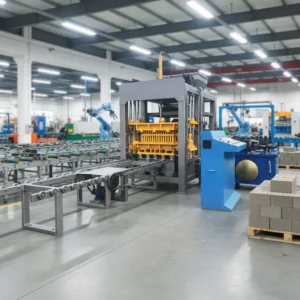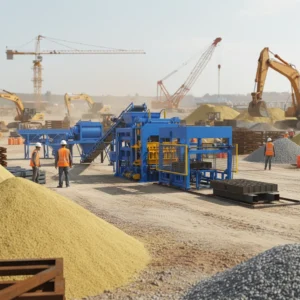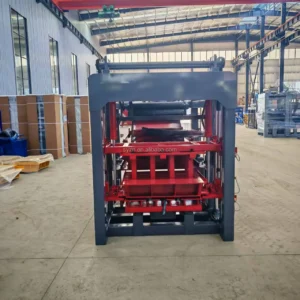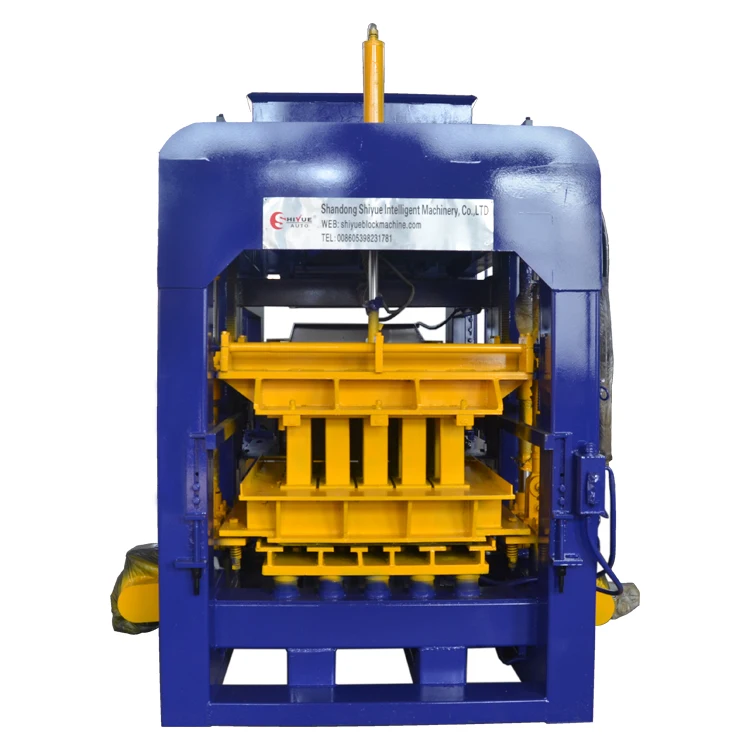
Matched System Integration — the QT8-15 press is specified alongside its feeding, mixing, pallet circulation, and stacking stations so cycle times align and no single unit dictates the line’s true output.
Technical Specifications
| Parameter | Value |
|---|---|
| Model | QT8-15 |
| Product Type | Automatic Concrete Block Making Machine |
| Overall Dimensions (L×W×H) | 8300 × 1860 × 3000 mm |
| Rated Pressure | 21 MPa |
| Main Vibration Form | Platform Vibration |
| Vibration Frequency | 2800–4500 r/min |
| Vibration Force | 45 kN |
| Pallet Size | 950 × 900 mm |
| Molding Cycle | 15–20 s (basis to be confirmed per block format) |
| Overall Power | 55.5 kW |
| Total Mass | 8 T |
| Demolding Method | Hydraulic |
| Required Factory Area | 300 m² |
| Applied Products | Concrete hollow/solid blocks, pavers, interlocking blocks, curbstones, colored pavers |
| Raw Materials | Crushed stone, sand, cement, fly ash, gravel, slag, stone dust |
| Automation Level | Automatic |
| Voltage & Frequency | Configurable (to be confirmed before ordering) |
| Control System | PLC (type and language to be confirmed) |
| Assembly & Shipment | Basic equipment shipped in 1×40HQ container |
| Warranty | 1 year (excluding spare parts) |
Application Suitability
| Application | Material or Output |
|---|---|
| Hollow block production for structural walls | Crushed stone, sand, cement, and fly ash blends |
| Solid block manufacturing for load-bearing construction | Gravel, cement, and stone dust mixtures |
| Interlocking paver production for landscaping | Colored cement with fine aggregate and slag |
| Curbstone and kerb production for municipal projects | High-density aggregate with cement binder |
| Porous and permeable block production | Graded aggregate with controlled cement ratio |
Why the Upstream Feed Dictates the Press Output
A block press only runs as fast as its slowest upstream station allows it to.
Many buyers focus on the press cycle time without checking whether the mixer can deliver a fresh batch in time, or whether the pallet return conveyor can clear the station before the next mold drops. When the mixer runs a 90-second batch but the press finishes every 20 seconds, the press sits idle for most of the cycle. The automatic concrete block making machine production line must be calculated as a chain of matched intervals, not as a single press rating [NEED_CITE: line balancing principles in concrete block manufacturing].
In a project I supported in West Africa, the buyer sourced a high-output press but paired it with a mixer sized for half the volume. The first two weeks showed output well below expectation until we replaced the mixer and adjusted the belt feeder speed. The press itself never changed — only the stations around it.
Balancing Mixer Output with Press Demand
The QT8-15 completes a molding cycle every 15 to 20 seconds depending on the block format and mix design. The raw material feeding and mixing station must therefore deliver a consistent batch at an interval that matches this rhythm. If the mixer batch size is too small, the press waits; if too large, material begins to set before reaching the hopper. The automatic concrete block making machine production line is configured so the mixer capacity, belt conveyor speed, and press hopper volume are calculated together against the target block format.
Pallet Circulation as the Hidden Bottleneck
The 950 × 900 mm pallet moves through pressing, demolding, curing rack loading, and return. If the pallet return conveyor runs slower than the press cycle, wet blocks stack up at the exit and risk surface damage. If the curing rack handler cannot accept pallets fast enough, the entire line stalls. Every pallet circuit station is timed against the QT8-15 cycle so the press never waits on a downstream blockage [NEED_CITE: pallet circulation timing in block production lines].
Reading the Pressure and Vibration Relationship
The 21 MPa rated pressure and 45 kN vibration force work together during compaction. Vibration settles the aggregate into the mold cavity, while hydraulic pressure compresses it from above. If vibration frequency sits too high for a dry mix, the material segregates and block faces show uneven density. If pressure is too low for a stiff mix, blocks crack during demolding. The adjustable vibration range of 2800 to 4500 r/min allows the operator to match the frequency to the local aggregate gradation and moisture content. The 8-tonne machine mass provides the static weight needed to keep platform vibration contained within the mold area rather than dissipating into the foundation.
The Cost of Skipping Line-Level Specification
When stations are sourced from separate suppliers without a single line layout, mismatched conveyor heights cause pallets to jam at transfer points. A pallet size chosen without checking the curing rack dimensions forces the buyer to rebuild the curing area or cut pallets down. Electrical panels wired for different voltages delay commissioning by weeks while transformers are sourced locally. These problems do not appear in any single quotation — they emerge only when machines arrive on site and refuse to connect [NEED_CITE: common commissioning delays in block plant installations].
Why the Line Is Specified as One System
The QT8-15 and its supporting stations are configured against the buyer’s actual mix design and local aggregate, not a catalogue default. The line layout document states the block format assumed for each output figure, so there is no ambiguity between cycles per hour and realistic daily production. Pallet size and material are confirmed against the buyer’s existing curing area and forklift fleet before production begins. Voltage, frequency, and PLC display language are locked in before the electrical panel is wired, so the local electrician can prepare the site using the provided schematic. Factory testing runs the full line sequence — feeding, pressing, pallet return — not the press in isolation.
Documentation & Verification
- Line layout showing station positions, conveyor lengths, and pallet circuit path for the QT8-15 configuration
- Capacity calculation sheet stating the block format and mix assumption behind each output figure
- Pallet specification matched to the 950 × 900 mm size with material grade and load rating
- Hydraulic and electrical schematic for site preparation before the QT8-15 arrives
- Voltage, frequency, and PLC language confirmation record signed before panel wiring
- Factory test record showing full line cycle including mixer, press, and pallet return
Installation, Commissioning & Support
- Foundation plan sized for the 8300 × 1860 mm QT8-15 footprint and 8-tonne operating mass
- Power supply spec for the 55.5 kW total load with dedicated circuit and breaker sizing
- Shipment in 1×40HQ container with dismantling sequence and reassembly instructions on site
- Commissioning includes mixer timing, vibration frequency tuning, and pallet conveyor speed adjustment
- Operator training covers mold change procedure, PLC navigation, and daily hydraulic inspection
- Wear parts list with mold and hydraulic seal part numbers for first reorder planning
What to Prepare Before Requesting a Quotation
Provide the target block formats with dimensions and required compressive strength so the mold and vibration settings can be matched. Share a sample or lab report of the local aggregate including gradation and clay content — this determines whether the mixer and feeder need adjustment. Confirm the site voltage and frequency, the PLC language preference, and whether existing curing racks or forklifts constrain the pallet size. State the daily output target per block format so the line stations can be balanced accordingly.
Frequently Asked Questions
Q: How is line capacity calculated per block format, and what assumptions are included?
A: Each output figure states the specific block format, dimensions, and mix design assumed. The molding cycle of 15 to 20 seconds varies by format thickness and material density. The capacity calculation also accounts for mixer batch interval and pallet return speed, not just the press cycle alone.
Q: Which upstream and downstream stations are included in the line quotation?
A: The standard line covers raw material feeding, mixing, pallet feeding, automatic stacking, and curing rack handling. Each station is listed with its cycle time so you can see where it matches or limits the QT8-15 press. Stations can be added or removed based on your automation level preference.
Q: How do pallet size and material affect curing rack layout and forklift selection?
A: The 950 × 900 mm pallet must fit your curing rack spacing and forklift tine width. We confirm these dimensions against your existing equipment before production. Pallet material — whether bamboo, PVC, or steel — affects weight, which in turn influences forklift load capacity and rack load ratings.
Q: What happens if one station cycle time does not match the press?
A: The line layout identifies the slowest station and shows where the press would idle. We adjust conveyor speed, mixer batch size, or pallet handler timing until the bottleneck is removed. If a station cannot be matched, we recommend an alternative model rather than quoting a line that underperforms.
Q: Can the line start semi-automatic and upgrade to full automatic stacking later?
A: Yes. The pallet circuit and press control are designed so that manual pallet handling and stacking can be replaced with automatic stations later. The PLC program and conveyor mounting points are prepared during initial installation to make the upgrade straightforward.