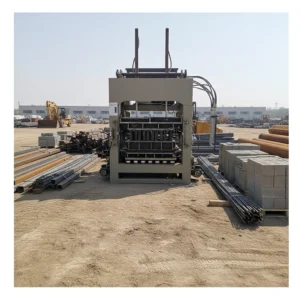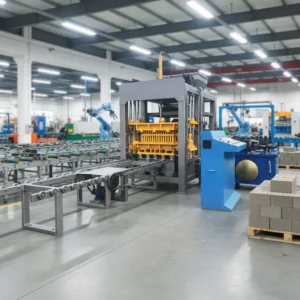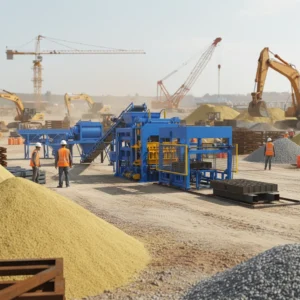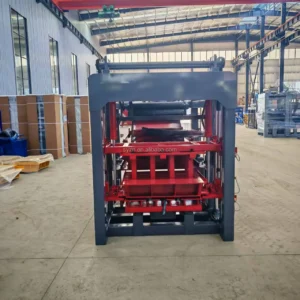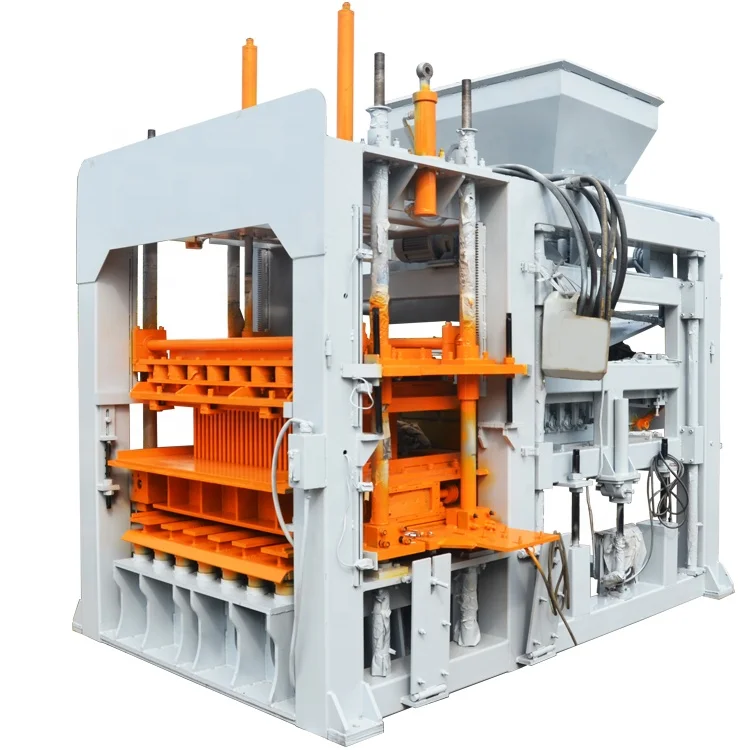
Balanced Line Configuration — every upstream and downstream station is sized to the QT8-15 molding cycle so the press never sits idle waiting on material or pallet handling.
Technical Specifications
| Parameter | Value |
|---|---|
| Model | QT8-15 |
| Product Type | Automatic Concrete Block Making Machine |
| Overall Dimensions (L×W×H) | 8300×1860×3000 mm |
| Rated Pressure | 21 MPa |
| Main Vibration Form | Platform Vibration |
| Vibration Frequency | 2800–4500 r/min |
| Vibration Force | 45 kN |
| Pallet Size | 950×900 mm |
| Molding Cycle | 15–20 s (basis to be confirmed) |
| Overall Power | 55.5 kW |
| Total Mass | 8 T |
| Demolding Method | Hydraulic |
| Recommended Factory Area | 300 m² |
| Automation Level | Automatic |
| Applied Products | Concrete hollow/solid blocks, pavers, interlocking blocks, curbstone, colored pavers |
| Raw Materials | Crushed stone, sand, cement, fly ash, gravel, slag |
| Loading | 1×40HQ container (basic equipment) |
| Warranty | 1 year (whole machine, excluding spare parts) |
Application Suitability
| Application | Material or Output |
|---|---|
| Hollow block production for wall construction | Crushed stone, sand, cement, fly ash blends |
| Solid block manufacturing for load-bearing structures | Gravel, sand, cement mixes |
| Paving block and colored paver runs | Fine aggregate with pigment additives |
| Interlocking block and curbstone forming | Slag, sand, cement combinations |
| On-site contractor block production | Locally sourced aggregate and cement |
What "Cycles Per Hour" Hides About Your Automatic Block Making Machine Production Line
A press rated at a certain cycle speed only achieves it when every surrounding station keeps pace.
I have walked through block plants where the host press sat idle for seconds every cycle because the mixer could not deliver a fresh batch in time, or the pallet feeder jammed on warped boards. The automatic block making machine production line looks impressive on paper, but real output depends on how the raw material feeding, mixing, pallet circulation, stacking, and curing rack handling are each timed to the press [NEED_CITE: typical block plant bottleneck analysis]. When any single station runs slower than the QT8-15 molding cycle, the entire line slows to match it.
How Each Station Must Match the QT8-15 Cycle
The QT8-15 completes a molding cycle in 15 to 20 seconds depending on block format and material. That means the mixer must deliver a finished batch to the press hopper within that same window, the pallet feeder must position a clean board before each press stroke, and the wet-side stacker must clear cured pallets without creating a queue. An automatic block making machine production line built around this press requires every conveyor speed, mixer discharge interval, and stacking arm movement to be calculated against that cycle time rather than chosen from a catalogue default.
Sizing the Pallet Loop to Your Curing Area
The 950×900 mm pallet dimension drives more than just the feeder specification. It determines the curing rack spacing, the forklift tine width the buyer already owns, and the total number of pallets needed to keep the line running continuously while earlier boards are still in the curing zone. When the pallet loop is undersized, operators start pulling boards from the curing racks before the blocks have set, causing breakage that quietly erodes daily output [NEED_CITE: pallet circulation and block curing best practices].
Reading the Specs That Shape Your Line Layout
Platform vibration at 2800 to 4500 r/min paired with 45 kN vibration force and 21 MPa hydraulic pressure determines how densely the mix is compacted into each mould cavity. The batching and mixing station must deliver a consistent moisture content and aggregate gradation every cycle, because any variation shows up as uneven block density across the pallet. The 55.5 kW overall power figure sets the electrical supply requirement for the press itself, but the complete line — mixer, conveyors, stacker, and curing rack handler — will draw considerably more, so the transformer and distribution panel must be sized for the full connected load. Hydraulic demolding means the auxiliary hydraulic circuit serving the pallet feeder and stacker must share compatible pressure ratings and flow capacity to avoid cycle delays.
The Hidden Cost of Quoting the Press Alone
When a quotation covers only the press, the buyer discovers after arrival that pallet handling, stacking, and curing rack systems were never included. Fresh blocks sit on the press output conveyor with nowhere to go, and workers end up carrying pallets by hand to the curing area — exactly the bottleneck the automatic block making machine production line was supposed to eliminate. Voltage, frequency, and PLC display language often go unconfirmed until the electrical panels are already built, delaying commissioning by weeks while replacement components are sourced [NEED_CITE: common commissioning delays in exported block machinery].
Why Sourcing the Full Line from One Supplier Matters
Block machinery is our single focus, so the QT8-15 press, moulds, pallets, and every handling station are specified as one matched system. We set the configuration against your actual mix design, local aggregate, and target block format rather than a catalogue default. Mould design covers the formats your market actually sells, with custom drawings available. The automation level is selectable — start semi-automatic and add stacking or cubing later without replacing the press. Installation and commissioning support includes operator training so your team runs the full line from day one.
Documentation & Verification
- Line layout showing capacity calculation per block format for every station
- Machine specification sheet with voltage and control language confirmation
- Mould drawing and format list matched to your target products
- Pallet specification aligned with your curing rack and forklift dimensions
- Factory test record covering the full pallet circulation loop
- Hydraulic and electrical schematic for the complete line
Installation, Commissioning & Support
- Foundation plan based on the 8300×1860 mm footprint and 8 T operating mass
- Electrical supply sized for 55.5 kW press load plus all auxiliary stations
- 40HQ container loading plan with dismantling sequence for reassembly on site
- Commissioning run with full pallet loop to verify 15–20 s cycle synchronization
- Operator training covering mould change, hydraulic checks, and daily maintenance
- Wear parts and mould inventory list for first replacement planning
What to Include in Your Inquiry
Tell us which block formats your market sells and the daily volume you need per format so we can calculate the line capacity honestly. Share your local raw material sources, available workshop area, and existing forklift and curing rack dimensions so the pallet system fits your site. Confirm your local voltage, frequency, and preferred PLC display language before we build the electrical panels for the automatic block making machine production line.
Frequently Asked Questions
Q: How is each station’s cycle time matched to the QT8-15 molding cycle?
A: We calculate the required throughput of the mixer, pallet feeder, stacker, and curing rack handler against the 15–20 s press cycle. Each station is specified so its delivery or clearing interval falls within that window, preventing the press from waiting on upstream material or downstream pallet removal.
Q: What mixing configuration keeps up with continuous production?
A: The mixer must discharge a complete batch within the press cycle time. We specify mixer capacity, discharge door type, and conveyor belt speed so fresh material reaches the QT8-15 hopper without gaps. The raw material feeding system is sized to replenish the mixer before the next batch begins.
Q: How should the pallet system be sized to my site?
A: The 950×900 mm pallet drives the feeder, curing rack spacing, and forklift requirements. We calculate the total pallet count needed based on your curing duration and line speed so boards are always available. Your existing curing area dimensions and forklift capacity are factored into the layout.
Q: What electrical supply does the complete line require?
A: The QT8-15 press draws 55.5 kW, but the full line including mixer, conveyors, and stacking equipment requires a higher connected load. We provide a total power calculation and recommend transformer sizing based on your confirmed voltage and frequency before panel fabrication begins.
Q: Which stations are included in the quotation?
A: Our quotation itemizes every station — raw material feeding, mixing, pallet circulation, stacking, and curing rack handling — so you see exactly what is covered. Any station you prefer to source locally is clearly marked and excluded from the pricing.