
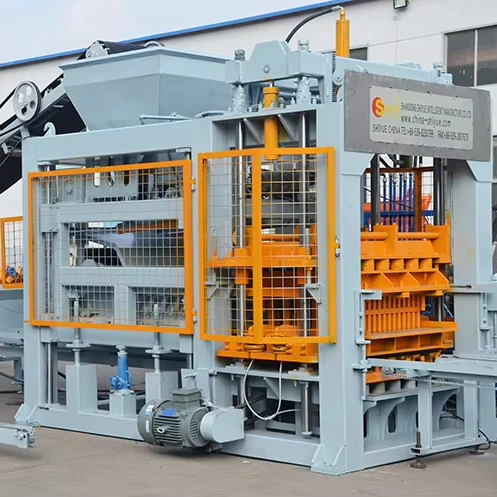
Synchronized Line Stations — The QT8-15 press is specified alongside a PLD1200 batching machine and JS750 mixer so material flow matches the 15-second molding cycle without manual pacing.
Technical Specifications
| Parameter | Value |
|---|---|
| Model | QT8-15 |
| Product Type | Automatic Cement Interlocking Block Making Machine |
| Host Machine Motor | Germany SIEMENS or CE standard brand |
| Control System | Original Siemens PLC with independently developed control program |
| Travel Switch | France Schneider and Japan Omron |
| Mould Treatment | Heat treatment and carburizing treatment (54-58 HRC, lifespan over 100,000 cycles) |
| Host Machine Dimension | 5870 × 2220 × 2850 mm |
| Host Machine Weight | 10 Tons |
| Molding Area | 950 × 900 mm |
| Workshop Area | 200 ㎡ |
| Host Machine Power | 47 kW |
| Vibration Force | 100 kN |
| Pallet Size | 950 × 900 × 25 mm |
| Voltage | 220/380/415/440V (Customized) |
| Molding Period | 15 Seconds (basis to be confirmed per block format) |
| Vibration Method | Hydraulic + Platform Vibration |
| Vibration Frequency | 2800–4500 Times/Minute |
| Batching Machine | PLD1200 (Capacity 1200L, Productivity 56m³/h) |
| Mixer | JS750 (Discharging volume 750L, Production capacity 35m³/h) |
| Stacker | SY-8 (Power 3kW) |
| Warranty | 1 year for the whole machine (excluding spare parts) |
Application Suitability
| Application | Material or Output |
|---|---|
| Interlocking brick production | Crushed stone, sand, cement blends |
| Hollow brick manufacturing | Lightweight aggregate and cement mixes |
| Paving brick and color paver output | Standard or colored concrete with added color feeding system |
| Solid brick runs | Dense aggregate and cement combinations |
What a "15-Second Cycle" Means for Your Supporting Equipment
A fast press only matters if the batching, mixing, and pallet handling keep pace.
Many plant owners focus on the press cycle time and overlook the surrounding stations. When the mixer delivers less volume than the QT8-15 consumes, the press sits idle while operators wait for the next batch. When the stacker cannot clear pallets quickly enough, cured blocks pile up on the floor and the entire production line rhythm collapses. I have walked through plants where an Automatic Block Making Machine production line was rated for high output but the JS750 mixer was swapped for a smaller unit to cut cost — daily throughput dropped noticeably because the press spent a third of each shift waiting. [NEED_CITE: block machine line synchronization standards]
Matching Material Flow to the Press Cycle
The PLD1200 batching machine feeds raw material at 56m³/h, while the JS750 mixer discharges at 35m³/h. Both stations must deliver enough mixed material so the QT8-15 never idles between cycles. If a buyer switches to a denser mix or a larger block format that draws more volume per press stroke, the mixer becomes the bottleneck first. This is where the turnkey block plant approach matters — specifying each station against the actual block format and mix design rather than a generic catalogue line.
Pallet Circulation and Stacking Rhythm
The SY-8 stacker rated at 3kW must clear loaded pallets before the next press cycle deposits fresh blocks. Pallet size at 950 × 900 × 25 mm determines how many blocks ride on each board and how heavy each loaded pallet becomes. If the curing yard uses a forklift with a narrower fork spread or a different pallet dimension, the entire handling chain from press to curing rack to final stacking breaks down. [NEED_CITE: pallet handling standards in concrete block production]
How Vibration and Pressure Shape Block Density
The 100 kN vibration force combined with hydraulic pressure and platform vibration at 2800–4500 cycles per minute determines how tightly aggregate particles pack inside the mould. Higher frequency works well for fine sand mixes, while lower frequency penetrates coarser crushed stone blends. The Siemens PLC control allows operators to adjust vibration duration and pressure hold time per format, which means an interlocking brick and a hollow block can run on the same machine with different density targets.
The Cost of Ignoring Line Synchronization
A plant that specifies only the press often discovers the gap after installation. The mixer runs dry, the stacker jams on oversized pallets, and operators spend shifts manually moving blocks that should have been stacked automatically. Downtime accumulates not because the QT8-15 failed but because the supporting equipment was never calculated against the press consumption rate. I have seen curing racks sit empty while the press waited for material — the opposite of what a synchronized turnkey block plant should deliver. [NEED_CITE: common block plant commissioning failures]
Why Source the Full Line From One Supplier
Block machinery remains our single focus, so the QT8-15, its moulds, pallets, and handling equipment are specified as one matched system. Configuration is set against the buyer’s actual mix design and local aggregate, not a default catalogue entry. Mould design covers the formats the buyer’s market sells, including custom drawings. Automation level is selectable, letting a buyer start semi-automatic and add the SY-8 stacker later. Installation support includes operator training so the team understands how each station connects.
Documentation & Verification
- Line layout with capacity calculation stating the block format assumed for the 15-second cycle
- Machine specification sheet covering host power at 47 kW and vibration ratings
- Mould drawing and format list for interlocking, hollow, paving, and solid bricks
- Pallet specification at 950 × 900 × 25 mm cross-referenced with curing area
- Electrical schematic confirming Siemens PLC and Schneider/Omron switch placement
- Factory test record on buyer’s target block format before dispatch
Installation, Commissioning & Support
- Workshop foundation for 200㎡ area leveled to support the 10-ton host machine
- Dedicated electrical circuit matching customized 220/380/415/440V supply for 47 kW total draw
- Host machine dismantled into main frame and hydraulic unit for container loading
- First-run parameter setup for vibration frequency and molding period by format
- Operator training covering PLC interface, mould change procedure, and daily maintenance
- Wear parts list covering mould liners rated for over 100,000 cycles
What to Share With Your Inquiry
Provide the specific block format you intend to produce, the daily volume target, and your local aggregate type so we can verify that the JS750 mixer output at 35m³/h meets your press consumption. Confirm your site voltage and frequency, the pallet dimension your curing yard and forklift accept, and whether the 200㎡ workshop footprint fits your available space.
Frequently Asked Questions
Q: How do the batching and mixing stations match the 15-second press cycle?
A: The PLD1200 delivers 56m³/h and the JS750 mixer outputs 35m³/h. Both are calculated against the material volume the QT8-15 draws per cycle for your specific block format. If you switch to a larger or denser block, the mixer output must be re-verified against the new consumption rate.
Q: Is the pallet feeding and stacking system included in the standard line?
A: Yes, the SY-8 stacker at 3kW is part of the standard configuration. Pallet size is 950 × 900 × 25 mm. Buyers should confirm this dimension matches their existing curing racks and forklift before shipment to avoid handling mismatches on site.
Q: What workshop area and foundation does the complete line require?
A: The grouped equipment needs approximately 200㎡. The QT8-15 host machine weighs 10 tons and requires a leveled concrete foundation. Batching and mixing stations need adjacent space with clear access for raw material delivery trucks.
Q: How is voltage confirmed across the line motors?
A: Voltage is customized to 220/380/415/440V based on your site supply. The electrical schematic shows distribution from the main panel through the Siemens PLC to each station motor, including the batching machine, mixer, host machine, and stacker.
Q: Can the SY-8 stacker handle different block weights and formats?
A: The SY-8 is rated to handle loaded pallets produced by the QT8-15 across interlocking, hollow, paving, and solid brick formats. Pallet weight varies by block density and format, so confirmation against your heaviest intended product is part of the line specification process.



