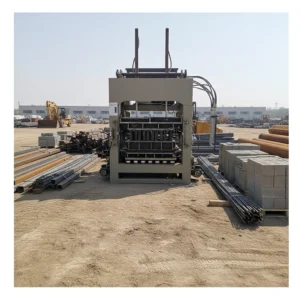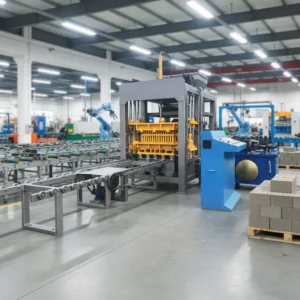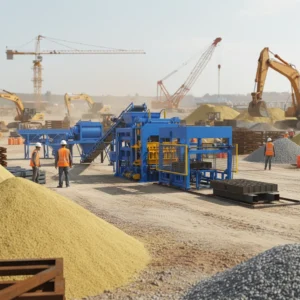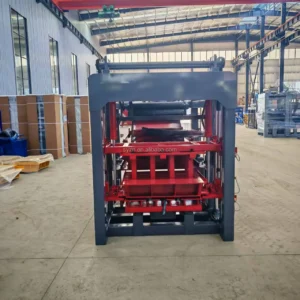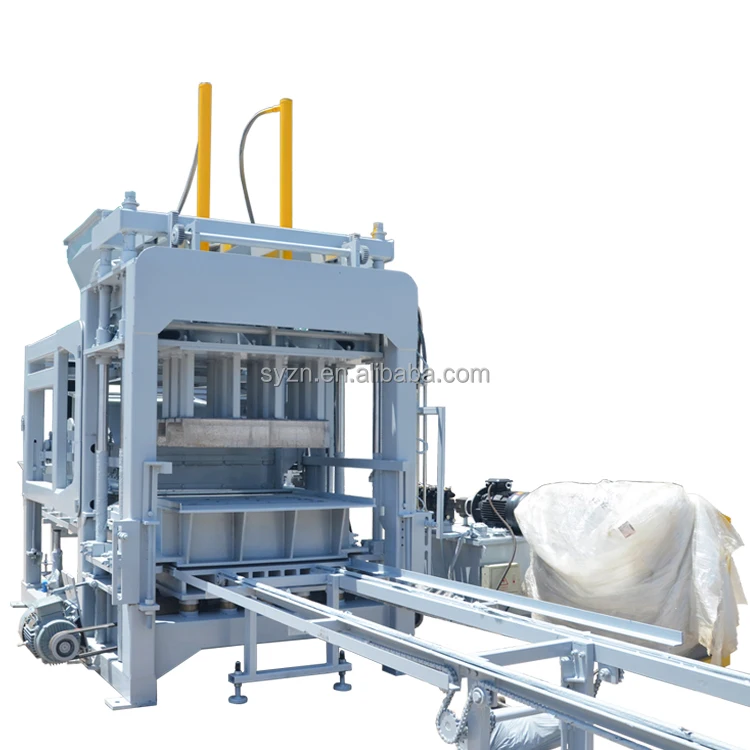
Coordinated Press Line — Every station from raw material feeding to curing rack handling is timed to the QT7-15 cycle, so the press never sits idle waiting for the next pallet or mix batch.
Technical Specifications
| Parameter | Value |
|---|---|
| Model | QT7-15 |
| Product Type | Hydraulic Block Making Machine |
| Pallet Size | 1150 x 700 mm |
| Molding Cycle | 15-20s (basis not stated in source — confirm block format / material / thickness) |
| Overall Power | 45 kW |
| Vibration Force | 100 kN |
| Vibration Frequency | 0-60 Hz |
| Vibration Form | Platform Vibration |
| Total Mass | 8 T |
| Demolding Method | Hydraulic |
| Control System | PLC with touch screen interface |
| Output Capacity (400x200x200mm Hollow Block) | 1260-1680 pcs/h, 10080-13440 pcs/8hr |
| Output Capacity (400x150x200mm Hollow Block) | 1440-1920 pcs/h, 11520-15360 pcs/8hr |
| Output Capacity (200x100x60mm Rectangular Brick) | 3888-4860 pcs/h (cycle 20-25s), 31104-38880 pcs/8hr |
| Key Features | Automatic PLC control, process data input and storage, fault diagnosis, hydraulic demolding |
Application Suitability
| Application | Material or Output |
|---|---|
| Hollow Block Production | Crushed stone, cement, and sand aggregates for load-bearing masonry |
| Paving Brick Manufacturing | High-density concrete mixes for interlocking and rectangular pavement formats |
| Solid Brick Formation | Standard concrete blends for structural and partition wall units |
| Multicellular Brick Output | Lightweight or standard aggregates for multi-cavity insulation blocks |
What "Pieces per Hour" Leaves Out of a Block Making Machine Production Line
A press rating means nothing if the mixer is still blending the next batch or the stacker is backed up.
Plant owners often receive a quote showing impressive cycles per hour, only to discover on day one that pallet return loops and upstream feeding cannot keep pace. The block making machine production line stalls between cycles, and real daily output drops well below the brochure figure. When the mixer discharge rhythm does not match the press timing, the main unit sits empty for seconds at a time [NEED_CITE: synchronization standards for concrete block production stations]. Those idle seconds compound across an eight-hour shift, turning a turnkey block plant into a bottleneck puzzle that the buyer must solve alone.
Station Synchronization Around the Press
The QT7-15 sits at the centre of a sequence where every upstream and downstream station must complete its task within the press molding window. Raw material feeding, mixing, and pallet supply are arranged so that a fresh charged pallet arrives the instant the previous block set exits. This coordination is what defines a functioning block making machine production line rather than a collection of independent units.
Pallet Loop and Curing Rack Coordination
Once the press completes its cycle, the wet blocks must move off the press table and onto curing racks without queueing. The 1150 x 700 mm pallet dimension is the constant that ties the pallet feeder, the stacking station, and the curing rack handler together. If the curing rack spacing or the forklift travel path does not match this pallet size, the entire downstream flow chokes [NEED_CITE: pallet handling and curing logistics in masonry plants].
Reading the Vibration and Pressure Specs
Platform vibration operating between 0 and 60 Hz works alongside 100 kN of vibration force to compact the concrete mix within the mould cavity. The hydraulic demolding system then extracts the formed block without cracking green edges. Together these forces determine the block density and, ultimately, the compressive strength the market requires. The PLC touch screen interface lets operators store process data for each format, so switching from hollow blocks to paving bricks does not mean starting parameter tuning from scratch. The 45 kW overall power rating covers the full press assembly, meaning electrical planning can account for the main unit draw without guessing auxiliary loads.
The Cost of Mismatched Line Stations
When a pallet feeder is specified one tier below the press speed, the operator ends up hand-feeding pallets during peak runs. Similarly, an undersized mixer forces the press to wait for each new batch, and those gaps are difficult to recover later in the shift. Buyers who skip the line-level calculation often find that their curing area cannot absorb the wet output, leaving blocks stacked on the floor and exposed to uneven drying [NEED_CITE: effects of inconsistent curing on concrete block strength]. These mismatches rarely show up in a single-machine quotation.
Why Sourcing the Full Line Matters
Block machinery is our single focus, which means the press, mould, pallet, and handling equipment are specified as one matched system. We set the configuration against your actual mix design and local aggregate rather than defaulting to catalogue settings. Mould design covers the formats your market actually sells, and custom drawings are available when standard options do not fit. The automation level is selectable, so a plant can open with semi-automatic pallet handling and add stacking or cubing later. Installation support includes operator training so your crew understands station timing from day one.
Documentation & Verification
- Line layout drawing showing every station from feeder to cubing with cycle times noted
- Capacity calculation sheet stating the block format assumed for each output figure
- Pallet specification confirming size, material, and weight against your curing area
- Hydraulic and electrical schematics for on-site maintenance reference
- Voltage and PLC display language confirmation before production begins
- Factory test record on your specified block format before dispatch
Installation, Commissioning & Support
- Foundation plan accounts for the 8 T total mass and vibration isolation requirements
- Power supply verified against the 45 kW overall draw and local voltage configuration
- PLC touch screen language set to operator preference before commissioning starts
- First-run parameter tuning covers vibration frequency, hydraulic pressure, and cycle timing
- Operator training addresses mould changeover and fault diagnosis on the control interface
- Wear parts list with reorder codes for hydraulic seals and mould liners
What We Need to Size Your Line
Tell us the block formats your market demands, the daily volume you intend to ship, and the raw materials available locally. Share your site footprint, existing curing rack dimensions, and the voltage standard in your region so we can match every station before the line enters production.
Frequently Asked Questions
Q: How is daily output calculated for the complete line?
A: Output is stated per block format — for example, 10080-13440 pieces per eight-hour shift based on 400x200x200mm hollow blocks. The calculation assumes all upstream and downstream stations are synchronized to the QT7-15 cycle so the press is never starved of material or pallets.
Q: How do upstream and downstream stations stay synchronized?
A: Each station — feeder, mixer, pallet feeder, stacker, and curing rack handler — is timed against the press molding cycle. The goal is that the press completes its press and demold sequence and immediately receives a charged pallet without idle gaps between cycles.
Q: What pallet size does this line require?
A: The line runs on 1150 x 700 mm pallets. This dimension must match your existing curing rack spacing and forklift capacity so that wet blocks move from press to curing area without manual re-handling or floor stacking.
Q: Can the line start semi-automatic and add automation later?
A: Yes. The automation level is selectable, so a buyer can begin with manual pallet handling and basic stacking, then integrate automatic cubing and curing rack handling as production volume grows without replacing the core press.
Q: What documentation comes with the full line?
A: You receive a station-by-station line layout, capacity calculations per block format, hydraulic and electrical schematics, pallet and mould specifications, a factory test record, and an operation manual covering the PLC interface and maintenance schedules.