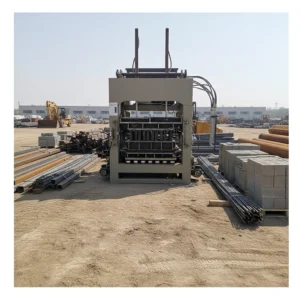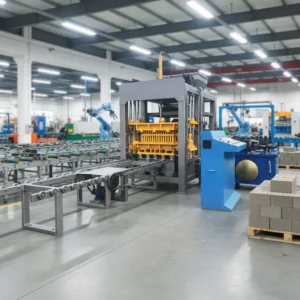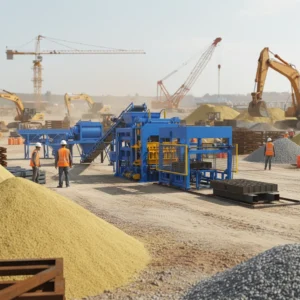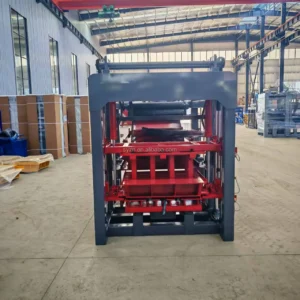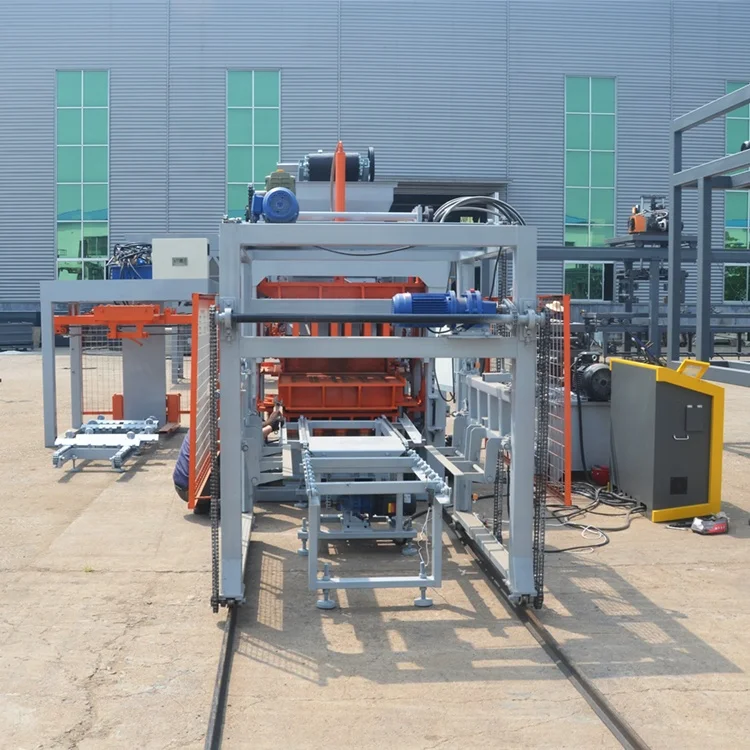
Line-Centric Configuration — Every upstream feeder, mixer cycle, and downstream pallet return is timed against the 15–20s press stroke so the QT6-15 never sits idle waiting for material or boards.
Technical Specifications
| Parameter | Value |
|---|---|
| Model | QT6-15 |
| Product Type | Hydraulic Automatic Block Making Machine |
| Overall Dimensions (L×W×H) | 8200 × 1700 × 2950 mm |
| Total Mass | 7 T |
| Overall Power | 37 kW |
| Vibration Force | 45 kN |
| Vibration Frequency | 0–60 Hz |
| Vibration Form | Platform Vibration |
| Moulding Mode | Automatic loading, vibration moulding |
| Demolding Method | Hydraulic |
| Pallet Size | 880 × 850 mm |
| Molding Cycle | 15–20 s (basis not stated in source — confirm block format, material and thickness) |
| Control System | PLC controlled with touch screen interface |
| Hydraulic System | Independent integrated hydraulic station |
| Output — Hollow Block 400×200×200 mm | 1,080–1,440 pcs/hour (8,640–11,520 pcs per 8 hr shift) |
| Output — Hollow Block 400×150×200 mm | 1,440–1,920 pcs/hour (11,520–15,360 pcs per 8 hr shift) |
| Output — Solid Brick 240×115×53 mm | 5,760–7,680 pcs/hour (46,080–61,440 pcs per 8 hr shift) |
| Output — Rectangular Paver 200×100×60 mm | 2,160–2,880 pcs/hour at 20–25 s cycle (17,280–23,040 pcs per 8 hr shift) |
| Output — Zigzag Paver 225×112.5×60 mm | 2,160–2,880 pcs/hour at 20–25 s cycle (17,280–23,040 pcs per 8 hr shift) |
| Block Compressive Strength | > 15 MPa |
| Raw Material Adaptability | Waste ash, slag, various aggregates |
| Factory Area Required | 1,200 m² |
| Warranty | 1 year for the whole machine (excluding spare parts) |
| Certification | CE (declared where applicable) |
Application Suitability
| Application | Material or Output |
|---|---|
| Hollow block production for load-bearing walls | Crushed stone, cement, sand and fly ash mixes on 400×200×200 mm and 400×150×200 mm formats |
| Solid brick manufacturing for masonry infill | Dense aggregate and cement blends producing 240×115×53 mm bricks |
| Paving brick production for roads and yards | High-strength mixes forming 200×100×60 mm rectangular and 225×112.5×60 mm zigzag pavers |
| Interlocking and multicellular brick runs | Custom mould formats using waste ash and slag-based raw feeds |
| On-site block production for housing projects | Mobile or fixed-plant setups feeding cured blocks directly to construction crews |
What "1,440 Blocks per Hour" Leaves Out of the Conversation
A press that outruns its mixer is just an expensive pallet rack.
When buyers focus on the headline cycle of a block production line equipment package, the number that matters is not how fast the press can close — it is how fast the full loop can repeat. I have stood on factory floors in West Africa where a high-speed press sat idle for eight seconds every cycle because the pan mixer upstream had not finished its batch. Over a ten-hour shift those eight-second gaps quietly erased thousands of blocks from the daily tally. The supporting block machine equipment — the belt feeder, the mixer discharge gate, the pallet return conveyor — must each complete their task inside the press cycle, not beside it. [NEED_CITE: typical pan mixer discharge times for concrete block mixes]
Matching Every Station to the 15–20 Second Press Cycle
The QT6-15 completes its vibration moulding sequence in 15–20 seconds depending on block format and material density. For a block production line equipment configuration to hold that pace, the raw material batcher must weigh and discharge into the mixer within the same window, and the mixer must deliver a homogeneous charge before the press hopper runs empty. We map every station’s cycle against the press and flag any mismatch before the line is built, not after it is bolted down.
Pallet Circulation as the Hidden Bottleneck
Eight-eighty by eight-fifty millimetre pallets travel from the press to the stacking station, onto curing racks, and back through the return conveyor. If the return leg is slower than the press discharge, boards pile up and the operator starts pulling them by hand. A properly timed supporting block machine equipment loop keeps pallets moving at a rate that matches the moulding cycle so the press never waits for a clean board. [NEED_CITE: pallet return conveyor speed requirements for continuous block lines]
Reading the Specs That Actually Govern Output
The 45 kN vibration force works with the hydraulic demolding pressure to compact the mix into a dense, dimensionally stable block. When vibration frequency is adjustable from 0 to 60 Hz, the operator can dial in the amplitude that suits a dry-cast paver mix versus a wetter hollow block blend. The independent integrated hydraulic station sits away from the main vibration zone, which keeps valve seals and hose fittings from shaking loose during long shifts. An 880 × 850 mm pallet size aligns with standard curing rack slots and common forklift tine widths, meaning blocks move from press to cure area without re-handling. The 37 kW total power draw tells you what transformer capacity and dedicated circuit the plant needs before the line ships.
When the Wrong Supporting Equipment Costs More Than the Press
Quoting the press alone and leaving pallet handling, stacking and curing rack loading off the scope is one of the most common gaps I see in block plant proposals. The buyer takes delivery, realises there is no automatic stacker, and assigns three workers to pull boards and pile blocks by hand. Daily output drops well below the quoted capacity, labour costs climb, and the buyer blames the press. Specifying the supporting block machine equipment as part of a single matched line prevents this mismatch from ever reaching the factory floor. [NEED_CITE: labour cost impact of manual pallet handling in block plants]
Why This Line Is Configured as One System
Block machinery is the single focus here, which means the press, mould, pallet and handling equipment are sized together rather than assembled from separate suppliers. The line layout starts with your target block format, local aggregate and daily output, then works backwards through every station to confirm that no single link constrains the press cycle. Mould design covers the formats your market actually sells, including custom drawings when standard options do not match. Automation level is selectable — start semi-automatic with manual pallet return and upgrade to full stacking and cubing later without replacing the press. Factory testing runs the entire line, not just the press, so capacity figures are validated before containers are loaded. [NEED_CITE: CE machinery directive requirements for integrated production lines]
Documentation & Verification
- Line layout drawing with capacity calculated per block format, not a single blanket figure
- Machine specification sheet covering the QT6-15 press and every supporting station
- Mould drawing and format list matching the block sizes your market requires
- Pallet specification aligned with your curing rack dimensions and forklift capacity
- Voltage, frequency and PLC display language confirmation signed off before production
- Factory test record documenting press and upstream/downstream station performance together
Installation, Commissioning & Support
- Foundation plan sized for the 8,200 × 1,700 mm press footprint plus pallet return conveyor length
- Dedicated power circuit for the 37 kW total load with correct voltage and frequency for your grid
- Machine dismantled into container-load sections with reassembly sequence and bolt torque chart
- On-site commissioning covering PLC touch screen calibration, hydraulic pressure setting and mould change procedure
- Operator training on block format switching, fault diagnosis display and daily greasing points
- Wear parts and mould list provided so first replacements are ordered before stock runs out
What We Need to Configure Your Line
Send us the block formats you plan to sell, your target daily output per format, and the raw materials available locally including aggregate grading. We also need your site dimensions, existing forklift capacity, and the voltage and frequency standard at your plant. If you already run a mixer or pallet return system, share the model and cycle data so we can confirm compatibility before quoting.
Frequently Asked Questions
Q: How is daily output calculated and which block format does each capacity figure assume?
A: Every output figure in the specification table names the exact block format — dimensions and type — behind the number. The 1,080–1,440 pieces per hour rate, for example, assumes a 400×200×200 mm hollow block at the stated cycle. Shift totals multiply that hourly rate by eight hours. If your target format differs, we recalculate using its specific moulding cycle.
Q: How do the raw material feeder and mixer keep pace with the press cycle?
A: We calculate the batch weight per press cycle and size the mixer drum and discharge gate so that a fresh batch lands in the hopper before the current charge runs out. Belt feeder speed, mixer rotation and discharge timing are all set against the 15–20 second moulding window so the press never idles waiting for material.
Q: Are pallet feeding, stacking and curing rack handling included in the quotation?
A: These stations are part of the line configuration, not optional extras bolted on later. The scope covers pallet feeding to the press, wet-block stacking off the press, curing rack loading and the empty-pallet return conveyor. Each station is quoted and tested as part of the matched system.
Q: What factory area is needed for the complete line, not just the press?
A: The 1,200 m² figure covers the press, raw material storage, mixer platform, pallet circulation, curing rack aisles and stacking area. Actual footprint depends on your chosen automation level and curing rack height. We provide a scaled line layout before production so every station fits your building envelope.
Q: How are voltage, frequency and control language confirmed before dispatch?
A: During the sales process we collect your site voltage, phase, frequency and preferred PLC display language. These values are written into the production order and verified on the factory test record. The touch screen interface ships in the confirmed language so commissioning starts without translation delays.