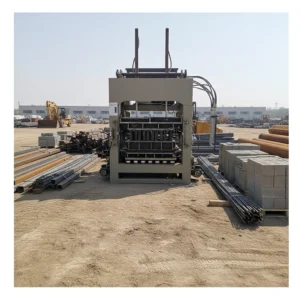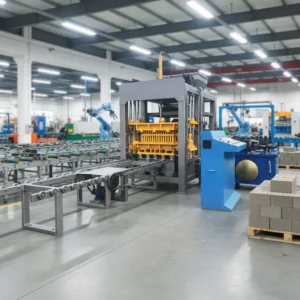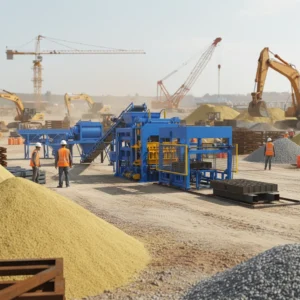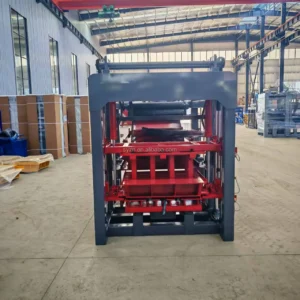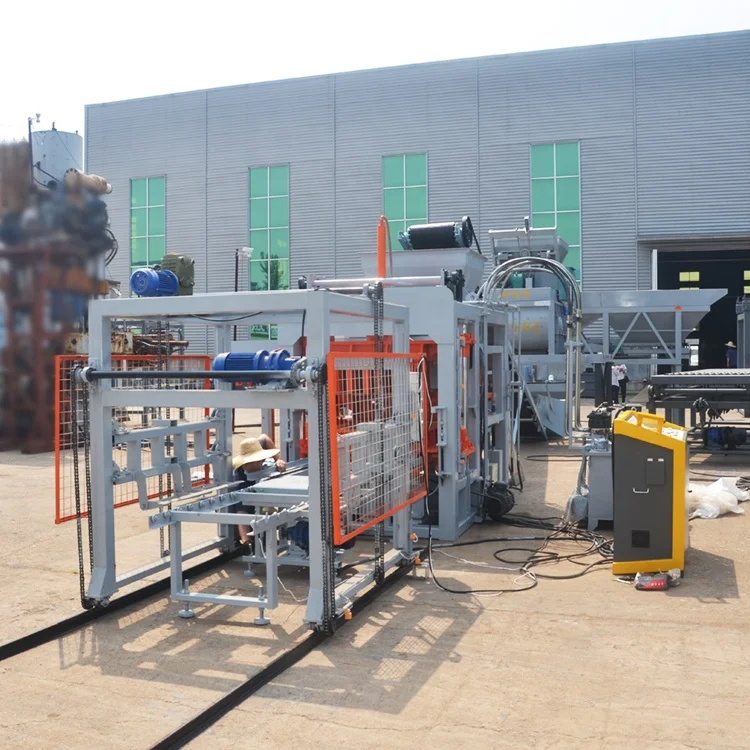
QT6-15 Hollow Block Machine Complete Production Line
Line Cycle Alignment — every upstream feeder and downstream stacker is timed to the QT6-15 press so the host never idles between moulding cycles.
Technical Specifications
| Parameter | Value |
|---|---|
| Model | QT6-15 |
| Product Type | Hydraulic Hollow Block Making Machine |
| Overall Dimensions (L×W×H) | 8200 × 1700 × 2950 mm |
| Total Mass | 7 T |
| Overall Power | 37 kW |
| Vibration Force | 45 kN |
| Vibration Frequency | 0–60 Hz |
| Vibration Form | Platform Vibration |
| Moulding Mode | Automatic load, vibration moulding |
| Demolding Method | Hydraulic |
| Pallet Size | 880 × 850 mm |
| Molding Cycle | 15–20 s (basis not stated in source — confirm block format / material / thickness) |
| Control System | PLC with touch screen interface |
| Hydraulic System | Independent integrated hydraulic station |
| Compressive Strength of Blocks | > 15 MPa |
| Output — Hollow Block 400×200×200 mm | 1080–1440 pcs/hour, 8640–11520 pcs/8 hr |
| Output — Hollow Block 400×150×200 mm | 1440–1920 pcs/hour, 11520–15360 pcs/8 hr |
| Output — Solid Brick 240×115×53 mm | 5760–7680 pcs/hour, 46080–61440 pcs/8 hr |
| Output — Rectangular Paver 200×100×60 mm | 2160–2880 pcs/hour, 17280–23040 pcs/8 hr (cycle 20–25 s) |
| Output — Zigzag Paver 225×112.5×60 mm | 2160–2880 pcs/hour, 17280–23040 pcs/8 hr (cycle 20–25 s) |
| Raw Material Adaptability | Waste ash, slag, cement |
| Factory Area | 1200 m² |
| Standards | CE |
Application Suitability
| Application | Material or Output |
|---|---|
| Hollow block production | Crushed stone, sand, cement, waste ash blends |
| Solid brick production | Slag-based mixes and standard concrete aggregates |
| Rectangular paving block | High-density concrete for driveways and walkways |
| Zigzag interlocking paver | Heavy-duty pavement mixes for traffic-bearing surfaces |
| Kerbstone and curb units | Coarse aggregate concrete with higher cement content |
What Happens When the Mixer Cannot Keep Up With the Press
A block press rated at 15–20 seconds per cycle produces nothing while it waits for the next batch of concrete.
Buyers often compare machines on cycle time alone, but the QT6-15 block production line only reaches its stated output when raw material arrives at the hopper on schedule. If the mixer discharges every 45 seconds while the press finishes a mould every 20 seconds, the host sits idle for more than half the shift. That gap compounds across thousands of cycles and the daily tally falls well below the number on the quotation. I have watched plant operators blame the press when the real bottleneck was a half-sized mixer two stations upstream [NEED_CITE: common causes of block line output shortfalls]. Sizing every supporting station to the press cycle is the first thing I check before finalizing any line layout.
Synchronizing the Batching Station to the Moulding Rhythm
The QT6-15 block production line relies on a consistent feed of mixed concrete arriving at the hopper before each vibration cycle begins. With a 15–20 second moulding window, the upstream batcher must complete weighing, discharge, and refill within that same interval. A pan mixer sized to the press volume, paired with a belt conveyor running at matched speed, closes the gap. Any slack in this chain shows up immediately as empty moulds and wasted vibration strokes.
Pallet Circulation as the Real Throughput Gate
Each moulding cycle consumes one 880 × 850 mm pallet, and a finished block must be cleared before the next pallet enters. If the pallet return conveyor or the stacking station cannot keep pace, the press halts regardless of how fast the mixer runs. Matching pallet inventory to the curing rack capacity and forklift rotation prevents a backlog at the line exit [NEED_CITE: pallet handling bottlenecks in block plants]. Planning pallet flow early avoids the situation where blocks pile up on the floor because the automatic stacker is still cycling through the previous batch.
Reading the Specs Behind the Output Figures
The vibration force of 45 kN combined with hydraulic pressure determines how densely the concrete is compacted inside the mould cavity. Higher compaction yields stronger blocks — the rated compressive strength exceeds 15 MPa — but also demands a mix with the right moisture and aggregate grading. The platform vibration form transmits energy uniformly across the 880 × 850 mm pallet area, which matters when producing thin pavers that need even density from edge to edge. The independent hydraulic station sits apart from the main frame, so vibration energy does not bleed into the hydraulic valves and cause pressure drift over a long shift. The PLC touch screen lets operators adjust cycle parameters for different block formats, switching from hollow blocks to solid bricks without manual valve adjustments.
When Undersized Support Equipment Quietly Doubles Your Labour Cost
Quotations that list only the press and omit the pallet feeder, stacker, and curing rack handler leave the buyer to fill those gaps with manual labour. Workers hauling pallets by hand and stacking wet blocks one row at a time will slow the entire line to their own pace. The press idles, the mixer over-produces and wastes material, and the daily output number on paper never materializes [NEED_CITE: hidden costs of incomplete block line quotations]. Months later the owner realizes the labour cost has erased any savings from buying a smaller supporting package.
Why Procurement Here Covers More Than the Press
Block machinery is the single focus of this operation, so the QT6-15 is never quoted as a standalone unit without confirming how the mixer, pallet system, and stacker connect around it. Configuration is set against the buyer’s actual mix design and local aggregate, not pulled from a catalogue default. Pallet size is verified against the buyer’s existing curing racks and forklift before production begins. Voltage, frequency, and PLC display language are confirmed in writing so the control panel speaks the operator’s language on day one. Mould design covers the exact block formats the buyer’s market demands, including custom drawings when standard formats do not match local building codes.
Documentation & Verification
- Line layout drawing with capacity calculation stated per block format
- Machine specification sheet covering all 37 kW power and hydraulic ratings
- Pallet specification matched to buyer’s curing rack dimensions
- Hydraulic and electrical schematic with valve and sensor callouts
- Voltage, frequency, and PLC language confirmation record
- Factory test record on the buyer’s target block format before dispatch
Installation, Commissioning & Support
- Foundation plan sized to the 8200 × 1700 mm footprint and 7 T operating mass
- Dedicated power circuit rated for 37 kW total draw with confirmed voltage and frequency
- Machine shipped in dismantled modules for standard container loading
- On-site alignment of vibration platform and hydraulic station before first cycle
- PLC touch screen configured to operator language during commissioning
- Operator training on mould change procedure and daily maintenance checkpoints
Preparing Your Line Inquiry
To size a QT6-15 block production line around your actual site conditions, share your target block formats with dimensions, the daily output you need per format, and the raw materials available locally. Include your workshop length and ceiling height so the line layout fits, along with your local voltage and frequency. If you already have curing racks or forklifts on site, send their specifications so pallet handling equipment can be matched from the start.
Frequently Asked Questions
Q: What supporting equipment must connect to the QT6-15 so the press cycle is not interrupted?
A: The press requires a raw material batcher and mixer sized to discharge within the 15–20 second cycle, a pallet feeder loaded with 880 × 850 mm pallets, and a downstream stacker or off-bearing system that clears finished blocks before the next pallet enters. Each station’s cycle must be verified against the press rhythm.
Q: How do I match pallet size to my existing curing racks and material handling equipment?
A: The QT6-15 uses 880 × 850 mm pallets. Share your curing rack shelf width and forklift tine spacing so the pallet dimensions, rack spacing, and stacker gripper width are confirmed as one system before production begins.
Q: What raw material feeding and mixing capacity is needed to keep up with 15–20 second cycle times?
A: The mixer must complete one full batch discharge within the moulding cycle. A pan mixer paired with a weigh batcher and belt conveyor, all timed to the press PLC signal, prevents the host from idling between cycles.
Q: Can I start with semi-automatic pallet handling and upgrade to automatic stacking later?
A: Yes. The PLC control architecture allows semi-automatic pallet feeding at startup, with the stacking and cubing stations added once production volume justifies the investment. Wiring and software provisions are included from the beginning.
Q: How is the line layout calculated to prevent bottlenecks between stations?
A: Each station — batcher, mixer, pallet feeder, press, stacker — is timed individually, then connected in sequence. The slowest station sets the line speed, so the layout is adjusted until every link matches or slightly exceeds the press cycle.