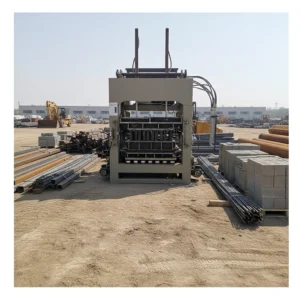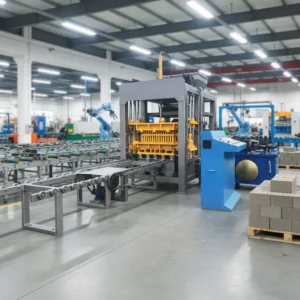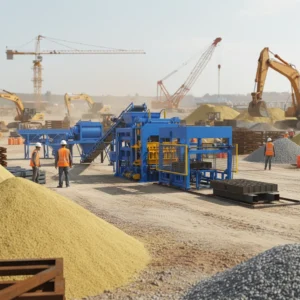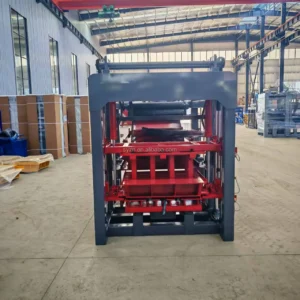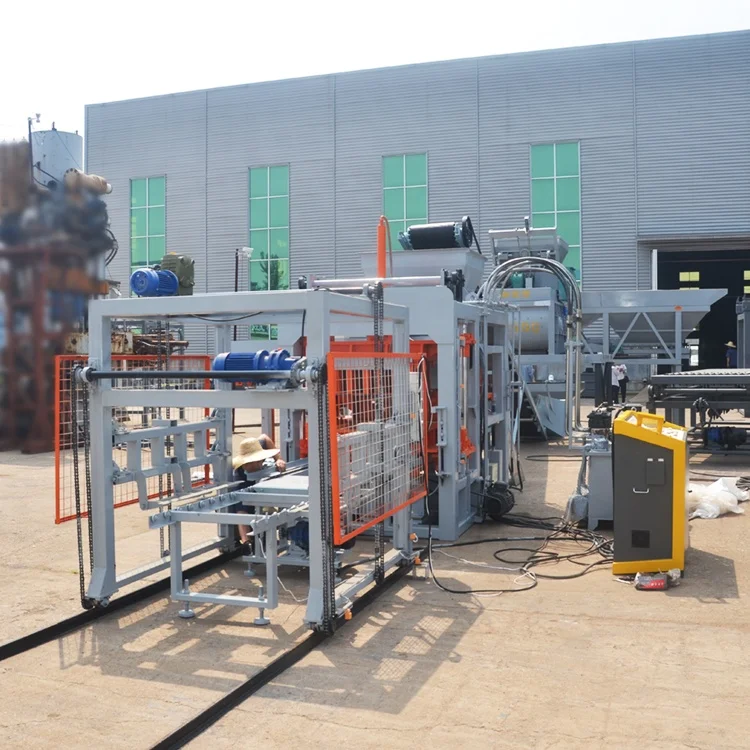
Matched Line Throughput — every station from raw material feeding to pallet return is specified around the QT6-15 press cycle so no single node becomes the bottleneck during an eight-hour shift.
Technical Specifications
| Parameter | Value |
|---|---|
| Model | QT6-15 |
| Product Type | Hydraulic Hollow Block Making Machine |
| Overall Dimension | 8200 × 1700 × 2950 mm |
| Overall Power | 37 kW |
| Total Mass | 7 T |
| Vibration Form | Platform Vibration |
| Vibration Frequency | 0-60 Hz |
| Vibration Force | 45 kN |
| Pallet Size | 880 × 850 mm |
| Moulding Mode | Load automatically, vibration moulding |
| Molding Cycle | 15-20 s (basis not stated in source — confirm block format / material / thickness) |
| Demolding Method | Hydraulic |
| Control System | PLC (Programmable Controller) with touch screen interface |
| Block Compressive Strength | More than 15 MPa |
| Output Capacity (Hollow Block 400×200×200 mm, 6 pcs/mould) | 1080-1440 pcs/h |
| Output Capacity (Hollow Block 400×150×200 mm, 8 pcs/mould) | 1440-1920 pcs/h |
| Output Capacity (Solid Brick 240×115×53 mm, 32 pcs/mould) | 5760-7680 pcs/h |
| Output Capacity (Rectangular Brick 200×100×60 mm, 21 pcs/mould, 20-25 s cycle) | 2160-2880 pcs/h |
| Output Capacity (Zigzag Brick 225×112.5×60 mm, 15 pcs/mould, 20-25 s cycle) | 2160-2880 pcs/h |
| Raw Material Compatibility | Waste ash, slag, cement-based mixes |
| Factory Area | 1200 m² |
| Standards | CE declaration where applicable (verify with supplier) |
Application Suitability
| Application | Material or Output |
|---|---|
| Hollow block production for residential and commercial walls | Cement-based mixes with waste ash or slag aggregate |
| Solid brick manufacturing for load-bearing structures | Crushed stone, sand and cement blends |
| Paving block production for driveways and walkways | High-density cement mixes with fine aggregate |
| Multi-cellular brick manufacturing | Lightweight cementitious mixes with ash content |
| Bearing and non-bearing block production | Variable aggregate gradation matched to structural grade |
What a Block Production Line Figure Actually Means On the Floor
A press rating only describes one station — the complete block production line output depends on how feeding, mixing, pallet circulation and stacking keep pace with every cycle.
I have stood in plants across West Africa and South Asia where the main press sat idle for seconds at a time because the mixer discharged slower than the QT6-15 could press, or the pallet return conveyor could not clear cured blocks fast enough. The block production line looked capable on paper, yet the daily tally fell noticeably short. Synchronizing every node around the press cycle is where real throughput is won or lost. [NEED_CITE: typical idle time losses in unsynchronized block production lines]
How Stations Connect Around the Press
The QT6-15 completes a vibration moulding cycle every 15-20 seconds when processing a standard 400×200×200 mm hollow block format. Upstream, the batch mixer must discharge a full pallet load of material within that same window, and the raw material feeding system must replenish the mixer hopper without interruption. Downstream, the wet-side stacker must lift and index the loaded pallet before the next one exits the press. A block production line that ignores any of these handoff points will see the press waiting, and waiting time is lost output.
Pallet Circulation and Curing Area Coordination
The 880×850 mm pallet travels from the press through the stacking station, into the curing area, and back to the press via the return conveyor. If the curing rack capacity is undersized, pallets queue on the floor and the return path stalls. The pallet material and weight must also match the forklift already on site — a mismatch forces the plant to either replace handling equipment or accept slower pallet movement. This coordination is what separates a block production line that runs at its documented capacity from one that does not. [NEED_CITE: pallet return logistics and curing rack sizing in block plants]
Vibration Force and Hydraulic Pressure in Practice
Platform vibration at 0-60 Hz with 45 kN of force drives the cementitious mix into every corner of the mould cavity, while the independent hydraulic station applies demolding pressure without transmitting vibration back into the main frame. This isolation matters during long production shifts: the hydraulic seals and valves remain stable because they are not subjected to continuous shaking. The resulting block compressive strength exceeds 15 MPa when the mix design is matched to the vibration profile, which is why specifying the press alongside the mixer and batching system prevents inconsistent density from one batch to the next.
Reading the Specs That Affect Line Balance
The 37 kW overall power draw covers the press motor, vibration system and hydraulic pump together. A block production line drawing power from a single transformer must account for the mixer motor, conveyor drives and curing room fans on the same supply. The 7 T machine mass reflects the frame rigidity needed to contain 45 kN vibration force without resonance transferring to adjacent stations. The PLC touch screen interface coordinates the automatic loading sequence with upstream and downstream signals, so the operator monitors one screen rather than watching each handoff point manually. Voltage and frequency must be confirmed before the control panel is wired, because rewiring a PLC cabinet on site adds noticeable commissioning time.
When Line Stations Are Specified Separately
Plants that source the press from one supplier and the supporting equipment from another often discover that the pallet dimensions, conveyor belt speed and stacking arm stroke were never checked against each other. The result is a wet-side stacker that reaches for a pallet position the press never delivers, or a return conveyor that moves too slowly for the QT6-15 cycle. I have seen lines where the stacking station was rated for a smaller pallet, forcing the operator to hand-lift every fifth pallet off the line. [NEED_CITE: interoperability issues when block line stations are sourced separately]
What a Coordinated Line Quotation Looks Like
The block production line is specified around the buyer’s actual mix design, local aggregate and target block format rather than a catalogue default. The capacity calculation states the assumed format at each station, so the press cycle, pallet return speed and stacking rate are balanced from the start. Pallet size and material are selected against the curing area dimensions and the forklift already on site. The automation level is selectable — a buyer can start with semi-automatic pallet handling and add automatic stacking and cubing later as volume grows. Supporting equipment including raw material feeding, mixing, pallet feeding, stacking and curing rack handling is either included in the scope or explicitly listed as the buyer’s responsibility, so there are no gaps on installation day.
Documentation & Verification
- Line layout drawing showing every station position and pallet flow path for the QT6-15
- Capacity calculation sheet stating the block format assumed at each node
- Machine specification sheet with PLC input/output list and wiring diagram
- Mould drawing and format list covering all hollow block and solid brick sizes
- Pallet specification matched to curing rack spacing and forklift capacity
- Voltage, frequency and PLC display language confirmation before production
Installation, Commissioning & Support
- Foundation plan based on the 8200 × 1700 mm machine footprint and 7 T operating mass
- Power supply confirmation for 37 kW total draw including dedicated circuit for vibration motor
- Machine dismantling for container loading with reassembly sequence documented on arrival
- PLC touch screen parameter setup matched to the buyer’s selected block format and cycle time
- Operator training covering press, mixer and stacking station coordination during the first production shift
- Wear parts and mould list with hydraulic seal replacement intervals specified
What to Prepare Before Requesting a Quotation
Provide the target block format and daily output requirement, the local raw material source and aggregate type, and the curing area dimensions including the forklift model already on site. Confirm the local voltage, frequency and the language required on the PLC display. If the plant already has upstream or downstream equipment, share the pallet size and conveyor speed so the block production line can be matched to what is already running.
Frequently Asked Questions
Q: How are cycle times matched across feeding, pressing, pallet return and stacking so the press is not idle?
A: Each station is timed against the QT6-15 moulding cycle. The mixer discharge, pallet feed conveyor speed and stacking arm stroke are calculated so that a finished pallet clears the press area before the next cycle begins. The capacity calculation document shows the timing for each node based on the selected block format.
Q: What supporting equipment is included in the line quotation and what remains the buyer’s scope?
A: Raw material feeding, mixing, pallet feeding, automatic stacking and curing rack handling are specified as part of the block production line. Items such as the curing room structure, water supply and external forklift are listed separately so the buyer knows the exact boundary before ordering.
Q: How is pallet size and material selected relative to the buyer’s existing curing area and forklift?
A: The 880×850 mm pallet dimension is checked against the curing rack bay width and the forklift tine spacing already on site. Material is chosen to withstand repeated wet and dry cycles without warping, ensuring consistent pallet return through the block production line over long production runs.
Q: Can the line automation level be staged over time?
A: The QT6-15 supports starting with semi-automatic pallet handling and adding automatic stacking and cubing later. The PLC control system is configured to accept additional station signals when the upgrade is ready, so the block production line grows without replacing the press or the main control panel.
Q: What documentation confirms the line capacity calculation and the block format assumed?
A: A capacity calculation sheet is provided with the quotation, listing the block format, mould cavity count and cycle time used for each output figure. This document accompanies the line layout drawing and the machine specification sheet for verification before production begins.