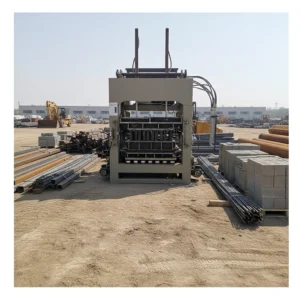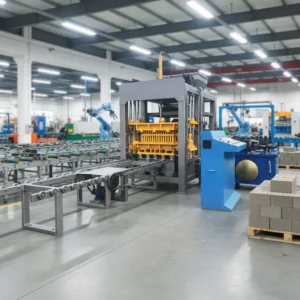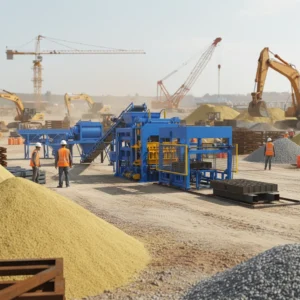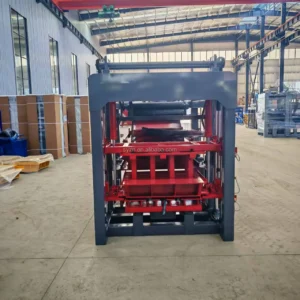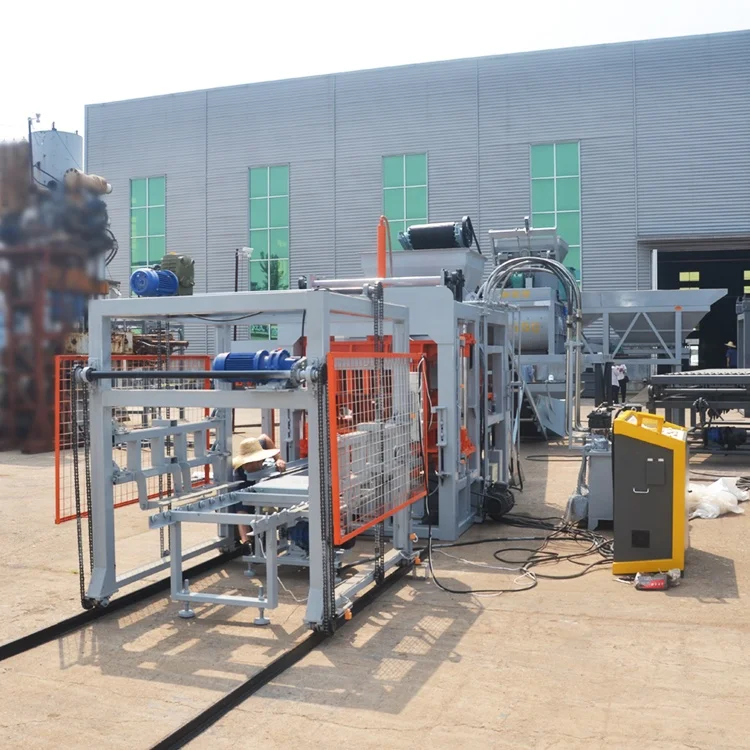
Line-Rhythm Engineering — every feeder, mixer, pallet return and stacker around the QT6-15 is timed to the same 15–20 s press cycle so the block machine never waits on upstream or downstream stations.
Technical Specifications
| Parameter | Value |
|---|---|
| Model | QT6-15 |
| Product Type | Concrete Hollow Block Making Machine |
| Overall Dimensions (L×W×H) | 8200 × 1700 × 2950 mm |
| Total Mass | 7 T |
| Overall Power | 37 kW |
| Vibration Frequency | 0–60 Hz |
| Vibration Form | Platform Vibration |
| Vibration Force | 45 kN |
| Moulding Mode | Load automatically, vibration moulding |
| Demolding Method | Hydraulic |
| Pallet Size | 880 × 850 mm |
| Molding Cycle | 15–20 s (basis not stated in source — confirm block format, material and thickness) |
| Control System | PLC with touch screen interface |
| Hydraulic System | Independent integrated hydraulic station |
| Block Compressive Strength | More than 15 MPa |
| Output — Hollow Block 400×200×200 mm | 8,640–11,520 pcs / 8 hr (6 pcs/mould, 15–20 s cycle) |
| Output — Hollow Block 400×150×200 mm | 11,520–15,360 pcs / 8 hr (8 pcs/mould, 15–20 s cycle) |
| Output — Solid Brick 240×115×53 mm | 46,080–61,440 pcs / 8 hr (32 pcs/mould, 15–20 s cycle) |
| Output — Rectangular Paver 200×100×60 mm | 17,280–23,040 pcs / 8 hr (21 pcs/mould, 20–25 s cycle) |
| Output — Zigzag Paver 225×112.5×60 mm | 17,280–23,040 pcs / 8 hr (15 pcs/mould, 20–25 s cycle) |
| Raw Material Adaptability | Waste ash, slag, and various aggregates |
| Recommended Factory Area | 1,200 m² |
| Standards | CE |
Application Suitability
| Application | Material or Output |
|---|---|
| Hollow block plant for commercial and residential construction | Crushed stone, sand, cement and waste ash blended for 400×200×200 mm and 400×150×200 mm hollow formats |
| Solid brick supply for load-bearing and infill walls | Local aggregates with reduced cement dosage for 240×115×53 mm bricks |
| Paving block production for roads, yards and walkways | High-density mix for 200×100×60 mm rectangular and 225×112.5×60 mm zigzag pavers |
| On-site block production for housing and infrastructure projects | Mobile batching with site-sourced aggregates where pallet and curing infrastructure are already in place |
| Format expansion for existing concrete product manufacturers | Shared 880×850 mm pallet circuit across hollow, solid and paver moulds on one line |
Why "Cycles per Hour" Misses the Real Output Picture
A concrete block production line only produces as fast as its slowest station, not its press.
The headline cycle number assumes every pallet, every batch of mix and every stacker movement arrives exactly on time — a condition that rarely holds without deliberate line design.
I once watched a block plant in South Asia sit idle for twenty minutes every hour because the mixer discharged slower than the press consumed. The operator kept tapping the PLC screen as if a fault code would appear, but the machine was doing exactly what it was told — waiting for material. That gap between quoted capacity and actual daily output is where most buyers lose money, and it is the reason the concrete block production line around the QT6-15 is specified station by station, not press-first [NEED_CITE: typical output gaps between quoted and actual block plant capacity].
Matching Every Station to the Press Heartbeat
The QT6-15 completes a moulding cycle in 15–20 seconds depending on block format and mix, which means the entire concrete block production line must deliver a loaded pallet to the press within that same window. Raw material feeding, mixing, pallet return and stacking are each sized against this cycle so no station accumulates a queue. The PLC touch screen monitors press timing and can be linked to upstream batching signals to pause the mixer when the hopper is full, preventing mix from setting before it reaches the mould.
Sizing Pallet Flow Around an 880×850 mm Circuit
Pallet size is one of the few line parameters that locks in every other station dimension — conveyor width, stacker fork spacing, curing rack slot pitch and forklift tine length all derive from it. The 880×850 mm pallet chosen for the QT6-15 must be confirmed against the buyer’s existing curing racks and handling equipment before the line layout is drawn. A mismatch here means either replacing hundreds of pallets or redesigning the rack hall after the machines arrive, a mistake I have seen cost buyers weeks of downtime [NEED_CITE: pallet size compatibility with curing rack and forklift specifications].
Reading the Specs That Actually Move the Line
Vibration force and hydraulic pressure work together to compact the mix: the 45 kN platform vibration consolidates aggregate particles while hydraulic pressure holds the mould box rigid during the cycle. If vibration dominates without sufficient hydraulic clamp, blocks emerge with ragged edges; if pressure dominates without enough vibration, density drops and compressive strength falls below the 15 MPa target. The independent integrated hydraulic station sits away from the main vibration zone, which keeps oil temperature stable and prevents seal wear from accelerating. The 0–60 Hz frequency range lets the operator dial in the right amplitude for lightweight ash mixes on one end and dense paver mixes on the other, and that consistency is what downstream stackers rely on to time their movements.
The Cost of Ignoring Line Timing
When the mixer, pallet feeder and stacker are sourced separately and never matched to the press cycle, the result is a plant that runs at a fraction of its nameplate capacity. Operators compensate by running extra shifts, which pushes maintenance intervals out and accelerates wear on hydraulic seals and vibration bearings. Pallets pile up between stations, forcing manual handling that introduces breakage and inconsistent curing times [NEED_CITE: manual pallet handling impact on block breakage and curing consistency]. Buyers then blame the press for low output when the real bottleneck was never the moulding cycle at all.
Why This Line Configuration Works Differently
Block machinery is our single focus, so the QT6-15 and its surrounding stations are specified as one matched system rather than assembled from separate suppliers. Each line configuration is set against the buyer’s actual mix design, local aggregate and target block format, not a catalogue default. Mould design covers the formats the buyer’s market actually sells, and custom drawings are available when a non-standard size is needed. Automation level is selectable — a buyer can start with semi-automatic pallet handling and add stacking and cubing later without replacing the press. Installation support includes on-site commissioning and operator training so the line reaches its calculated output from the first week.
Documentation & Verification
- Line layout and capacity calculation stating the block format assumed for each output figure
- Machine specification sheet with pallet size, vibration force and hydraulic pressure confirmed
- Mould drawing and format list matching buyer’s market requirements
- Hydraulic and electrical schematic for integration with existing plant controls
- Voltage, frequency and PLC display language confirmation before production
- Factory test record on buyer’s selected block format before dispatch
Installation, Commissioning & Support
- Foundation plan drawn to the 8200 × 1700 mm press footprint and 7 T operating mass
- Dedicated 37 kW power circuit with voltage and frequency confirmed before shipment
- Press, hydraulic station and pallet conveyor arrive dismantled and reassemble on-site
- First-run cycle time set against the buyer’s specific mix and block format
- PLC touch screen language set to operator preference during commissioning
- Operator training on mould change, daily lubrication and PLC fault diagnosis
What to Prepare Before You Enquire
Share the block formats your market sells, the daily output you need for each, and the raw materials available locally — including aggregate grading and cement type. Confirm your existing pallet dimensions, curing rack layout and forklift capacity so the line can be designed around them. State your site voltage, frequency and preferred PLC language so the concrete block production line ships ready for commissioning on arrival.
Frequently Asked Questions
Q: How is line capacity calculated for the QT6-15 — which block format does each output figure assume?
A: Every output figure is tied to a specific block size, mould cavity count and cycle time. Hollow block 400×200×200 mm at six cavities and a 15–20 s cycle yields 8,640–11,520 pieces per eight-hour shift. Paver formats run on a longer 20–25 s cycle. The line layout document states the assumed format beside each number so there is no single headline capacity.
Q: How do pallet feeders, stackers and curing rack handlers get timed to the QT6-15 press cycle?
A: Each station’s motor speed and sensor position are set so pallet delivery, block removal and rack loading fall within the press cycle window. The PLC touch screen provides timing diagnostics, and adjustments can be made from the main panel without rewiring individual motors.
Q: What raw material feeding and mixing setup keeps the press supplied without overstocking?
A: The mixer discharge rate must match the press consumption rate for the chosen block format. Over-mixing leads to slump loss before the mix reaches the mould, while under-mixing leaves the hopper empty mid-cycle. The batching system is sized against the QT6-15 cycle time and the buyer’s specific mix design.
Q: Can surrounding station automation be upgraded independently of the press?
A: Yes. A line can start with manual pallet return and semi-automatic stacking, then add a fully automatic stacker and cubing system later. The press PLC retains the timing reference, and new stations are synchronised during commissioning without modifying the core press controls.
Q: What voltage, frequency and PLC language details need confirming before the line ships?
A: The buyer must provide site voltage, phase, frequency and the preferred PLC display language before production begins. These parameters are locked into the electrical schematic and the touch screen configuration so commissioning can start on day one without component swaps or software re-flashing.