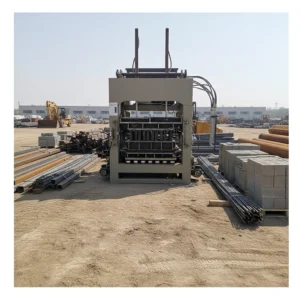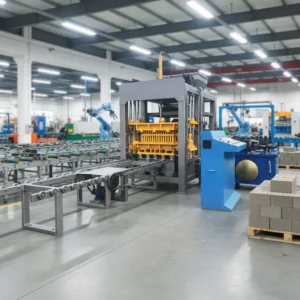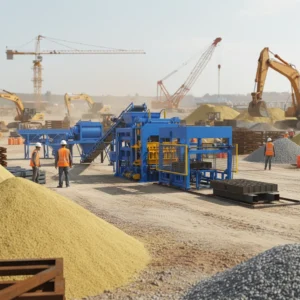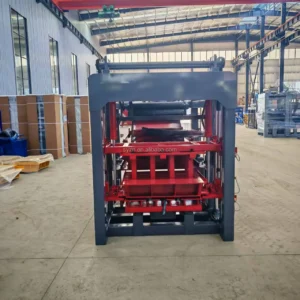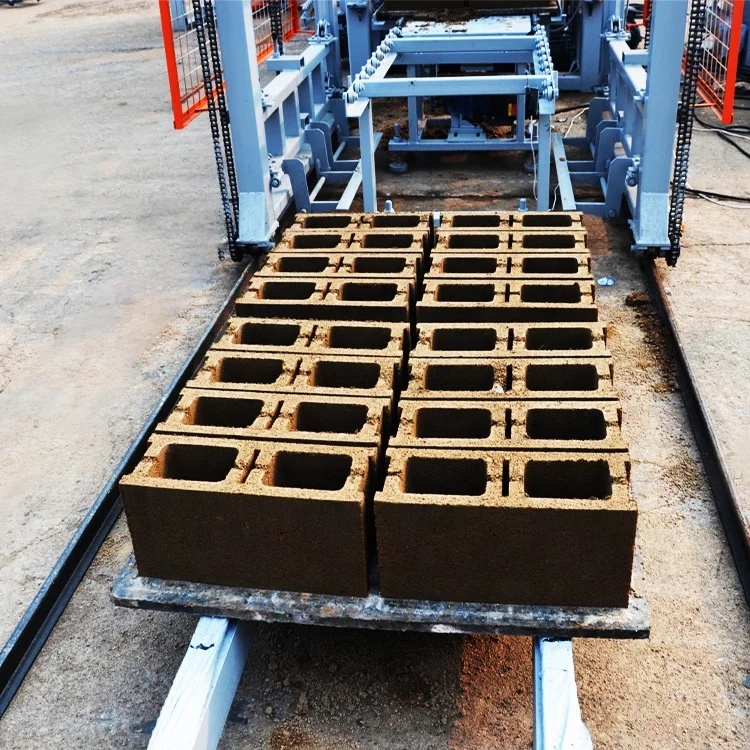
Matched Line Rhythm — The QT6-15 block making machine production line is configured so the press, pallet feeder, and brick conveyor share a synchronized cycle rather than operating as isolated stations.
Technical Specifications
| Parameter | Value |
|---|---|
| Model | QT6-15 |
| Product Type | Automatic Hydraulic Vibrating Concrete Block Making Machine |
| Overall Dimensions (L×W×H) | 7400×1900×2660 mm |
| Molding Cycle | 15-25s |
| Vibration Frequency | 4600 r/min |
| Exciting Power (Vibration Force) | 40-50 kN |
| Rated Power | 31.25 kW |
| Mixer Model | JQ350 |
| Pallet Size | 850×550×25 mm |
| Net Weight | 7T |
| Control System | PLC control system |
| Included Equipment | Block making machine, hydraulic station, PLC control system, pallet feeder, brick conveyor, block sweeper |
| Output Capacity (Hollow Block 400×200×200mm) | 1200-1680 pcs/hr, 9600-13440 pcs/8hr |
| Output Capacity (Hollow Block 400×150×200mm) | 1800-2400 pcs/hr, 14400-19200 pcs/8hr |
| Output Capacity (Solid Brick 240×115×53mm) | 3240 pcs/hr, 16200-19440 pcs/8hr |
Application Suitability
| Application | Material or Output |
|---|---|
| Block and paver production plants | Hollow blocks, solid bricks, pavers, curbstones from crushed stones, sand, cement, fly ash |
| Construction contractors | On-site concrete block production using local aggregates |
| Building material manufacturers | Expanding format ranges with interlocking and porous bricks |
| Housing project contractors | Local block production with defined daily output targets |
Why the Upstream Feeding Rhythm Dictates the Press Output
A block press is only as fast as the mixer and pallet feeder allow it to be.
When planning a plant layout, I often see buyers focus entirely on the press cycle time while ignoring the batching speed. If the JQ350 mixer or the upstream feeding belt cannot deliver a consistent mix within the 15-25s molding cycle, the QT6-15 block making machine production line will spend its shift idling. This starvation effect is rarely captured in brochure capacity figures, yet it is the primary reason daily output falls short of expectations [NEED_CITE: impact of upstream bottlenecks on actual plant throughput]. The entire line must be balanced so that raw material feeding, mixing, and pallet delivery arrive at the press exactly when the previous cycle finishes.
Synchronizing the Pallet Feeder with the Press Cycle
The pallet feeder is not merely a storage rack; it is the heartbeat of the QT6-15 block making machine production line. With a pallet size of 850×550×25 mm, the feeder must advance a fresh pallet into the press the moment the mould lifts. If the feeder mechanism lags, the vibration and hydraulic pressure phases are delayed, extending the total cycle time beyond the rated 15-25s. This synchronization ensures that the press remains the bottleneck rather than the material handling system, maintaining a steady flow of green blocks toward the curing area.
Balancing the Brick Conveyor and Sweeper Stations
Downstream of the press, the brick conveyor and block sweeper must clear the finished pallet before the next one arrives. The conveyor speed must match the press output to prevent a backlog that could force the press to pause. In a well-configured QT6-15 block making machine production line, the sweeper cleans the pallet surface immediately after the block is stripped, ensuring that residual concrete does not interfere with the next moulding cycle [NEED_CITE: importance of pallet cleaning in maintaining block dimensional accuracy]. This continuous loop eliminates the manual handling that often slows down semi-automatic setups.
Interpreting Vibration Force and Hydraulic Pressure
The 40-50 kN vibration force at 4600 r/min works in tandem with the hydraulic station to compact the concrete mix. High frequency vibration liquefies the mix, allowing it to flow into the mould corners, while the hydraulic pressure applies the static force needed to achieve the target density. If the local aggregate is highly abrasive or the mix is too dry, the vibration force must be sufficient to overcome the internal friction. The QT6-15 configuration pairs these forces to produce consistent hollow blocks and solid bricks without excessive wear on the mould steel. The 31.25 kW rated power supports both the hydraulic pump and the vibration motors simultaneously, preventing voltage dips during the peak load of the pressing phase.
The Cost of Ignoring Line Integration
Buying a standalone press without verifying the supporting equipment often leads to a fragmented plant where stations operate at different speeds. A buyer might secure a high-speed press, only to find that the manual pallet handling or undersized mixer cuts the actual daily output in half. The hidden cost appears as overtime labor paid to workers who spend their shift waiting for material or moving pallets by hand [NEED_CITE: hidden operational costs in fragmented block plants]. By specifying the QT6-15 as a complete line with feeder, conveyor, and sweeper, these integration gaps are closed before the equipment is shipped.
Why Specify the Line as a Single System
Sourcing the press, moulds, pallets, and handling equipment from one supplier ensures that the mechanical interfaces match. The pallet feeder is designed specifically for the 850×550×25 mm pallets, and the PLC control system coordinates the logic between the press and the conveyor. This approach eliminates the blame-shifting that occurs when separate vendors supply incompatible stations. The line layout and capacity calculation are provided stating the exact block format assumed, so the buyer knows the realistic output for hollow blocks versus solid bricks before the foundation is poured.
Documentation & Verification
- Line layout and capacity calculation stating the block format assumed for each output figure.
- Machine specification sheet with hydraulic and electrical schematic for the 31.25 kW system.
- Pallet specification confirming 850×550×25 mm dimensions and material load rating.
- Voltage and control language confirmation documented before production begins.
- Factory test record showing cycle times for the specific mould installed.
Installation, Commissioning & Support
- Foundation plan detailing the load points for the 7T machine and 7400×1900×2660 mm footprint.
- Power supply verification for the 31.25 kW rated power and local voltage frequency.
- PLC control system parameter setting for the specific block format and cycle time.
- Operator training on the pallet feeder and brick conveyor synchronization logic.
- Wear parts list for the mould and hydraulic seals based on the local aggregate abrasiveness.
Planning Your Line Configuration
To ensure the QT6-15 block making machine production line fits your facility, we need to review your target block formats, the specific raw materials available locally, and the dimensions of your curing area. Please provide your site voltage and frequency, along with the desired level of automation for the stacking and curing rack handling. This information allows us to generate a line layout that balances every station to the press cycle.
Frequently Asked Questions
Q: How is the output capacity calculated for different block formats?
A: The capacity figures are based on specific block dimensions and a standard molding cycle. For example, the 1200-1680 pcs/hr rate assumes a 400×200×200mm hollow block. Different formats, such as solid bricks or pavers, have different cycle times and mould cavity counts, which changes the hourly output. We provide a capacity calculation for your specific target format.
Q: What supporting equipment is included in the line quotation?
A: The standard line package includes the block making machine, hydraulic station, PLC control system, pallet feeder, brick conveyor, and block sweeper. Items like the raw material batching plant, cement silo, and automatic stacker are typically configured separately based on your site layout and automation requirements.
Q: How does the pallet size affect the curing area layout?
A: The 850×550×25 mm pallet size determines the spacing of the curing racks and the type of forklift required for handling. If your existing curing area is designed for a different pallet dimension, the rack spacing and forklift tines may need adjustment. We confirm the pallet specification early to ensure compatibility with your site infrastructure.
Q: When must the voltage and PLC language be confirmed?
A: These parameters must be locked in before the electrical cabinet is wired. The PLC control system is configured for your local voltage and frequency, and the display language is set to match your operators. Changes requested after the wiring phase can delay the shipment and require component replacement.
Q: How does the line cycle time balance between stations?
A: The PLC control system coordinates the press cycle with the pallet feeder and brick conveyor to ensure no station waits for the next. The total cycle time includes the mould filling, vibration, pressing, and stripping phases, plus the time required for the pallet to advance. We calculate this balance to prevent bottlenecks in the material flow.