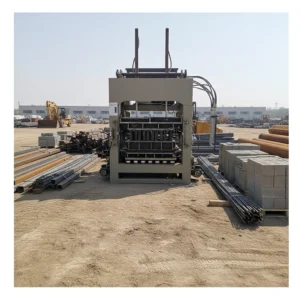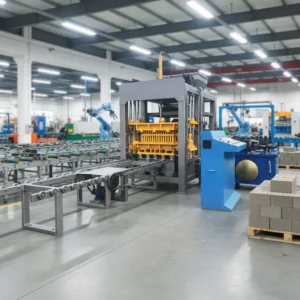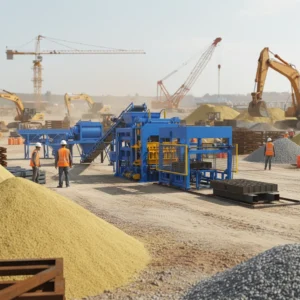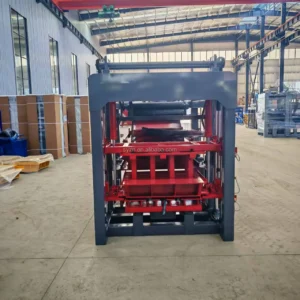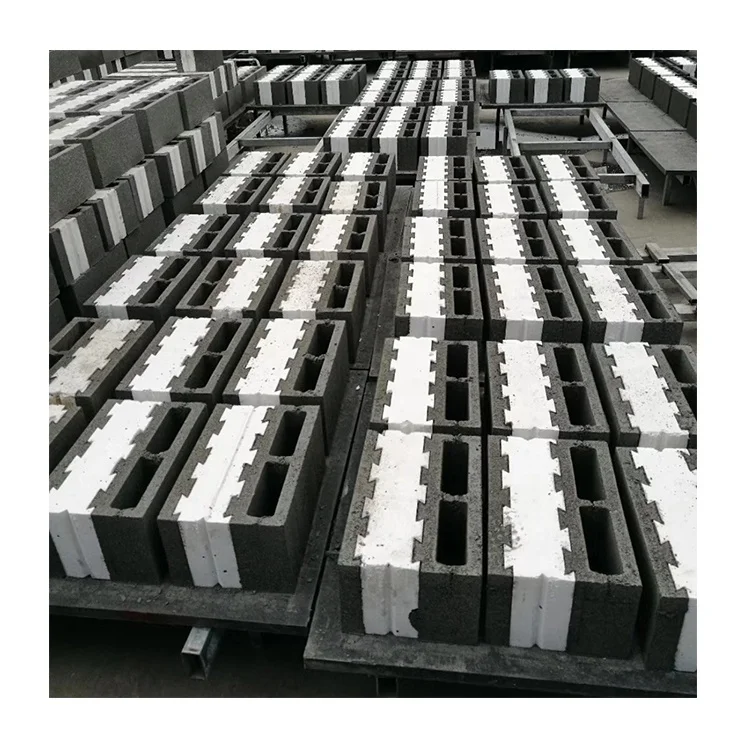
Matched Line Rhythm — every station from the JQ350 mixer through the pallet feeder to the block sweeper is timed against the QT6-15 press cycle so the host machine is never left idling while upstream or downstream equipment catches up.
Technical Specifications
| Parameter | Value |
|---|---|
| Product Type | Concrete Block Making Machine |
| Model | QT6-15 |
| Overall Dimensions (L×W×H) | 7400 × 1900 × 2660 mm |
| Total Weight | 7 T |
| Rated Power | 31.25 kW |
| Control System | PLC control system |
| Molding Cycle | 15–25 s |
| Vibration Frequency | 4600 r/min |
| Vibration Force | 40–50 kN |
| Pallet Size | 850 × 550 × 25 mm |
| Mixer Model | JQ350 |
| Applied Products | Paver, solid block, hollow block, curbstone |
| Output Capacity (400×200×200 mm hollow block) | 1200–1680 pcs/hr (basis: 15–20 s cycle) |
| Output Capacity (400×150×200 mm hollow block) | 1800–2400 pcs/hr (basis: 15–20 s cycle) |
| Output Capacity (240×115×53 mm solid brick) | 3240 pcs/hr (basis: 15–20 s cycle) |
| Included Equipment | Block making machine, hydraulic station, PLC control system, pallet feeder, brick conveyor, block sweeper |
| Free Parts Included | Manual hydraulic trolley, spare parts and tools |
Application Suitability
| Application | Material or Output |
|---|---|
| Hollow block production for commercial and residential walls | Crushed stone, sand, cement, fly ash, dust |
| Solid brick manufacturing for load-bearing structures | Sand, cement, crushed stone aggregates |
| Paver and interlocking block runs for roads and walkways | Cement, fine aggregates, stone dust |
| Curbstone and kerb production for municipal infrastructure | Coarse aggregates, cement, sand |
What the QT6-15 Block Making Machine Production Line Actually Solves
A press that waits for material or pallets is a press making zero blocks.
I have spent years walking onto African job sites where the concrete block machine sits idle while a mixer that is one size too small struggles to keep up, or a pallet feeder jams because its cycle was never aligned with the host machine. The daily shortfall adds up fast — a few hundred missed cycles per shift becomes tens of thousands of blocks lost over a project timeline. The QT6-15 block making machine production line is specified so that the JQ350 mixer, the pallet feeder, the brick conveyor and the block sweeper each complete their sequence within the press molding window [NEED_CITE: line synchronization standards in block production]. The goal is simple: every station finishes before the press is ready for the next step, not after.
How Line Cycle Matching Works in Practice
The QT6-15 block making machine production line starts with the JQ350 mixer delivering a batch to the host hopper within the press cycle window. The pallet feeder positions a fresh 850 × 550 × 25 mm pallet before the mold descends. Once the vibration and hydraulic pressing complete in 15–25 seconds, the brick conveyor carries the loaded pallet away while the block sweeper clears residual material. Each station has its own timing, and the PLC control system coordinates the sequence so the press is never the bottleneck waiting on upstream supply or downstream clearance.
Where Mismatched Stations Cost You Output
When a line is assembled from catalog defaults rather than calculated against actual cycle times, one station inevitably drags. A mixer that takes 45 seconds to discharge into a hopper while the press cycle is 20 seconds means the press sits idle for nearly half its shift. A conveyor that clears pallets slower than the press ejects them causes a backup that forces the operator to pause the cycle. I have seen these mismatches on sites where the owner assumed every supplier had coordinated the timing — they had not [NEED_CITE: common causes of output shortfall in block plants]. The QT6-15 block making machine production line addresses this by treating every station as part of one timed system.
Reading the Specifications That Matter
Vibration force at 40–50 kN combined with a 4600 r/min frequency determines how densely the aggregate is compacted inside the mold cavity. Higher force on a coarse crushed-stone mix produces a denser block wall, but the same force on a fine fly-ash mix may over-compact and crack the green block. Hydraulic pressure must be set in balance with that vibration — too much pressure on a lightweight mix crushes the aggregate structure, too little leaves voids. The 850 × 550 × 25 mm pallet size is not arbitrary either; it dictates how many blocks fit per cycle, how the pallets stack in the curing area, and whether the buyer’s existing forklift can handle the loaded weight. The PLC control system with a 15–25 second molding cycle range lets the operator adjust timing per format rather than running every block type on a single default setting.
The Hidden Cost of Skipping Line-Level Configuration
Buying a press on its own and sourcing the mixer, pallet feeder and conveyor separately often saves money on the purchase order. What it costs is coordination. When the pallet feeder arrives with a different control protocol than the press PLC, the operator runs the feeder manually — adding a person to the line and introducing timing errors every shift. When the mixer output volume does not match the hopper capacity, batches pile up or the hopper runs dry mid-cycle. These are not defects; they are planning gaps [NEED_CITE: equipment integration challenges in emerging-market block plants]. The consequence is a line that technically works but never reaches the output figures the buyer budgeted around.
Why Source the Full Line Through One Configuration Point
Block machinery is the single focus here, which means the QT6-15 press, its mold, the pallets, the JQ350 mixer and the conveyor are specified as one matched system rather than assembled from separate suppliers who do not talk to each other. Configuration is set against the buyer’s actual mix design and local aggregate, not a catalog default that assumes materials unavailable at the job site. Molds are designed for the formats the buyer’s market actually sells, and supporting equipment within the line — from raw material feeding through to block output — is included in the same scope. Automation level is selectable, so a plant can start with the semi-automatic setup and expand later. Installation and commissioning support includes operator training on the specific line as delivered.
Documentation & Verification
- Line layout drawing showing every station from JQ350 mixer to block sweeper with cycle time noted at each point
- Capacity calculation sheet stating the exact block format assumed for every output figure
- Pallet specification matched to the buyer’s curing rack dimensions and forklift capacity
- Voltage, frequency and PLC display language confirmed in writing before production begins
- Factory test record on the buyer’s target block format before dispatch
Installation, Commissioning & Support
- Foundation plan accounts for the 7400 × 1900 mm footprint and 7 T operating weight of the QT6-15 line
- Electrical supply confirmed for 31.25 kW total rated power with dedicated circuit and correct voltage and frequency
- PLC display language set and tested at the factory before the control panel ships
- Mixer, pallet feeder and conveyor cycle times verified on-site against press molding window during commissioning
- Operator training covers mold change procedure, PLC parameter adjustment and daily maintenance checkpoints
- Wear parts list and hydraulic seal kit provided for first replacement cycle
Before You Send an Inquiry
To size the QT6-15 block making machine production line to your site, the useful starting information includes the block formats your market sells and the daily output target for each. Share the raw materials available locally — type of aggregate, sand source, whether fly ash or stone dust is part of your mix — along with the voltage and frequency at your site and the language your operators need on the PLC display. If you already have a curing area and forklift, note the pallet dimensions and stacking equipment in use so the line configuration aligns with your existing handling setup.
Frequently Asked Questions
Q: How is daily output calculated and which block format does each capacity figure assume?
A: Every output figure on this page is tied to a specific block size and cycle time. For example, 1200–1680 pieces per hour applies to a 400×200×200 mm hollow block at a 15–20 second cycle. Daily figures assume an 8-hour shift. If your target format differs, the capacity must be recalculated against the mold layout and cycle time for that format.
Q: What supporting equipment is included and what must I source separately?
A: The line includes the QT6-15 press, hydraulic station, PLC control system, pallet feeder, brick conveyor, block sweeper and the JQ350 mixer. A manual hydraulic trolley and spare parts kit are included. Items typically sourced locally include the curing rack structure, forklift, water supply and electrical cabling from the main panel to the line.
Q: How do pallet size and quantity relate to my curing area?
A: The standard pallet for this line is 850 × 550 × 25 mm. The total pallet count must cover the blocks in the press, on the conveyor, and in the curing area at any given time. Pallet material must withstand the vibration force and moisture exposure during curing while remaining compatible with your forklift tine spacing.
Q: What voltage and PLC language options are confirmed before shipment?
A: Voltage and frequency are confirmed against your site supply before production begins. The PLC display language is set at the factory so operators can read the interface from the first day of commissioning. These details are documented in writing and included in the pre-shipment verification package.
Q: How are station cycle times matched so no point becomes a bottleneck?
A: Each station — mixer discharge, pallet feed, press cycle, conveyor clearance — is timed against the QT6-15 molding window of 15–25 seconds. The PLC coordinates the sequence so the press receives the next pallet and material charge before it finishes its current cycle, keeping continuous output without manual pacing.