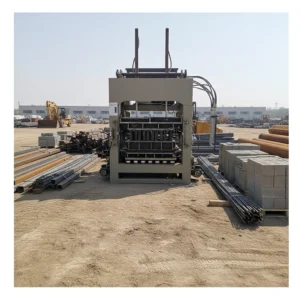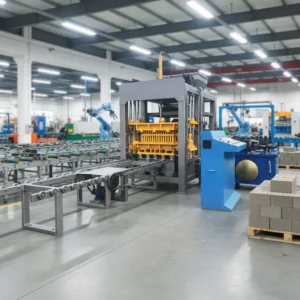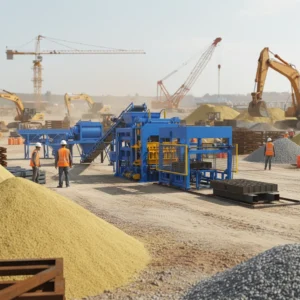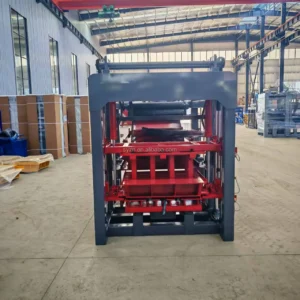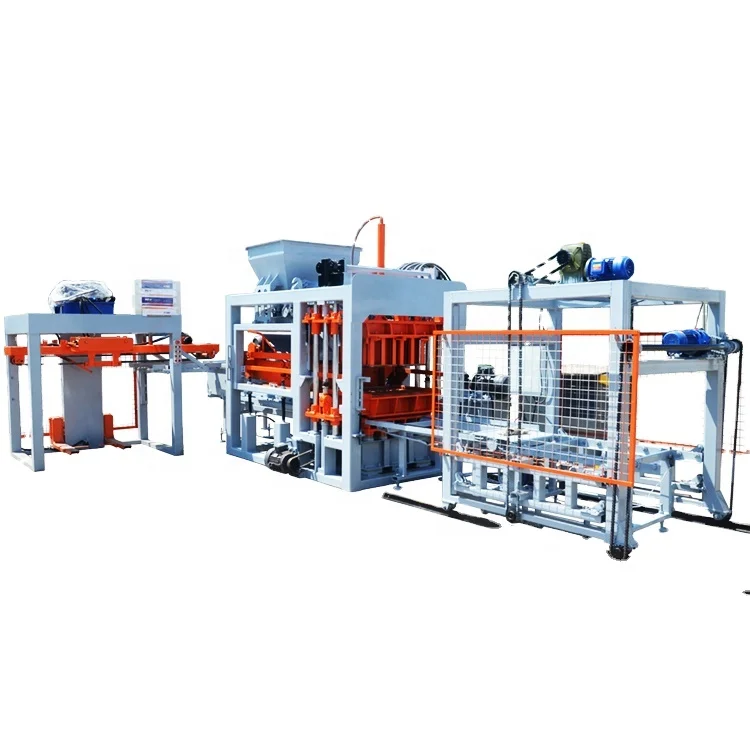
Matched Line Stations — Feeding, mixing, pallet circulation and stacking are specified around the QT6-15 press cycle so the machine runs at its rated tempo without idle gaps between stations.
Technical Specifications
| Parameter | Value |
|---|---|
| Model | QT6-15 |
| Product Type | Hollow Block and Solid Block Making Machine |
| Overall Dimensions (L×W×H) | 8200×1700×2950 mm |
| Pallet Size | 880×850 mm |
| Molding Cycle | 15-20 s |
| Vibration Frequency | 0-60 Hz |
| Vibration Form | Platform Vibration |
| Vibration Force | 45 kN |
| Hydraulic System | Independent integrated hydraulic station |
| Demolding Method | Hydraulic |
| Control System | PLC (Programmable Controller) with touch screen |
| Overall Power | 37 kW |
| Total Mass | 7 T |
| Block Compressive Strength | >15 MPa |
| Output Capacity (Hollow Block 400×200×200 mm) | 1080-1440 pcs/h, 8640-11520 pcs/8hr |
| Output Capacity (Hollow Block 400×150×200 mm) | 1440-1920 pcs/h, 11520-15360 pcs/8hr |
| Output Capacity (Solid Brick 240×115×53 mm) | 5760-7680 pcs/h, 46080-61440 pcs/8hr |
| Output Capacity (Rectangular Paver 200×100×60 mm) | 2160-2880 pcs/h (basis: 20-25s cycle), 17280-23040 pcs/8hr |
| Output Capacity (Zigzag Paver 225×112.5×60 mm) | 2160-2880 pcs/h (basis: 20-25s cycle), 17280-23040 pcs/8hr |
| Recommended Factory Area | 1200 m² |
Application Suitability
| Application | Material or Output |
|---|---|
| Hollow block production | Crushed stone, sand, fly ash, slag, cement mixes |
| Solid brick production | Dense aggregate and cement blends for load-bearing walls |
| Rectangular paving brick | Fine aggregate surface mix with base layer aggregate |
| Zigzag / interlocking paver | Pigmented face mix over standard concrete base |
| On-site contractor production | Locally sourced waste ash and aggregate with reduced cement |
| Format expansion for existing plants | Quick mould change across hollow, solid and paver formats |
What "Rated Output" Hides When the Rest of the Line Is Missing
A press that cycles at full speed only matters if the mixer, pallet feeder and stacker can keep pace with it.
I spent years on the assembly floor before moving into technical sales, and the pattern repeats: a buyer receives a block machine production line quotation for the press alone, the mixer is undersized, the pallet return is manual, and the real daily throughput never reaches the number on paper. One hollow block plant in Shandong installed a host machine rated for strong output, but the batching station could not feed fast enough and the stacking station relied on hand labour — the line stalled at the press every few minutes. The block machine production line only delivers its headline capacity when every upstream and downstream station is matched to the same cycle tempo [NEED_CITE: common causes of throughput loss in concrete block plants].
How Station Cycle Times Are Aligned Around the Press
The QT6-15 molding cycle of 15-20 seconds sets the heartbeat for the entire turnkey block making plant. The batching and mixing station must deliver a fresh charge within that window, the pallet feeder must place a clean pallet before the mould descends, and the stacker must clear cured product before the next wet block arrives. Each supporting station is selected so its own cycle completes slightly faster than the press, preventing the QT6-15 from waiting on material or pallet availability.
The Pallet Loop That Keeps the Press Fed
Pallets travel from the press output through the curing rack, back to the pallet feeder, and into the press again. The 880×850 mm pallet size is confirmed against the buyer’s curing area dimensions and existing forklift capacity before production begins, so pallets move through the loop without bottlenecks at the rack or the return conveyor. If the pallet loop is too slow, the press sits idle regardless of how fast it can cycle.
Reading the Specifications That Actually Matter
The 45 kN vibration force and 0-60 Hz frequency range work together with the independent hydraulic station to compact the mix into a dense block. Platform vibration transmits energy through the pallet into the mould, and the hydraulic pressure holds the mould halves closed during compaction — if either value is too low for the buyer’s aggregate, block strength drops below the >15 MPa target. The 37 kW overall power rating covers the press itself; the mixer, conveyor motors and stacker draw additional load, so the total connected power for the block machine production line must be calculated before sizing the site transformer. The PLC touch screen coordinates all stations from one control point, and the display language is confirmed in writing before shipment to avoid commissioning delays [NEED_CITE: PLC language configuration for export machinery].
The Cost of Skipping the Line-Level View
When a buyer purchases the press without specifying the pallet feeder, stacking and curing rack handling, those stations arrive later from separate suppliers with different cycle times and control interfaces. The result is a turnkey block making plant that is anything but turnkey — operators manually move pallets, the press idles between cycles, and the daily output falls far short of the quoted figure. Voltage and frequency mismatches discovered after arrival add further commissioning delays, and the first mould or hydraulic wear part replacement arrives late because the spare parts list was never agreed upon before shipment [NEED_CITE: electrical supply standards for industrial machinery across export markets].
Why Sourcing the Full Line From One Supplier Changes the Outcome
Block machinery as a single focus means the QT6-15 press, its moulds, pallets and every handling station are specified as one matched system rather than assembled from separate vendors. The configuration is set against the buyer’s actual mix design and local aggregate, not a catalogue default. Pallet size and material are chosen to fit the curing area the buyer already operates. Automation level is selectable — a buyer can start with semi-automatic pallet handling and upgrade to full automatic stacking and cubing later without replacing the press. Installation includes operator training so the crew understands the PLC fault diagnosis system from day one.
Documentation & Verification
- Line layout and capacity calculation stating the block format assumed for each output figure
- Machine specification sheet covering the QT6-15 press and all supporting stations
- Mould drawing and format list for hollow block, solid brick and paver sizes
- Pallet specification matched to buyer’s curing area and forklift capacity
- Hydraulic and electrical schematic with confirmed voltage and control language
- Factory test record on buyer’s target block format before dispatch
Installation, Commissioning & Support
- 1200 m² recommended factory area with level concrete floor and drainage for the QT6-15 line
- 37 kW press power plus mixer and conveyor load on a dedicated circuit at confirmed voltage and frequency
- Main press arrives fully assembled; supporting stations bolted and wired on site during commissioning
- PLC touch screen parameters set for buyer’s mix design and target block format at first run
- Operator training covers mould change procedure, PLC fault diagnosis and daily maintenance routines
- Wear parts and mould list provided with first-order shipment for planned replacements
What We Need to Build Your Line Layout
Send us the block formats your market sells, the daily output you need, and the raw materials available locally including aggregate type and cement dosage. Include your site dimensions, curing area layout, existing forklift capacity, and the local voltage and frequency. If you already operate upstream or downstream equipment, list those stations so the turnkey block making plant integrates with what you have.
Frequently Asked Questions
Q: How are the supporting line stations matched to the QT6-15 press cycle time so the press is not left waiting?
A: The 15-20 second molding cycle sets the tempo. We select the mixer discharge rate, pallet feeder speed and stacker cycle so each station completes its task slightly faster than the press. This prevents idle gaps and keeps the block machine production line running at its rated output for the chosen block format.
Q: What does the line layout drawing include, and how is capacity calculated per block format?
A: The layout shows every station from raw material feeding through curing rack handling, with conveyor lengths and pallet flow paths. Capacity is calculated separately for each block format — hollow, solid, paver — based on the number of cavities per mould and the confirmed cycle time, so daily throughput expectations are realistic.
Q: How is pallet size and material chosen to match my curing area and existing forklift?
A: The standard 880×850 mm pallet is verified against your curing rack spacing and forklift tine width before production. If your facility requires a different dimension or material — bamboo, steel, or composite — the pallet specification is adjusted so the loop runs without manual intervention.
Q: What is included in the quotation beyond the press — feeding, mixing, stacking, curing rack handling?
A: The quotation covers the QT6-15 press plus every station in the block machine production line: raw material feeding, mixing, pallet feeding, stacking and curing rack handling. Each item is listed separately so you can see what is included and what you may already have on site.
Q: How do I upgrade from a semi-automatic line to full automatic stacking and cubing later?
A: The QT6-15 PLC control system supports both semi-automatic and full automatic operation. When you are ready to add automatic stacking and cubing, the upgrade involves installing the stacker module and updating the PLC program — the press and its hydraulic station remain unchanged.