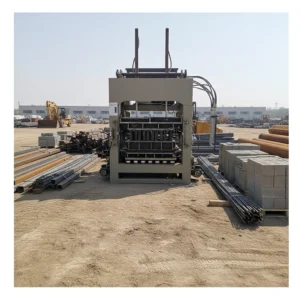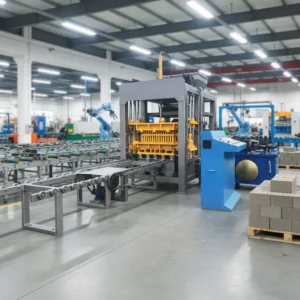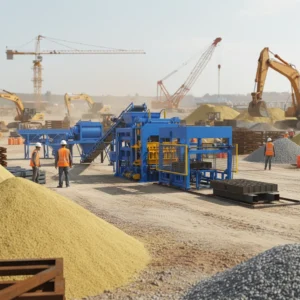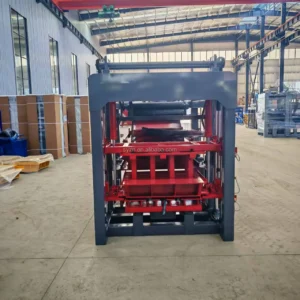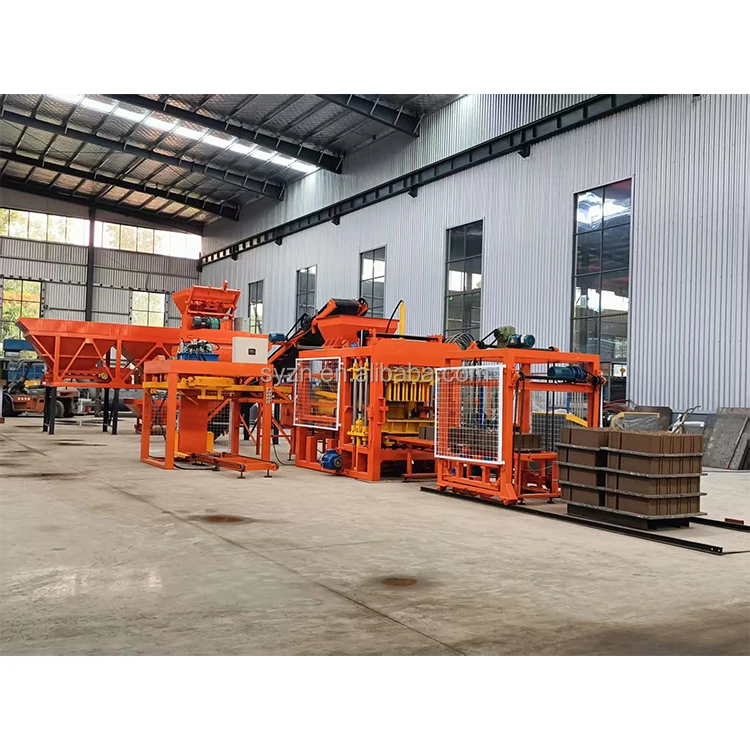
Matched System Configuration — the QT6-15 block machine production line is specified as one coordinated system, so upstream feeders, the mixer, pallet handling, stacking, and curing rack stations are all timed to the press cycle rather than sourced separately.
Technical Specifications
| Parameter | Value |
|---|---|
| Model | QT6-15 |
| Product Type | Hydraulic Block Making Machine |
| Overall Dimensions (L×W×H) | 8200×1700×2950 mm |
| Total Mass | 7 T |
| Overall Power | 37 kW |
| Vibration Form | Platform Vibration |
| Vibration Frequency | 0-60 Hz |
| Vibration Force | 45 kN |
| Moulding Mode | Automatic load, vibration moulding |
| Demolding Method | Hydraulic |
| Molding Cycle | 15-20 s |
| Pallet Size | 880×850 mm |
| Control System | PLC with touch screen HMI |
| Hydraulic System | Independent integrated hydraulic station |
| Recommended Factory Area | 1200 m² |
| Output Capacity (Hollow block 400×200×200 mm) | 1080-1440 pcs/hour (basis: 15-20s cycle) |
| Output Capacity (Solid brick 240×115×53 mm) | 5760-7680 pcs/hour (basis: 15-20s cycle) |
| Output Capacity (Rectangular brick 200×100×60 mm) | 2160-2880 pcs/hour (basis: 20-25s cycle) |
Application Suitability
| Application | Material or Output |
|---|---|
| Hollow block production | Standard and partition formats from cement, waste ash, and local aggregate |
| Solid brick production | Bearing and non-bearing formats from crushed stone and cement mix |
| Paving brick production | Rectangular and interlocking/zigzag formats for walkways and driveways |
| Kerbstone and porous brick | Specialty formats using adjusted mix designs with local coarse aggregate |
Why Your Daily Output Falls Short of the Quoted Cycle Rate
The bottleneck is almost never the press itself — it is the station next to it.
In production planning, I have watched a QT6-15 block machine production line lose thousands of blocks per shift because the mixer discharged ten seconds late, or the pallet feeder jammed while the press sat idle. Buyers often receive a quotation that lists only the host machine, leaving pallet return conveyors, stacking stations, and curing rack handling as unaddressed gaps. When those upstream and downstream stations are not timed to the same 15-20 second molding cycle, the press waits, and the real daily tonnage drops [NEED_CITE: bottleneck analysis in block production lines].
Coordinating Every Station to the Press Cycle
A complete block line is a chain of dependencies. The raw material feeder must deliver aggregate to the mixer at a rate that keeps the hopper ahead of the press demand. The mixer must discharge a fresh batch into the distribution hopper before the current charge is exhausted. On the QT6-15 block machine production line, the PLC touch screen HMI manages action interlock logic across these stations, pausing the press rather than letting it run a half-charged mould, which would produce weak or broken blocks.
Where Pallet Flow Determines Throughput
The 880×850 mm pallet is the physical link between the press and the curing yard. After demolding, the wet block sits on that pallet until it is stacked and moved to the curing rack. If the pallet return conveyor cannot cycle back within the press window, or if the stacking station cannot lift and index the pallets fast enough, the press has no surface to mould onto. Every station in the QT6-15 block machine production line must therefore be specified around this pallet dimension and the buyer’s existing forklift capacity [NEED_CITE: pallet handling standards in concrete block manufacturing].
Reading the Spec Sheet Against Your Actual Product
The vibration force of 45 kN at 0-60 Hz, combined with hydraulic demolding, determines the compressive strength of the finished block — but only if the mix design and local aggregate are fed into the equation. A high-fines sand will compact differently than a crushed granite aggregate, and the PLC frequency setting must be adjusted accordingly. The overall power draw of 37 kW covers the press itself; upstream mixing and downstream stacking draw separately, and the plant electrical design must account for the full connected load. The recommended factory area of 1200 m² assumes space for the press, the pallet circulation loop, raw material storage, and a curing zone sized for the daily output volume.
The Cost of Skipping the Line Audit
When upstream and downstream equipment is sourced from different suppliers, cycle time mismatches surface only during commissioning. The mixer may deliver a batch every 90 seconds while the press completes a cycle every 18 seconds, leaving four or five cycles running on an empty hopper. Pallets specified without checking the curing rack dimensions may not fit the buyer’s existing rack system, forcing a yard redesign after the machines arrive. These are the failures that never appear in a brochure but consume weeks of production time [NEED_CITE: commissioning delays from equipment mismatch].
Why Buyers Specify the Full Line Here
Every station — raw material feeding, mixing, pallet feeding, automatic stacking, and curing rack handling — is configured around the QT6-15 press cycle so no single supplier gap creates a bottleneck. The pallet size and material are confirmed against the buyer’s curing area layout and forklift capacity before production begins. Mould design covers the block formats the buyer’s market actually sells, including custom drawings when standard formats do not match local demand. The automation level is selectable, so a buyer can start with semi-automatic pallet handling and add automatic stacking later without replacing the press. Voltage, frequency, and PLC display language are confirmed in writing before the machine enters assembly, preventing the commissioning standstill that occurs when a 415 V machine arrives at a 380 V site.
Documentation & Verification
- Line layout drawing showing station spacing and pallet circulation path for the 880×850 mm pallet
- Capacity calculation sheet stating output per block format with the molding cycle assumption
- Hydraulic and electrical schematics showing the independent integrated station connections
- PLC I/O list confirming touch screen HMI language and interlock logic points
- Factory test record on the buyer’s specified block format before dispatch
- Voltage and frequency confirmation sheet signed before production release
Installation, Commissioning & Support
- Foundation plan covering the 8200×1700 mm press footprint and pallet conveyor trench requirements
- Electrical load schedule breaking out the 37 kW press draw from upstream mixer and downstream stacker loads
- Dispatch as fully assembled main press with line equipment dismantled for container loading
- Commissioning includes PLC parameter tuning for the buyer’s local aggregate and mix design
- Operator training on HMI fault diagnosis and mould change procedure
- Wear parts list with hydraulic seal kit and vibration motor brush replacement intervals
What to Prepare Before Requesting a Quotation
To size the QT6-15 block machine production line correctly, share the target block formats and the daily output you need for each. Provide a sample or description of your local aggregate so the vibration frequency range can be matched to your mix. Confirm your existing curing yard dimensions and forklift capacity so the pallet specification aligns with your handling equipment. State your site voltage, frequency, and preferred PLC display language to avoid rewiring or reprogramming on arrival.
Frequently Asked Questions
Q: How is output capacity verified per block format, and what cycle time assumption is used?
A: Each output figure is calculated from the molding cycle range stated in the spec sheet — 15-20 seconds for standard hollow and solid blocks, and 20-25 seconds for denser paver formats. The quotation includes a capacity table that lists every target format with its specific cycle assumption, so the buyer can cross-check daily production against their actual product mix rather than a single headline number.
Q: How do upstream and downstream stations match the QT6-15 press cycle to prevent idle time?
A: The raw material feeder, mixer discharge rate, pallet feeder index speed, and stacking station lift cycle are all calculated against the press molding cycle. The PLC interlock logic pauses the press if any upstream station is not ready, preventing half-charged moulds. The line layout document shows the timing relationship between every station so the buyer can verify the coordination before shipment.
Q: What voltage, frequency, and PLC language options are confirmed before production?
A: The buyer states the site supply voltage, frequency, and the preferred touch screen HMI language in writing before the machine enters assembly. A confirmation sheet listing these values is signed by both parties and attached to the production order. This prevents the situation where a machine wired for one standard arrives at a site with a different supply and requires transformer or PLC reprogramming work before commissioning can begin.
Q: How is the pallet size and material selected in relation to the curing area and forklift?
A: The 880×850 mm pallet is specified alongside the press, but the material — bamboo, PVC, or steel — is chosen based on the buyer’s curing rack spacing and forklift fork dimensions. The quotation includes a pallet specification sheet confirming load rating and material. This ensures the wet blocks can be moved from the press to the curing yard without a pallet change or a fork mismatch that would slow handling.
Q: What is included in the complete line quotation versus buyer-supplied equipment?
A: The quotation lists every station from raw material feeding through cubing: feeder, mixer, press, pallet feeder, stacker, and curing rack handler. Items typically left to the buyer are the raw material silos, water supply connection, and the curing yard structure itself. The equipment list in the proposal clearly marks each item as supplier-provided or buyer-provided, so there are no unpriced gaps when the line arrives on site.