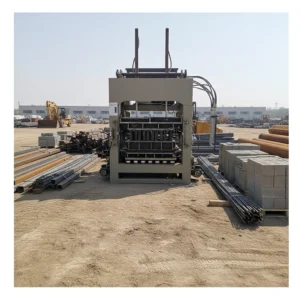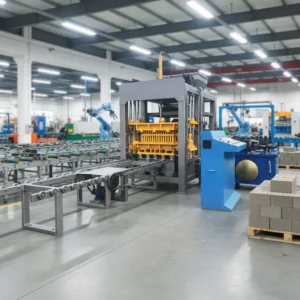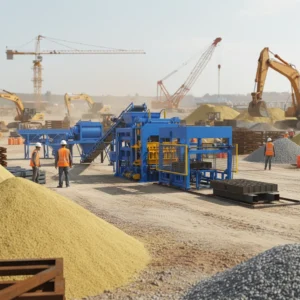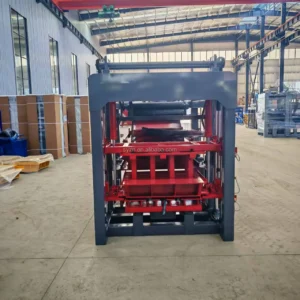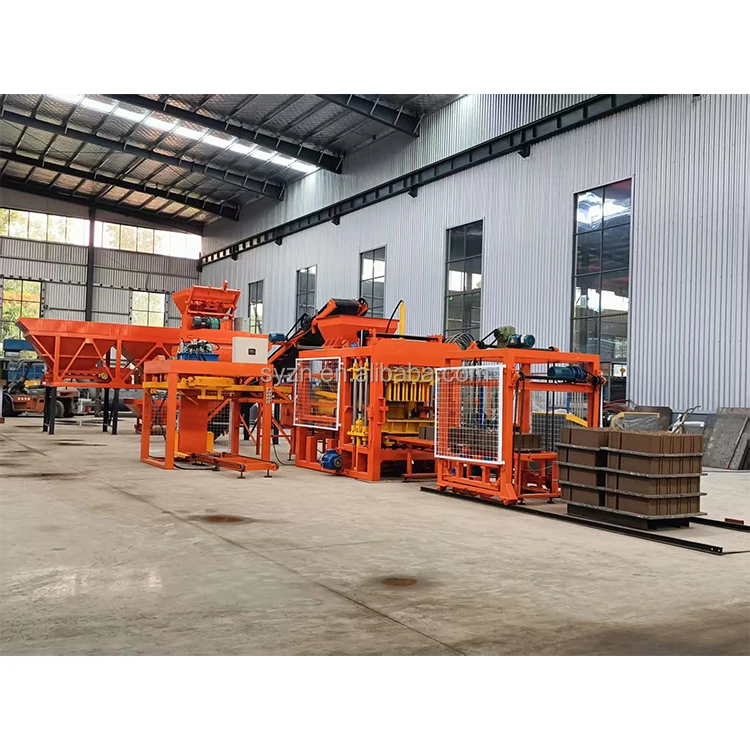
Matched system integration — Every station in the QT6-15 block production line equipment QT6-15 is sized against the press cycle, so upstream feeding and downstream stacking never become the bottleneck that limits real daily throughput.
Technical Specifications
| Parameter | Value |
|---|---|
| Model | QT6-15 |
| Product Type | Hydraulic Block Making Machine |
| Overall Dimensions (L×W×H) | 8200×1700×2950 mm |
| Total Mass | 7 T |
| Overall Power | 37 kW |
| Vibration Form | Platform Vibration |
| Vibration Frequency | 0-60 Hz |
| Vibration Force | 45 kN |
| Moulding Mode | Load automatically, vibration moulding |
| Demolding Method | Hydraulic |
| Pallet Size | 880×850 mm |
| Molding Cycle | 15-20 s (hollow/solid formats); 20-25 s (pavers) |
| Control System | PLC (Programmable Controller) with touch screen interface |
| Hydraulic System | Independent integrated hydraulic station |
| Fault Diagnosis | Built-in fault diagnosis system with action interlock logic |
| Block Compressive Strength | >15 MPa |
| Output Capacity (Hollow block 400×200×200 mm) | 1080-1440 pcs/h, 8640-11520 pcs/8hr |
| Output Capacity (Hollow block 400×150×200 mm) | 1440-1920 pcs/h, 11520-15360 pcs/8hr |
| Output Capacity (Solid brick 240×115×53 mm) | 5760-7680 pcs/h, 46080-61440 pcs/8hr |
| Output Capacity (Rectangular paver 200×100×60 mm) | 2160-2880 pcs/h (basis: 20-25s cycle), 17280-23040 pcs/8hr |
| Output Capacity (Zigzag paver 225×112.5×60 mm) | 2160-2880 pcs/h (basis: 20-25s cycle), 17280-23040 pcs/8hr |
| Factory Area Required | 1200 m² |
| Voltage & Frequency | Configurable to site requirement (basis to be confirmed) |
| PLC Display Language | Multiple options available (basis to be confirmed) |
| Raw Material Adaptability | Waste ash, slag, and various aggregates; cement dosage reducible |
| Warranty | 1 year for whole machine (excluding spare parts) |
Application Suitability
| Application | Material or Output |
|---|---|
| Hollow block production | Crushed stone, sand, cement and fly ash blends for 400×200×200 mm and 400×150×200 mm formats |
| Solid brick manufacturing | Fine aggregate and cement mixes for 240×115×53 mm standard bricks |
| Rectangular paver production | High-density concrete mixes for 200×100×60 mm interlocking paving units |
| Zigzag paver production | Interlocking profile moulding for 225×112.5×60 mm heavy-duty pavement formats |
| On-site contractor block making | Locally sourced waste ash and slag aggregates for project-specific hollow block supply |
| Format expansion for existing plants | Additional paver and kerbstone formats added to an operational hollow block line |
Why the QT6-15 Block Production Line Equipment QT6-15 Must Be Specified as a System, Not a Standalone Press
A block press quoted without its supporting stations will never deliver the cycle rate printed on its nameplate.
I have watched lines where the mixer could not feed fast enough to keep up with a 15-second moulding cycle, leaving the press idle for several seconds every pallet. The press itself was capable, but the line throughput dropped because the raw material feeding and pallet return loop were never matched to the station that actually sets the pace. When buyers focus only on the press specification and treat feeding, stacking and curing as afterthoughts, the entire block production line equipment QT6-15 investment underperforms from day one. [NEED_CITE: line balancing principles for concrete block production]
How Upstream Feeding and Mixing Stations Must Track the Press Cycle
The QT6-15 block production line equipment QT6-15 completes a hollow block moulding cycle in 15-20 seconds, which means the batching and mixing station must deliver a fresh charge of concrete to the hopper within that same window. If the mixer discharge falls behind, the press waits and the theoretical 1080-1440 pieces per hour for 400×200×200 mm hollow blocks drops with every idle pallet. The raw material feeding configuration is therefore specified against the press cycle, not chosen from a catalogue of standard conveyors.
Downstream Pallet Handling and Stacking Synchronisation
Once the press demoulds, the loaded pallet must travel to the stacking station before the next pallet exits. With an 880×850 mm pallet and a 15-second cycle for hollow formats, the conveyor speed and stacker indexing must be calibrated so the press is never blocked. If the automatic stacking station cycles slower than the press, pallets queue on the roller bed and operators end up pulling them off by hand — the exact scenario that defeats the purpose of investing in a fully configured line.
Decoding the Specifications That Determine Line Balance
The 37 kW overall power rating covers the press, hydraulic station and vibration system together, meaning the electrical supply and distribution board must be sized for continuous draw at this level plus the supporting stations. The independent integrated hydraulic station sits apart from the main frame, isolating it from platform vibration and cement dust — a design choice that directly affects uptime across a multi-shift run. Vibration force at 45 kN combined with adjustable 0-60 Hz frequency allows the operator to tune compaction to the specific aggregate blend, which in turn determines whether the blocks reach the >15 MPa compressive strength target without extending the moulding cycle beyond the 15-20 second range. [NEED_CITE: relationship between vibration force and concrete block density]
The Cost of Leaving Supporting Stations Out of the Quotation
When pallet handling, stacking and curing rack systems are not scoped into the block production line equipment QT6-15 order, the buyer discovers after arrival that the press produces faster than the site can absorb. Pallets pile up at the press exit, workers are reassigned from other tasks to move blocks manually, and the curing area becomes a bottleneck because the pallet size was never cross-checked against the rack dimensions already on site. These gaps are not visible in the press specification sheet but they directly determine whether the line runs at its rated capacity or at half of it. [NEED_CITE: hidden costs of incomplete block line specification]
Why Procurement Through a Line-Integrated Supplier Changes the Outcome
Block machinery is the single focus of this operation, so the QT6-15 is configured as a centre station within a matched system rather than assembled from separate vendors. The line layout and capacity calculation state the block format assumed for every throughput figure, giving the buyer a station-by-station verification tool. Mould design covers the formats the buyer’s market actually sells, including custom drawings, and the pallet specification is confirmed against the buyer’s existing curing racks and forklift capacity before production begins. Voltage, frequency and PLC display language are locked in writing during the order stage, preventing the commissioning delays that commonly occur when these details are left to assumption. The automation level is selectable, allowing a buyer to begin with semi-automatic pallet handling and upgrade the stacking and cubing stations as volume grows.
Documentation & Verification
- Line layout drawing showing station-by-station cycle time matching for the QT6-15
- Capacity calculation sheet stating the block format behind each throughput figure
- Pallet specification cross-referenced to buyer’s curing rack and forklift dimensions
- Hydraulic and electrical schematic for the 37 kW system including supporting stations
- Factory test record run on the buyer’s specified block format before dispatch
- Voltage, frequency and PLC language confirmation document signed before production
Installation, Commissioning & Support
- Foundation plan scaled to the 8200×1700 mm footprint and 7 T operating mass
- Electrical supply specification for 37 kW total draw with dedicated circuit requirements
- Dispatch configuration confirmed as assembled or dismantled for container loading
- On-site commissioning with PLC touch screen parameter setup for local block formats
- Operator training covering mould change procedure and fault diagnosis system use
- Wear parts list covering hydraulic seals, vibration springs and mould liner components
What to Prepare Before Requesting a Line Quotation
To configure the QT6-15 block production line equipment QT6-15 against your actual site conditions, the inquiry should include the target block formats and daily output requirement, the local aggregate types available, the factory area dimensions and ceiling height, and the existing forklift and curing rack specifications. If the site already operates upstream or downstream equipment intended to connect with the new press, providing those details allows the line layout to account for every interface point from raw material intake through to cubing.
Frequently Asked Questions
Q: How is the QT6-15 hourly capacity verified for a specific block format, and what happens when formats are mixed in one shift?
A: Each throughput figure in the line layout is tied to a specific format — for example, 1080-1440 pieces per hour assumes the 400×200×200 mm hollow block at a 15-20 second cycle. When a shift mixes hollow blocks with pavers at a 20-25 second cycle, the overall line throughput recalculates station by station, and the quotation includes a blended capacity projection so no station becomes the limiting factor.
Q: Which supporting stations are included in the block production line equipment QT6-15 quotation, and where must cycle times match?
A: The quotation explicitly lists raw material feeding, mixing, pallet feeding, automatic stacking and curing rack handling. Each station’s cycle time is calculated against the press moulding cycle so the mixer discharges within the 15-20 second window and the stacker indexes before the next pallet arrives, preventing queue build-up on the roller conveyor.
Q: How is the 880×850 mm pallet size confirmed against the buyer’s curing area and forklift before ordering?
A: The pallet specification is cross-checked against the buyer’s existing curing rack slot width and forklift fork spacing during the proposal stage. If the curing racks were built for a different pallet dimension, the line layout adjusts the pallet size or recommends rack modification so blocks move from press to curing without manual rehandling.
Q: What voltage, frequency and PLC language options are confirmed before production begins?
A: Voltage and frequency are confirmed in writing based on the buyer’s site electrical supply, and the PLC touch screen language is selected from available options before the machine enters production. This written confirmation prevents the commissioning delays that occur when these parameters are assumed rather than specified.
Q: How is the independent hydraulic station protected from press vibration and dust during continuous line operation?
A: The hydraulic station is mounted separately from the main press frame, isolating it from the platform vibration generated during the 0-60 Hz compaction cycle. The built-in fault diagnosis system monitors action interlock logic across the hydraulic circuit and alerts the operator to anomalies before they escalate into unplanned downtime during multi-shift production runs.