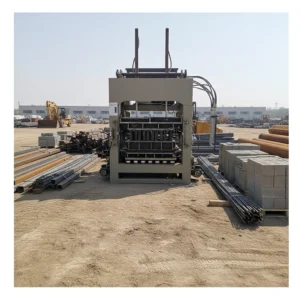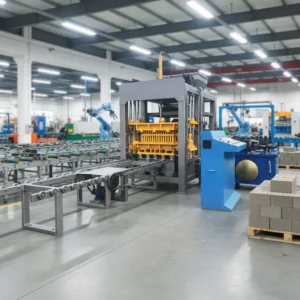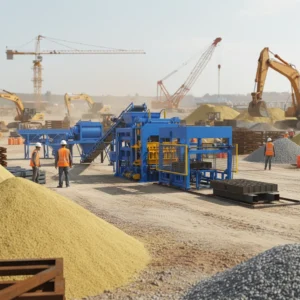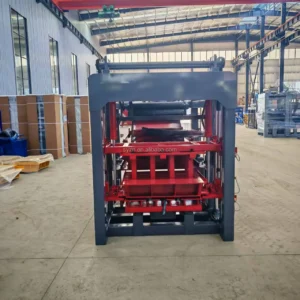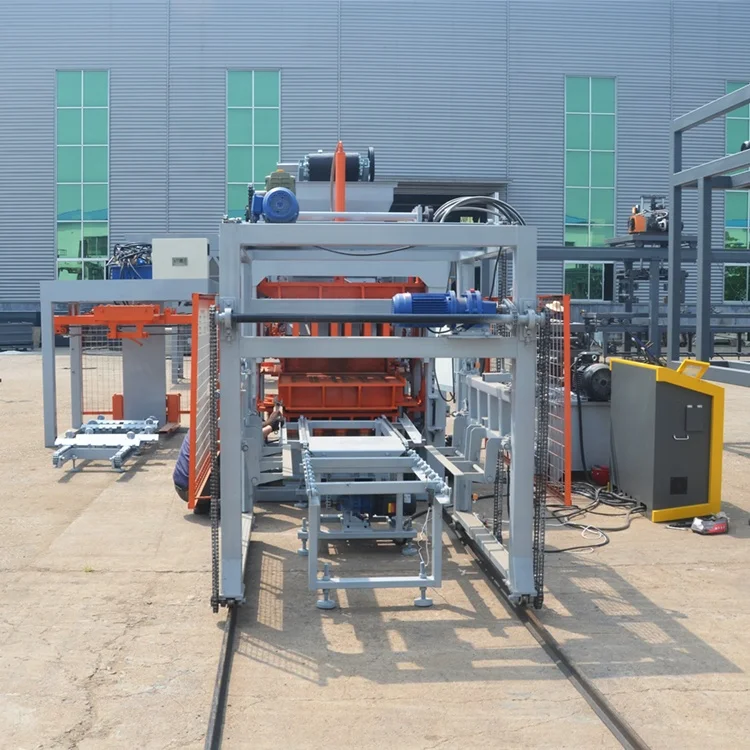
Hydraulic Line Integration — the QT6-15 press is specified alongside raw material feeding, mixing, pallet circulation and stacking stations so the block production line QT6-15 runs without upstream or downstream bottlenecks.
Technical Specifications
| Parameter | Value |
|---|---|
| Model | QT6-15 |
| Product Type | Hydraulic Automatic Block Making Machine |
| Overall Dimensions (L×W×H) | 8200×1700×2950 mm |
| Total Mass | 7 T |
| Vibration Frequency | 0-60 Hz |
| Vibration Force | 45 kN |
| Vibration Form | Platform Vibration |
| Hydraulic System | Independent integrated hydraulic station |
| Demolding Method | Hydraulic |
| Moulding Mode | Automatic loading, vibration moulding |
| Pallet Size | 880×850 mm |
| Molding Cycle | 15-20 s (hollow blocks) / 20-25 s (pavers) |
| Overall Power | 37 kW |
| Control System | PLC controlled with touch screen interface |
| Fault Diagnosis | Included in PLC |
| Block Compressive Strength | >15 MPa |
| Factory Area Required | 1200 m² |
| Automation Level | Automatic (PLC-controlled, auto-loading and vibration moulding) |
| Warranty | 1 year for whole machine (excluding spare parts) |
| Output (400×200×200 mm hollow, 6 pcs/mould) | 1080-1440 pcs/h (basis: 15-20s cycle) |
| Output (400×150×200 mm hollow, 8 pcs/mould) | 1440-1920 pcs/h (basis: 15-20s cycle) |
| Output (240×115×53 mm solid, 32 pcs/mould) | 5760-7680 pcs/h (basis: 15-20s cycle) |
| Output (200×100×60 mm rect. paver, 21 pcs/mould) | 2160-2880 pcs/h (basis: 20-25s cycle) |
| Output (225×112.5×60 mm zigzag paver, 15 pcs/mould) | 2160-2880 pcs/h (basis: 20-25s cycle) |
| Voltage & Frequency | (basis to be confirmed) |
| PLC Display Language | (basis to be confirmed) |
| Stacking Method | (basis to be confirmed) |
| Mould Change Time | (basis to be confirmed) |
Application Suitability
| Application | Material or Output |
|---|---|
| Hollow block production for walls and partitions | Concrete mixes with waste ash, slag, and reduced-cement formulations |
| Solid brick production for structural and non-structural masonry | Crushed stone, sand, and cement blends |
| Rectangular paving block production | High-density concrete with fine aggregate gradation |
| Zigzag interlocking paver production | Cement-reduced mixes with bearing-grade strength |
| On-site contractor block production | Locally sourced aggregate and cement combinations |
Why the Mixer Output Must Keep Up With the Press
A press cycling every 15-20 seconds becomes an expensive idle asset the moment the upstream mixer cannot feed it.
I once stood on a plant floor watching a hydraulic block machine wait forty-five seconds between cycles because the pan mixer two stations over was still blending the next batch. The press rated at a certain output on paper was producing barely half that by the end of the shift. The buyer had selected a high-capacity press and paired it with an undersized mixer, and the gap showed up only once the block production line QT6-15 was running under real conditions. [NEED_CITE: block production line station synchronization requirements]
The same problem appears downstream. If pallet circulation is slower than the press ejection cycle, freshly moulded blocks queue on the table and risk surface damage before reaching the curing racks. Every station in the turnkey block making system must be matched to the press cycle, not to a theoretical maximum.
Matching Raw Material Feeding to the Molding Cycle
The QT6-15 completes a hollow block cycle in 15-20 seconds, which means the batching and feeding station must deliver a finished mix to the hopper within that same window. A belt feeder sized for a slower semi-automatic press will starve this machine. The raw material adaptability — waste ash, slag, and cement-reduced mixes — also means the feeder must handle materials with different flow characteristics; fly ash behaves very differently from crushed sand in a gravity-fed hopper. Specifying the feeder type and capacity alongside the press ensures the block production line QT6-15 never waits for material.
Pallet Circulation and Curing Area Compatibility
The 880×850 mm pallet size dictates how many blocks travel through the line per cycle and how they fit into the curing rack system. A buyer who already owns a fleet of forklifts and a curing yard laid out for a different pallet dimension will face daily handling friction. The pallet material — wood, bamboo, or composite — also affects weight and therefore the load rating of the stacker and the rack structure. Confirming pallet specification before the line enters production prevents a situation where the press output piles up faster than the downstream handling can clear it. [NEED_CITE: pallet size and curing rack coordination in block plants]
How Hydraulic Pressure and Vibration Force Shape Block Density
The 45 kN vibration force works together with the independent hydraulic station to compact the mix into the mould cavity. Vibration alone settles the aggregate; hydraulic pressure applied through the mould head squeezes out trapped air and forces cement paste into voids. The result is a block compressive strength exceeding 15 MPa — but only when the mix design and aggregate gradation suit these specific force values. A mix optimized for a lower-force machine may produce weak, crumbly blocks under this press, while a very stiff mix may not flow into the mould corners before the cycle ends. The PLC-controlled fault diagnosis system monitors hydraulic pressure during each stroke and flags deviations before they produce an entire pallet of substandard output.
What Happens When Line Stations Are Mismatched
Buyers who quote the press alone and add supporting equipment later often discover that the pallet feeder operates at a different speed, the stacker cannot lift a full rack before the next one arrives, or the mixer motor trips under continuous load. The downtime from these mismatches accumulates shift by shift. In plants I have visited, the most common cause of below-target daily output was not the press itself but a single undersized station in the rest of the line. [NEED_CITE: common causes of throughput loss in block production lines]
Why We Specify the Entire Line Together
Shiyue approaches the QT6-15 as the center of a coordinated block production line rather than a standalone sale. The raw material feeding, mixing, pallet circulation, stacking and curing rack handling are proposed as one matched package, with cycle times verified across every station. Mould design covers the formats the buyer’s market actually demands, and custom mould drawings are available when standard formats do not match local building codes. Voltage, frequency and PLC display language are confirmed before production begins, so the touch screen reads the operator’s language on day one. The automation level is selectable — a buyer can start with semi-automatic pallet handling and add full stacking and cubing later without replacing the press. [NEED_CITE: CE machinery directive requirements for industrial block making equipment]
Documentation & Verification
- Line layout drawing with capacity calculation stated per target block format
- Machine specification sheet confirming hydraulic pressure, vibration force and pallet size
- Mould drawing and format list for every block type in the quotation
- Pallet specification matched to buyer’s curing area and forklift capacity
- Voltage, frequency and PLC language confirmation recorded before production
- Factory test record on buyer’s actual mix design and aggregate sample
Installation, Commissioning & Support
- 1200 m² factory area layout with station sequence matched to the 8200×1700 mm press footprint
- 37 kW overall power requirement confirmed against site electrical supply before shipment
- PLC touch screen commissioned in confirmed display language with fault diagnosis activated
- Mould change procedure trained on-site so format switches fit within the shift schedule
- Wear parts list supplied for hydraulic seals and vibration components with reorder lead times
- Operator training covers mix adjustments when local aggregate differs from factory test material
What We Need to Size Your Line Correctly
To configure a block production line QT6-15 that matches your actual output targets, we need your target block format and daily volume, the local raw materials you plan to use, and the dimensions of your available production and curing area. Please also confirm your site voltage, frequency, and preferred PLC display language so the electrical and control systems are built to your specification from the start.
Frequently Asked Questions
Q: How is the capacity per format calculated for the QT6-15, and what block size does the quoted output assume?
A: Each output figure in the specification table is calculated from the molding cycle time and the number of cavities per mould for a specific block format. For example, hollow blocks at 400×200×200 mm use 6 cavities and a 15-20 second cycle. We state the assumed format alongside every capacity number so you can match it to your actual product mix.
Q: Which supporting line stations are included, and where do cycle times need to match?
A: The turnkey block making system proposal covers raw material feeding, mixing, pallet feeding, stacking and curing rack handling. Each station’s cycle time is checked against the press molding cycle so no station becomes a bottleneck. We identify the synchronization points in the line layout drawing before production begins.
Q: How do I confirm pallet size, voltage, frequency and PLC language before the line ships?
A: These parameters are collected during the inquiry stage and recorded in the specification confirmation document. The 880×850 mm pallet size is checked against your existing curing racks and forklifts. Voltage, frequency and PLC language are locked in before the machine enters production so commissioning proceeds without delays.
Q: What factory area is required and how should the line stations be laid out?
A: The QT6-15 requires approximately 1200 m² of factory space. The line layout drawing shows the sequence from raw material intake through pressing, stacking and curing rack transfer, with each station positioned so pallet flow is continuous and forklift travel paths do not cross the production line.
Q: Can the line be upgraded from semi-automatic stacking to fully automatic cubing later?
A: Yes. The automation level is selectable at the time of order, and the PLC control system supports additional station integration. A buyer who starts with manual pallet handling can add automatic stacking and cubing modules in the future without replacing the press or modifying the core hydraulic system.