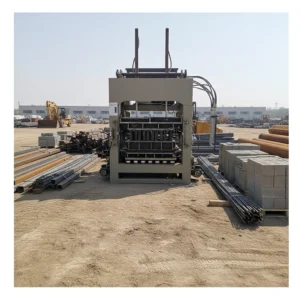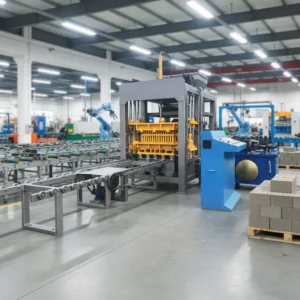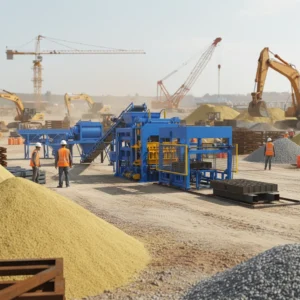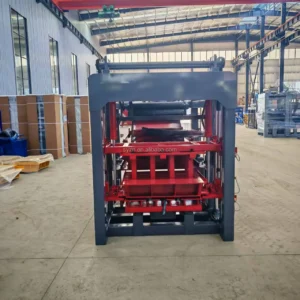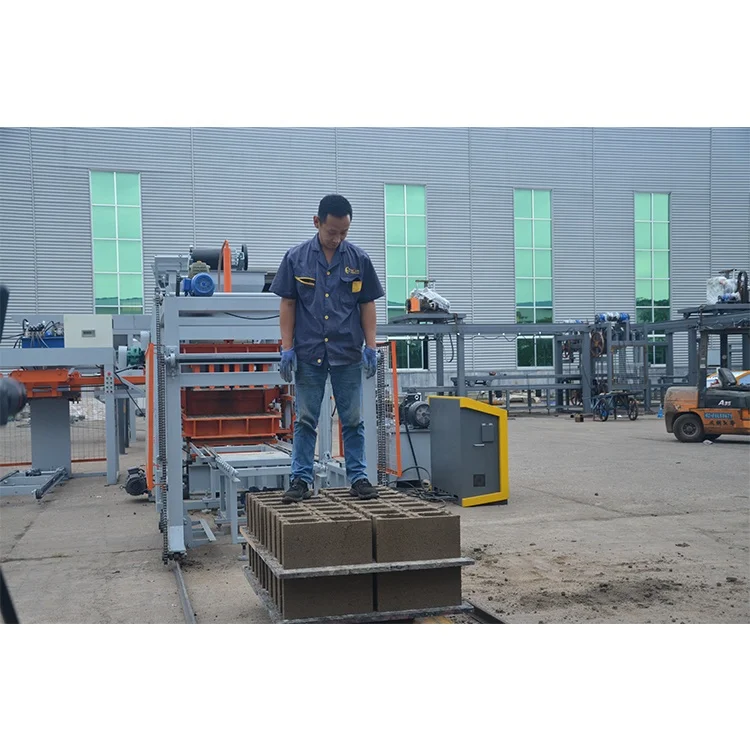
Integrated Line Logic — Every QT6-15 station from mixer to stacker is timed to the press cycle so the hydraulic system never waits on upstream delays.
Technical Specifications
| Parameter | Value |
|---|---|
| Model | QT6-15 |
| Product Type | Automatic Hydraulic Concrete Block Making Machine |
| Overall Dimensions (L×W×H) | 8200×1700×2950 mm |
| Total Mass | 7 T |
| Overall Power | 37 kW |
| Hydraulic System | Independent integrated hydraulic station |
| Vibration Form | Platform Vibration |
| Vibration Frequency | 0-60 Hz |
| Vibration Force | 45 kN |
| Pallet Size | 880×850 mm |
| Moulding Mode | Load automatically, vibration moulding |
| Demolding Method | Hydraulic |
| Molding Cycle | 15-20 s (basis not stated in source — confirm block format) |
| Control System | PLC with touch screen HMI and fault diagnosis |
| Output — Hollow Block 400×200×200 mm | 1080-1440 pcs/h, 6 pcs/mould, 15-20s cycle |
| Output — Hollow Block 400×150×200 mm | 1440-1920 pcs/h, 8 pcs/mould, 15-20s cycle |
| Output — Solid Brick 240×115×53 mm | 5760-7680 pcs/h, 32 pcs/mould, 15-20s cycle |
| Output — Rectangular Paver 200×100×60 mm | 2160-2880 pcs/h, 21 pcs/mould, 20-25s cycle |
| Output — Zigzag Paver 225×112.5×60 mm | 2160-2880 pcs/h, 15 pcs/mould, 20-25s cycle |
| Block Compressive Strength | ≥15 MPa (source value — verify against manufacturer catalog) |
| Factory Area Required | 1200 m² |
| Warranty | 1 year for whole machine (excluding spare parts) |
Application Suitability
| Application | Material or Output |
|---|---|
| Hollow block production for building construction | Crushed stone, sand, cement, waste ash, slag |
| Solid brick production for masonry walls | Local aggregate blended with cement binder |
| Rectangular and zigzag paver production | Fine aggregate with cement for road and landscaping use |
| Interlocking block production | Crusher dust, quarry sand, cement mixes |
| On-site production for housing projects | Locally sourced sand and gravel with Portland cement |
Why the Mixer-to-Press Timing Matters More Than the Press Itself
An automatic block making machine production line is only as fast as its slowest upstream station.
I once stood on a site in West Africa watching a block press sit idle for nine seconds every cycle because the mixer discharge could not keep pace with the hopper demand. The press was rated for a certain cycle, but the line as a whole lost a third of its theoretical output. That gap between press capacity and line throughput is where most production plans fall apart [NEED_CITE: block plant bottleneck analysis in field conditions]. When sizing an automatic block making machine production line, the question is never what the press can do in isolation — it is whether raw material feeding, mixing, and pallet circulation can sustain that pace across a full shift without the operator intervening to clear jams or wait for batches.
Matching Every Station to the Press Cycle
The QT6-15 operates on a 15-20 second molding cycle depending on block format. For this automatic block making machine production line to deliver, the mixer must discharge a full batch into the distribution hopper within that same window. Raw material feeding conveyors must replenish the mixer before the next batch call. If any station lags, the PLC will hold the press — protecting the hydraulic system but cutting daily output. Line configuration here starts from the press cycle backward, setting conveyor speed, mixer batch size, and pallet feed rate so each station hands off exactly when the next one is ready.
Pallet Circulation and Curing Area Alignment
The 880×850 mm pallet is the physical link between the press and everything downstream. Pallets must travel from the press to the stacking station, then to curing racks, and back to the feed magazine — a continuous loop that must match the 15-20 second press cycle. If curing racks are sized for a different pallet dimension, or if the site forklift cannot handle the loaded pallet weight, the entire loop slows [NEED_CITE: pallet handling standards in concrete block plants]. The automatic block making machine production line specification therefore includes pallet material, load rating, and rack compatibility so the circulation loop closes without manual pallet transfers.
Reading the Numbers Behind the Output Claims
The vibration force of 45 kN combined with the independent hydraulic station determines how densely the mix is compacted in the mould. Higher compaction means the block holds its shape during demolding and reaches target compressive strength after curing. The 0-60 Hz adjustable vibration frequency allows the operator to tune the energy input to different mix designs — a wetter mix needs less vibration time, while a dry mix with coarse aggregate demands sustained high-frequency energy. The PLC touch screen stores these parameters per mould, so switching from a 400×200×200 mm hollow block to a 200×100×60 mm paver does not require trial-and-error tuning on the shop floor. Each format runs with its validated cycle from the first piece.
What Happens When Stations Are Mismatched
A line where the stacking station operates slower than the press forces wet blocks to queue on pallets with nowhere to go. Operators start pulling pallets by hand, which defeats the automation investment and introduces handling damage. Similarly, if the raw material feed is configured for a single aggregate type but the buyer needs to run two different mixes across the shift, changeover stops the line entirely [NEED_CITE: aggregate changeover impact on block plant uptime]. These are not press problems — they are line design problems that surface only after installation, when the cost of rework is highest.
What Sets This Line Configuration Apart
Block machinery is the single focus here, which means the press, moulds, pallets, and handling equipment are specified together rather than assembled from separate vendors. The QT6-15 line is configured against the buyer’s actual mix design and local aggregate, not pulled from a catalogue default. Mould design covers the formats the buyer’s market actually sells, with custom drawings when standard cavities do not match. The automation level is selectable — a buyer can begin with semi-automatic pallet handling and add automatic stacking later as volume grows. Installation includes operator training so the PLC parameters are understood, not just set by a visiting technician who leaves before the first full production run.
Documentation & Verification
- Line layout drawing with capacity calculation stated per block format
- Machine specification sheet with hydraulic and electrical schematics
- Mould drawing and format list showing cavity count per product
- Pallet specification covering size, material, and load rating
- Voltage, frequency, and PLC display language confirmation record
- Factory test record on buyer’s target block format before dispatch
Installation, Commissioning & Support
- Foundation plan aligned to the 8200×1700 mm machine footprint and 7 T mass
- Dedicated power circuit sized for the 37 kW total load at confirmed voltage
- Hydraulic station commissioned separately to verify pressure under vibration isolation
- PLC touch screen loaded with confirmed language before the line powers on
- Pallet circulation tested end-to-end against curing rack dimensions on site
- Wear parts and mould list supplied with reorder part numbers for local procurement
Preparing Your Line Inquiry
To move from general interest to a configured line proposal, share the block formats your market demands along with target daily output for each. Include the local aggregate types available and any existing equipment — mixers, forklifts, curing racks — that the new automatic block making machine production line must connect to. Confirming site voltage and the preferred PLC language up front removes the most common commissioning delays.
Frequently Asked Questions
Q: How is line capacity verified and what block format does each output figure assume?
A: Every output number in the specification table is tied to a specific block size, mould cavity count, and cycle time range. The line layout document you receive states the assumed format for each capacity figure, so daily production planning is based on verified data rather than a single best-case number applied across all products.
Q: How do pallet feeding and stacking stations match the press cycle time?
A: Each station is timed to the QT6-15 molding cycle during line configuration. Conveyor speeds, stacker lift rates, and pallet magazine capacity are calculated so no station queues or starves. The result is a continuous loop where the press completes a cycle and the next pallet is already positioned.
Q: How is voltage and PLC language confirmed before shipment?
A: These are locked in writing during the quotation stage. The confirmation record becomes part of the production file, so the electrical cabinet is wired to your site supply and the HMI displays in your operator’s language before the machine leaves the factory floor.
Q: What supporting equipment is included versus sourced separately?
A: The quotation clearly lists every station included — raw material feeding, mixing, pallet circulation, stacking. Items outside the line boundary, such as curing yard construction or external forklifts, are identified so there are no gaps or overlaps when the equipment arrives on site.
Q: Can the automation level be upgraded after initial installation?
A: Yes. The line is designed so stations like pallet feeding and stacking can start in semi-automatic mode and be upgraded with additional sensors and actuators later. The PLC architecture accommodates these additions without replacing the main controller.