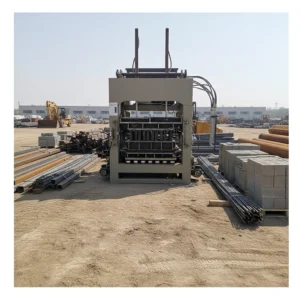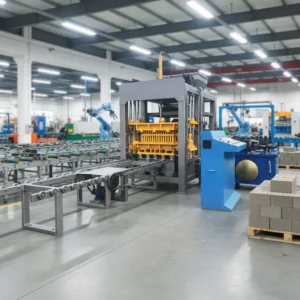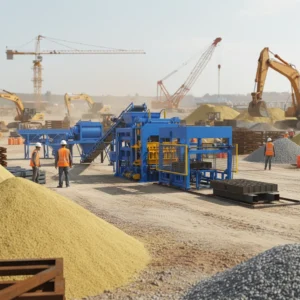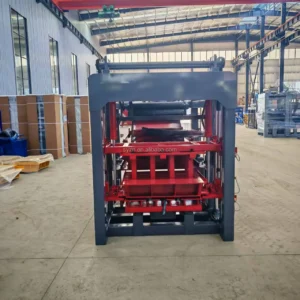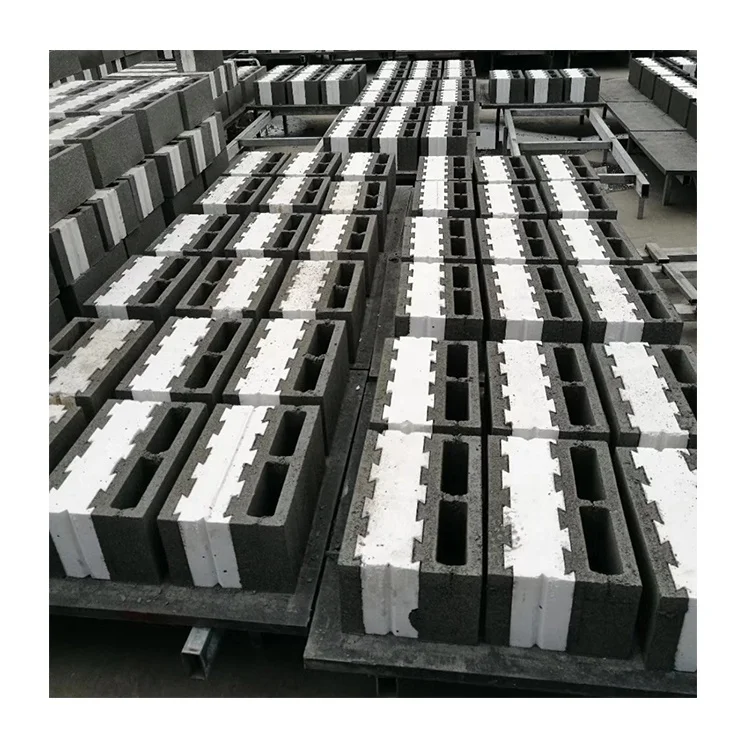
Matched Line Engineering — every station from the JQ350 mixer through to the brick conveyor is timed to the QT6-15 press cycle so material and pallets arrive exactly when the mold box is ready.
Technical Specifications
| Parameter | Value |
|---|---|
| Model | QT6-15 |
| Product Type | Automatic Concrete Block Making Machine |
| Overall Dimensions (L×W×H) | 7400×1900×2660 mm |
| Total Weight | 7 T |
| Molding Cycle | 15–25 s |
| Vibration Frequency | 4600 r/min |
| Vibration Force (Exciting Power) | 40–50 kN |
| Total Power | 31.25 kW |
| Mixer Model | JQ350 |
| Pallet Size | 850×550×25 mm |
| Control System | PLC control system |
| Hydraulic Station | Included |
| Included Line Equipment | Pallet feeder, brick conveyor, block sweeper |
| Applied Products | Paver, solid block, hollow block, curbstone |
| Raw Materials | Crushed stones, sand, cement, dust, fly ash |
| Free Accessories | Manual hydraulic trolley, spare parts and tools |
| Output Capacity (Hollow block 400×200×200 mm) | 1200–1680 pcs/hr, 9600–13440 pcs/8hr |
| Output Capacity (Hollow block 400×150×200 mm) | 1800–2400 pcs/hr, 14400–19200 pcs/8hr |
| Output Capacity (Solid brick 240×115×53 mm) | 3240 pcs/hr, 16200–19440 pcs/8hr |
Application Suitability
| Application | Material or Output |
|---|---|
| Block production plants | Hollow blocks, solid bricks, pavers, and curbstones from crushed stones, sand, and cement |
| On-site construction projects | Localized block manufacturing using available regional aggregates and fly ash |
| Concrete product expansion | Adding new formats like interlocking pavers or kerbstones to an existing range |
| Housing development contractors | High-volume solid brick and hollow block runs for infrastructure and residential builds |
Why the Mixer Often Bottlenecks the Automatic Concrete Block Making Machine Production Line
A 15-second press cycle means nothing if the mixer takes 30 seconds to deliver the next batch.
When planning a block plant, buyers often fixate on the host machine’s vibration force and cycle time. I have seen QT6-15 class machines sit idle for half of every cycle because the upstream material supply could not keep pace. The JQ350 mixer included in this line is sized to match the press rhythm, preventing the material starvation that silently cuts daily throughput in half [NEED_CITE: synchronization of mixer discharge and press cycle times].
Synchronizing Upstream Feeding with the Press Rhythm
The core of a reliable automatic concrete block making machine production line is the handshake between stations. The QT6-15 line integrates a pallet feeder that delivers boards to the press exactly as the previous cycle finishes. If the pallet arrives late, the press waits; if it arrives early, it queues and risks misalignment. This station-to-station timing is calibrated during factory testing to ensure the 15–25 second molding cycle is maintained without manual intervention.
Managing Downstream Flow to Prevent Backlog
Once the block is pressed, it must leave the station immediately to clear space for the next pallet. The included brick conveyor moves wet products away from the press at a rate matched to the output tier. Without this conveyor, or with one that runs too slowly, pallets pile up at the press exit, forcing the operator to halt the automatic concrete block making machine production line manually. The block sweeper further ensures that debris does not accumulate on the return path, keeping the pallet feeder track clear for continuous operation.
Interpreting Vibration and Pressure for Local Aggregates
The 40–50 kN vibration force and 4600 r/min frequency are not arbitrary figures; they are tuned to compact specific mix designs. When working with fly ash or fine sand, the vibration must be sustained long enough to settle the particles, while crushed stone requires higher impact force to lock the aggregate together. The hydraulic station provides the static pressure that holds the mold box steady during this vibration. If the pressure is too low relative to the vibration, the mold lifts slightly and the block top surface becomes uneven [NEED_CITE: hydraulic pressure and vibration force matching for concrete density].
The Cost of Ignoring Line Integration
A common failure in block plant projects is sourcing the press from one supplier and the mixer or conveyor from another, then expecting them to work together seamlessly. When the electrical interlocks are missing, the press may cycle while the mixer is still discharging, causing spillage and inconsistent block weight. I have walked through facilities where the curing rack handling was an afterthought, leaving finished blocks stacked on the floor by hand, completely negating the automation of the press itself [NEED_CITE: hidden costs of unmatched block line components].
Why Sourcing the Full Line Matters
We specify the QT6-15 as a single matched system rather than a collection of standalone machines. The pallet size of 850×550×25 mm is chosen to align with standard curing rack dimensions and forklift tine spacing, ensuring that the transition from press to curing area does not require manual re-stacking. The PLC control system manages the logic for the entire sequence, from raw material feeding to block sweeping, which simplifies troubleshooting since all sensors and motors report to one interface.
Documentation & Verification
- Line layout drawing showing station spacing and material flow path for the QT6-15 footprint.
- Capacity calculation sheet stating the exact block format and cycle time assumed for each output figure.
- Hydraulic and electrical schematics covering the press, mixer, and all conveyor motors.
- Factory test record demonstrating synchronized cycle times across all included stations.
- Pallet specification sheet confirming material grade and dimensional tolerance for the 850×550 mm boards.
Installation, Commissioning & Support
- Foundation plan detailing load-bearing points for the 7 T machine and mixer installation.
- Electrical diagram confirming voltage and frequency requirements for the 31.25 kW total power load.
- On-site assembly guidance for the 7400 mm length and pallet feeder integration.
- PLC parameter setting for the specific molding cycle and vibration frequency of your product.
- Operator training on mold change procedures and daily lubrication of the hydraulic station.
- Wear parts list identifying high-friction components in the mixer and press for inventory planning.
Planning Your Block Line Inquiry
To provide a configuration that matches your site conditions, we need to know your target block formats and the specific raw materials available locally, including aggregate size and moisture content. Please also confirm the voltage and frequency at your facility, as well as the language preference for the PLC display, so the control system is pre-configured before shipment. Finally, details about your existing curing area dimensions and forklift type help us verify that the 850×550 mm pallet size will integrate with your current handling equipment.
Frequently Asked Questions
Q: How is the output capacity verified per block format, and what cycle time is assumed for each?
A: The output figures such as 1200–1680 pieces per hour are based specifically on a 400×200×200 mm hollow block with a standard cycle. For other formats like solid bricks or pavers, the cycle time changes due to different compaction requirements and mold filling volumes. We provide a capacity calculation sheet that lists the realistic hourly and daily output for every specific block type you intend to produce, ensuring no discrepancy between the quote and actual site performance.
Q: Which upstream and downstream stations are included, and where are the gaps the buyer must fill?
A: This line includes the JQ350 mixer, pallet feeder, brick conveyor, and block sweeper, which covers material preparation and immediate product transport. The buyer typically needs to provide the curing racks, forklifts for moving racks to the curing yard, and the raw material storage silos or batching system if not using manual feeding. We clarify these boundaries in the line layout so you know exactly which equipment is required to complete the loop from raw sand to cured block.
Q: How is pallet size chosen to match the curing area and forklift the buyer already has?
A: The 850×550×25 mm pallet size is selected to fit standard curing rack slots and common forklift tine widths used in block plants. If your existing racks or handling equipment use a different dimension, running the standard pallet size would force you to replace your entire curing infrastructure. We confirm your current site dimensions during the inquiry phase to ensure the pallets supplied with the QT6-15 line are compatible with your facility from day one.
Q: How is the mixer capacity matched to the press cycle so material supply never causes idle time?
A: The JQ350 mixer is sized to discharge a batch volume that aligns with the QT6-15 mold box capacity within the 15–25 second cycle window. If the mixer were smaller, the press would wait for material; if it were significantly larger, energy would be wasted and material might begin to set before pressing. We calculate the mix volume and discharge time against your specific block density and format to ensure the material flow is continuous and synchronized.