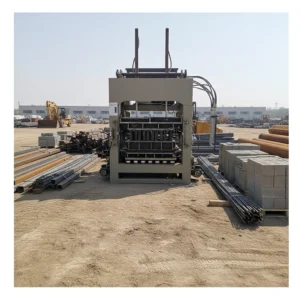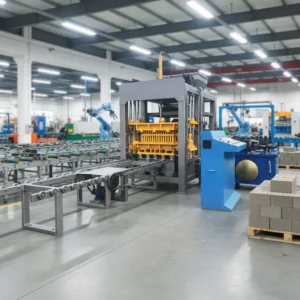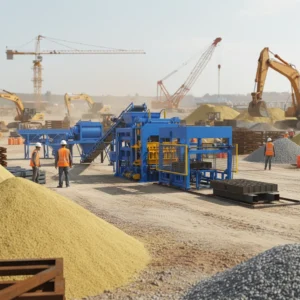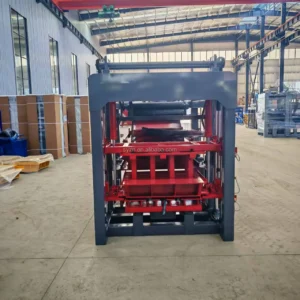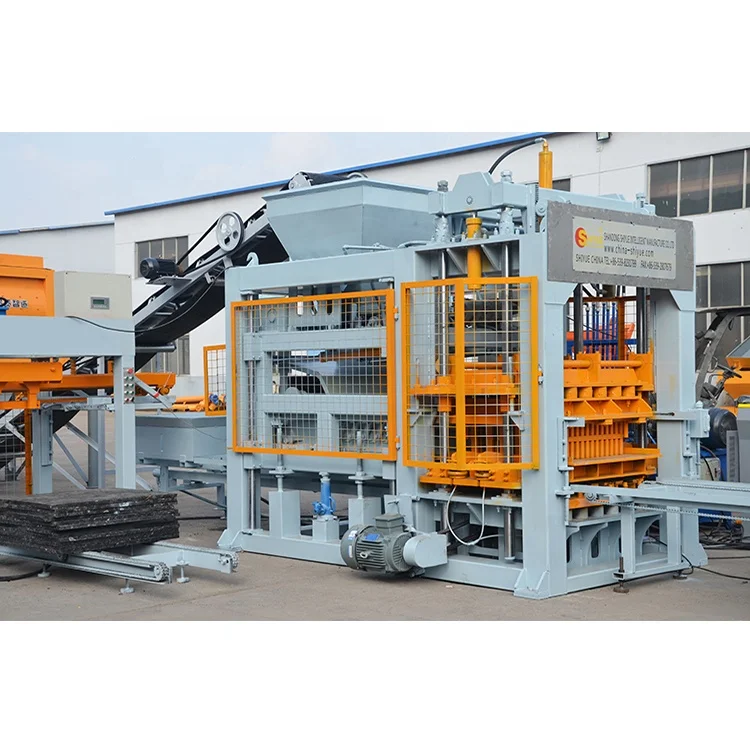
Matched Station Flow — every feeder, mixer and conveyor in the QT6-15 line is timed against the 15-20s press cycle so the block machine never idles waiting for upstream material or downstream pallet clearance.
Technical Specifications
| Parameter | Value |
|---|---|
| Model | QT6-15 |
| Product Type | Automatic Hydraulic Concrete Block Making Machine |
| Overall Dimensions (L×W×H) | 8300×1860×3000mm |
| Molding Cycle | 15-20s |
| Vibration Force | 55kN |
| Rated Power | 37.2kW |
| Mixer | JS750 |
| Pallet Size | 1020×900mm |
| Total Weight | 8T |
| Applied Products | Paver, solid block, hollow block, curbstone |
| Raw Materials | Crushed stone, sand, cement, dust, fly ash |
| Control System | PLC control system |
| Hydraulic Station | Included |
| Pallet Feeder | Included |
| Block Conveyor | Included |
| Block Sweeper | Included |
| Material Feeder | Included |
| Automation Level | Automatic |
| Output Capacity | 6 pcs/mould (basis not stated in source — confirm block format / material / thickness) |
| Key Features | Hydraulic station, pallet feeder, block conveyor, block sweeper, material feeder integrated |
Application Suitability
| Application | Material or Output |
|---|---|
| Hollow block production for building walls | Crushed stone, sand, cement, fly ash |
| Solid block manufacturing for load-bearing structures | Cement, sand, crushed stone, dust |
| Paver production for walkways and yards | Cement, sand, fine aggregate |
| Curbstone forming for road and driveway edges | Cement, crushed stone, sand |
What Buyers Miss When They Only Price the Press
A block press without its surrounding stations is a bottleneck waiting to happen.
I have watched a plant owner in West Africa receive a high-quality block machine, set it on the floor, and then spend the next month sourcing a mixer, rigging a pallet feed, and hiring four workers just to move wet blocks to the curing yard. The press sat idle most of those weeks. When the automatic block making machine production line is quoted as a turnkey package, those gaps close before the container leaves the factory [NEED_CITE: typical block plant commissioning delays caused by missing ancillary equipment].
Station Synchronization Across the QT6-15 Line
The JS750 mixer batches enough material per cycle to feed the press hopper before the next mold closes. The material feeder meters that mix into the mold box at a rate matched to the 15-20s molding window. Downstream, the block conveyor carries loaded pallets away at a pace that prevents queue backup at the press exit. Each station in this automatic block making machine production line is wired into the same PLC, so a fault at any point pauses the whole sequence rather than letting half-finished pallets pile up.
Pallet Flow and the Hidden Idle Time
A 1020×900mm pallet leaves the press every 15-20 seconds. If the pallet feeder cannot strip and return an empty pallet within that window, the press skips a cycle. The included pallet feeder is timed to return pallets just ahead of the press ready signal, removing the most common cause of micro-stops. Block sweeper heads clear debris before the pallet re-enters the mold zone, keeping block dimensions consistent across the shift [NEED_CITE: pallet return cycle impact on block press uptime].
Reading the Numbers That Actually Matter on Site
The 55kN vibration force works together with the hydraulic station to compact the mix — vibration loosens the aggregate while hydraulic pressure locks it in place. If either value is too low for the buyer’s specific sand and cement ratio, block strength drops noticeably. The 37.2kW rated power covers the press, mixer, conveyor and feeder motors running simultaneously; a site transformer undersized for that total draw will trip during start-up. The 8T machine weight requires a cured concrete slab rated for point loads at the press feet, not just a general floor loading figure. Molding cycle of 15-20s shifts depending on block height and mix workability — taller hollow blocks sit at the longer end of that band.
The Cost of Leaving Stations to Chance
When a buyer sources the mixer locally to save on the invoice, its batch size rarely matches the press cycle, forcing the press to wait. Undersized conveyors jam under wet block weight, and mismatched pallet dimensions mean the curing racks already on site cannot accept the output. Each of these mismatches stalls production after arrival and the fixes always cost more than including the station in the original order [NEED_CITE: ancillary equipment mismatch costs in block plant startups].
Why Source the Whole Line Here
Block machinery is the single focus at Shiyue, so the QT6-15 press, JS750 mixer, pallet feeder and block conveyor are specified as one matched system rather than assembled from separate suppliers. The configuration is set against the buyer’s actual mix design, local aggregate and target block format, not a catalogue default. Mould design covers the formats the buyer’s market sells, including custom drawings when a standard mold does not fit. Automation level is selectable, letting a buyer start with the included pallet feeder and add a stacker later. Installation support includes operator training on the PLC so the crew can read fault codes from day one.
Documentation & Verification
- Line layout drawing showing station spacing for the 8300mm press footprint
- Capacity calculation stating the block format assumed per station throughput
- Hydraulic and electrical schematic confirming PLC I/O wiring between stations
- Pallet specification matched to buyer’s curing rack slot width and forklift fork length
- Factory test record run on the buyer’s sample aggregate before dispatch
- Voltage, frequency and PLC display language confirmation sheet signed before production
Installation, Commissioning & Support
- Concrete foundation pad poured to handle the 8T point load at press anchor bolts
- Dedicated three-phase circuit sized for the 37.2kW total connected load including JS750 mixer
- Press, mixer and conveyor arrive dismantled; reassembly sequence detailed in the manual
- PLC language set and cycle times verified on-site during first-week commissioning visit
- Operator training covers mold change, pallet feeder adjustment and fault code reading
- Wear parts list identifies hydraulic seals and vibrator springs with reorder part numbers
Before You Send the Inquiry
Share the block formats your market moves fastest — hollow, solid, paver or curbstone — along with the daily volume target for each. Tell us your local sand type and whether fly ash or crushed dust is available, plus the curing yard dimensions and forklift capacity you already run. We will map each station in the automatic block making machine production line to those figures and return a layout you can walk through before anything is built.
Frequently Asked Questions
Q: How is each line station’s cycle time matched to the QT6-15 press so no station becomes a bottleneck?
A: The JS750 mixer batch volume, material feeder gate speed and block conveyor belt rate are each calculated against the 15-20s molding cycle. The PLC links all stations so if one slows, the upstream stations pause instead of overflowing. We provide a timing diagram in the proposal showing each station’s cycle relative to the press.
Q: What pallet size and material are specified, and how do they align with existing curing areas?
A: The standard pallet is 1020×900mm, sized to match common curing rack slots and forklift fork widths. Bamboo, PVC and steel pallet options are available. Before production we confirm your rack spacing and fork length so pallets move straight from press to curing yard without re-handling.
Q: Which block formats share the 1020×900mm pallet, and what is the realistic daily output per format?
A: Hollow blocks, solid blocks, pavers and curbstones all mold on this pallet size. Output per shift varies by block height and mix design — taller hollow blocks use the longer end of the 15-20s cycle. We supply a capacity table in the quotation showing pieces per hour for each specific format you plan to run.
Q: How are raw material feed and JS750 mixer capacity sized against the press cycle?
A: The JS750 holds enough batch volume to supply the mold box across consecutive cycles without the mixer running continuously. Material feeder gate opening is tuned to the buyer’s aggregate gradation during factory testing, so the mix reaches the mold at the right moisture and consistency every time.
Q: What upstream and downstream equipment can be added to complete the line further?
A: Beyond the included stations, buyers can add automatic stackers, curing rack handlers and cubing systems as volume grows. The PLC has reserved I/O channels so these additions plug in without rewiring the main cabinet. We quote each upgrade against the existing line layout to confirm floor space and pallet flow direction.