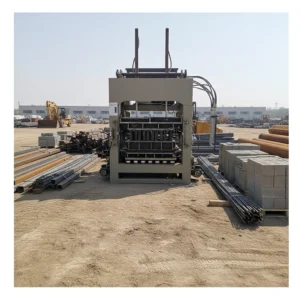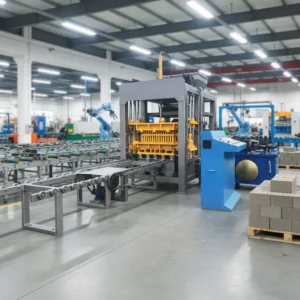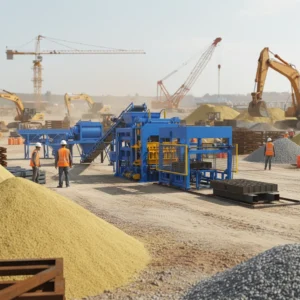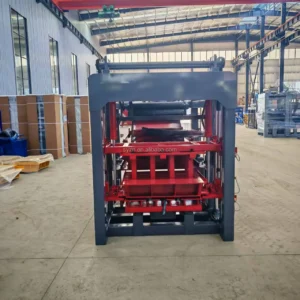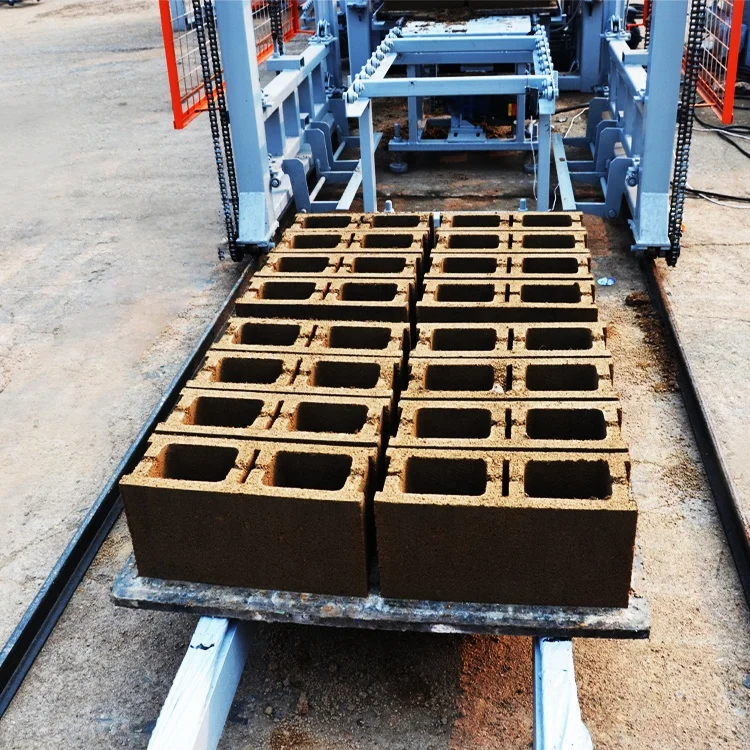
Matched Line Timing — Every supporting station from mixer to stacker is specified against the press cycle time so the automatic block making machine production line never sits idle between moulding strokes.
Technical Specifications
| Parameter | Value |
|---|---|
| Model | QT6-15 |
| Product Type | Automatic Hydraulic Block Making Machine |
| Overall Dimensions (L×W×H) | 8200 × 1700 × 2950 mm |
| Total Mass | 7 T |
| Overall Power | 37 kW |
| Vibration Force | 45 kN |
| Vibration Frequency | 0–60 Hz |
| Vibration Form | Platform Vibration |
| Moulding Mode | Automatic loading, vibration moulding |
| Demolding Method | Hydraulic |
| Pallet Size | 880 × 850 mm |
| Molding Cycle | 15–20 s |
| Control System | PLC with touch screen HMI |
| Hydraulic System | Independent integrated hydraulic station |
| Output — Hollow 400×200×200 mm | 1080–1440 pcs/h (8640–11520 pcs / 8 hr shift) |
| Output — Hollow 400×150×200 mm | 1440–1920 pcs/h (11520–15360 pcs / 8 hr shift) |
| Output — Solid Brick 240×115×53 mm | 5760–7680 pcs/h (46080–61440 pcs / 8 hr shift) |
| Output — Rectangular Paver 200×100×60 mm | 2160–2880 pcs/h (17280–23040 pcs / 8 hr shift) |
| Output — Zigzag Paver 225×112.5×60 mm | 2160–2880 pcs/h (17280–23040 pcs / 8 hr shift) |
| Block Compressive Strength | ≥ 15 MPa |
| Automation Level | High — automatic loading, PLC process control, fault diagnosis |
| Factory Area Required | 1200 m² |
| Warranty | 1 year (excluding spare parts) |
Application Suitability
| Application | Material or Output |
|---|---|
| Hollow block production for load-bearing and partition walls | Crushed stone, sand, cement, waste ash or slag blends |
| Solid brick manufacturing for masonry | Standard cement-aggregate mix designs |
| Rectangular and interlocking paver production | Cement, fine aggregate, pigment layers |
| Mid-to-high capacity concrete product lines | Multi-format output with pallet-based curing |
| On-site production for housing and development projects | Local aggregate adapted to project specifications |
Why "Pieces per Hour" Means Nothing Without the Rest of the Line
The press only holds cycle time if every upstream and downstream station delivers on schedule.
I once watched a client run a mid-range hydraulic press that quoted a fast moulding cycle on paper. The mixer feeding it was undersized, so the press sat idle waiting for material every stroke. Pallets were moved by hand because the return conveyor was never included in the quotation. The automatic block making machine production line lost thousands of blocks per shift — not because the press was slow, but because nobody planned the stations around it [NEED_CITE: common output losses from mismatched supporting equipment in block plants].
Timing Every Station to the Press Cycle
The QT6-15 moulds at 15–20 seconds per stroke. That number only matters if the mixer discharges a fresh batch into the hopper before the next cycle begins, and if the pallet feeder places a clean pallet under the mould box without delaying demolding. When we spec an automatic block making machine production line, the raw material feeder, mixer capacity, pallet return speed, and stacking interval are all calculated against this cycle window. A station that runs even a few seconds late compounds across hundreds of cycles and silently erodes daily output.
Pallet Flow and Curing Rack Coordination
Each moulding cycle consumes one 880 × 850 mm pallet. Across an eight-hour shift producing hollow blocks, that means thousands of pallet movements through the press, into the curing area, and back to the feeder. The pallet specification must align with the forklift and curing rack dimensions already on site, or pallets pile up at transfer points. Stacking and rack handling equipment is included in the line layout so that wet blocks move directly from the press to the curing zone without manual intervention [NEED_CITE: pallet handling standards for concrete block curing areas].
Reading the Specs That Actually Determine Output
Vibration force and hydraulic pressure work together to compact the mix into a dense block before demolding. The QT6-15 delivers 45 kN of platform vibration at frequencies adjustable from 0–60 Hz, paired with an independent integrated hydraulic station that isolates the hydraulic circuits from the main frame vibration. This separation extends seal and hose life across long production shifts. The PLC control with touch screen HMI manages the loading, vibration, and demolding sequence, including fault diagnosis that alerts the operator before a minor fault becomes a line stoppage. Pallet size at 880 × 850 mm determines how many blocks fit per stroke and must be cross-checked against the buyer’s existing curing racks.
The Hidden Cost of Quoting the Press Alone
When a quotation lists only the press, the buyer discovers after delivery that pallets must be loaded by hand, stacking is done manually, and the curing area has no rack system. Labour costs climb, and the line never reaches its stated output because workers cannot keep pace with the press. Voltage and frequency left unconfirmed at order stage can delay commissioning for weeks while transformers or motor replacements are sourced locally [NEED_CITE: commissioning delays from unconfirmed electrical specifications in imported machinery].
Why Buyers Spec the Whole Line Here
Block machinery is our single focus, so the QT6-15 is never shipped as a standalone press. The mixer, pallet feeder, stacker, and curing rack handling are specified as one matched system, each timed to the 15–20 second moulding cycle. Configuration is set against the buyer’s actual mix design and local aggregate, not a catalogue default. Mould design covers the formats the buyer’s market actually sells, with custom drawings available. Automation level is selectable — a buyer can start with semi-automatic pallet handling and add stacking later. Factory testing runs the full line sequence before dispatch, so cycle timing is verified against the stated block format.
Documentation & Verification
- Line layout with capacity calculation stating the exact block format for each output figure
- Machine specification sheet covering the QT6-15 press and every supporting station
- Hydraulic and electrical schematics with voltage and frequency confirmed per buyer site
- Pallet specification cross-referenced to the buyer’s curing rack and forklift dimensions
- Factory test record showing full line cycle timing before shipment
- Wear parts list and mould drawing set included with packing photographs
Installation, Commissioning & Support
- Foundation plan sized for the 8200 × 1700 mm press footprint and 7 T operating mass
- Power supply layout confirming the 37 kW total load and dedicated circuit requirements
- PLC display language and voltage confirmed in writing before the control panel is wired
- On-site assembly of the independent hydraulic station and vibration platform with alignment checks
- Full line commissioning with operator training on mould change, fault diagnosis, and daily maintenance
- Wear parts and mould replacement schedule provided at handover for long-term production continuity
Before You Request a Quote
To size the automatic block making machine production line accurately, we need to know the block formats you plan to produce, your target daily output per format, and the raw materials available locally including aggregate type and any ash or slag blends. Please confirm your site voltage and frequency, the pallet and curing rack system you already have or plan to build, and whether your current facility has space within the 1200 m² footprint requirement.
Frequently Asked Questions
Q: How is the daily output of the QT6-15 calculated, and which block format is each figure based on?
A: Every output figure in the specification sheet is tied to a specific block dimension and moulding cycle. For example, hollow blocks at 400×200×200 mm are rated at 1080–1440 pieces per hour based on the 15–20 second cycle. We provide a written capacity calculation that states the exact format, cycle time, and shift length assumed, so there is no ambiguity about realistic daily production.
Q: Which supporting stations must be matched to the press cycle time?
A: The raw material feeder, mixer discharge rate, pallet feeder, automatic stacker, and curing rack handler all need to align with the 15–20 second moulding stroke. If any station runs slower, the press waits and output drops. We specify each station as part of the line so timing is verified during factory testing before shipment.
Q: How do we confirm voltage, frequency, and PLC language before the line is built?
A: These are confirmed in writing during the order stage, before the electrical cabinet is assembled. The PLC touch screen HMI is configured to the buyer’s preferred language, and the motor and control wiring are built to the site voltage and frequency. This prevents commissioning delays once the line arrives at the destination port.
Q: What raw material mixes can the QT6-15 run, and can it handle local ash or slag blends?
A: The press is configured for waste ash, slag, and standard cement-aggregate mixes. Vibration frequency and hydraulic pressure are adjusted during commissioning to match the buyer’s specific mix design and local aggregate properties. This ensures consistent block density and compressive strength at or above 15 MPa across different material sources.
Q: What documentation arrives with the line for installation and long-term maintenance?
A: Buyers receive the line layout, capacity calculation per format, hydraulic and electrical schematics, pallet specification, factory test record, operation and maintenance manual, wear parts list, and mould drawings. Packing photographs are issued before shipment, and customs documentation support is provided to clear the equipment smoothly at destination.