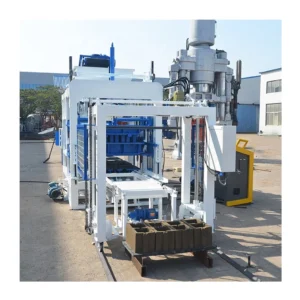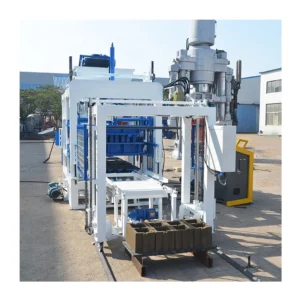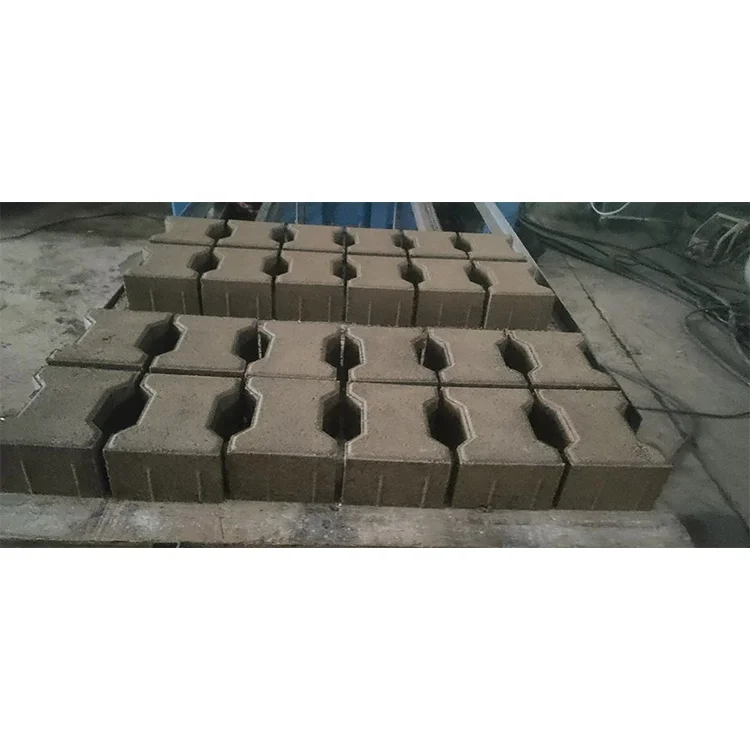
Balanced Line Integration — every upstream feeder, pallet conveyor and downstream stacker is timed against the QT5-15 press cycle so no station sits idle between strokes.
Technical Specifications
| Parameter | Value |
|---|---|
| Model | QT5-15 |
| Product Type | Hydraulic Concrete Block Making Machine |
| Overall Dimension | 7400 × 1950 × 2800 mm |
| Total Mass | 6 T |
| Rated Pressure | 21 MPa |
| Main Vibration Form | Platform Vibration |
| Vibration Frequency | 2800–4500 r/min |
| Vibration Force | 40 KN |
| Pallet Size | 1100 × 550 mm |
| Molding Cycle | 15–20 s |
| Demolding Method | Hydraulic |
| Control System | PLC intelligent control with man-machine interface, fault diagnosis system, remote control function |
| Applied Products | Concrete blocks, hollow/solid blocks, pavers, interlocking blocks, curbstone, colored pavers |
| Raw Materials | Crushed stone, sand, cement, dust, fly ash, gravel, slag |
| Factory Area | 600 m² |
| Output Capacity (Hollow brick 400×200×200 mm) | 5 pcs/mold, 7200–9600 pcs/day (based on 15–20 s cycle) |
| Output Capacity (Porous brick 240×115×90 mm) | 16 pcs/mold, 23040–28800 pcs/day (based on 16–20 s cycle) |
| Output Capacity (Standard brick 240×115×53 mm) | 32 pcs/mold, 61440–70892 pcs/day (based on 13–15 s cycle) |
| Voltage & Frequency | Configurable to buyer’s local grid (basis to be confirmed) |
| PLC Display Language | Selectable (basis to be confirmed) |
| Stacking Method | Configuration-dependent (basis to be confirmed) |
Application Suitability
| Application | Material or Output |
|---|---|
| Hollow block production for load-bearing walls | Crushed stone, sand, cement with fly ash or slag |
| Interlocking paver manufacturing for driveways and walkways | Colored concrete mixes with fine aggregate |
| Curbstone and kerb production for road projects | High-strength concrete with gravel and cement |
| Solid block output for partition and boundary walls | Sand, cement, dust and local stone aggregate |
| Porous brick runs for permeable pavement systems | Graded aggregate blends with controlled cement content |
What "Cycles Per Hour" Leaves Out of Your QT5-15 Block Making Machine Production Line
The press rate is only one station — the real daily tonnage depends on whether the pallet return, mixer discharge and stacking conveyor keep pace.
I once stood in a block yard watching a well-tuned press push out pallets faster than two workers could carry them to the curing racks. The rhythm broke every six minutes because the upstream mixer was still batching the next load, and the whole line lost roughly a third of its nameplate capacity before lunch. That gap between catalogue cycle time and actual throughput is where most buyers lose money. When the QT5-15 block making machine production line is laid out on paper, every conveyor length, pallet count and mixer batch weight must be reconciled against the 15–20 second molding window. [NEED_CITE: line balancing methods in concrete product manufacturing]
How Upstream Batching Feeds the Press Without Pausing
A 21 MPa hydraulic press with platform vibration demands a steady, predictable flow of mixed material into the hopper. If the mixer discharge gate opens late or the raw material feeding belt stalls, the QT5-15 block making machine production line drops into an idle wait that no PLC fault code will flag as a production loss. We size the mixer drum and belt width so the batch completes inside the molding cycle, giving the hopper a continuous supply even when mold formats change between runs.
Pallet Circulation and Curing Rack Alignment
The 1100 × 550 mm pallet is the physical link between press output and the curing area. Choosing pallet material and thickness without checking the forklift tine spacing or curing rack slot width leads to double-handling on day one. We map pallet travel from the feeding station through the press, onto the wet-product conveyor and into the rack system so each pallet completes its loop within the target cycle. [NEED_CITE: pallet material selection for concrete block curing]
Reading the Specs That Actually Shape Daily Output
Platform vibration at 2800–4500 r/min works together with the 21 MPa rated hydraulic pressure to compact the mix against the mold walls; too little pressure and the block edges crumble on demolding, too much and fine aggregate is forced out leaving voids. The 40 KN vibration force must be matched to the buyer’s aggregate gradation — a coarse gravel blend needs different amplitude than a fly-ash-heavy mix. Pallet size 1100 × 550 mm defines how many blocks ride per stroke, and that area multiplied by the cycle time gives the honest hourly figure per format, not a generic cycles-per-hour claim. Total mass of 6 T indicates the structural steel gauge in the frame, which matters when vibration resonance travels through a thin floor slab. The PLC with fault diagnosis and remote control function lets one operator watch mixer level, press pressure and conveyor speed from a single screen, catching a belt slip before it starves the hopper.
The Hidden Cost of Ignoring Downstream Stations
Leaving stacking and curing rack handling off the purchase order seems to save budget at the signature line, but the press then runs at the pace of the slowest manual pallet carrier. Workers fatigue, pallets pile up at the exit conveyor, and by afternoon the 15–20 second cycle stretches into 30 seconds of waiting. Block surface damage from hand stacking adds a further reject layer that never appears in the factory test record. [NEED_CITE: manual versus automatic pallet handling in block plants]
Why Line Buyers Source the Complete Setup Here
Block machinery is the single focus of this supply chain, so the press, mold, pallet and handling equipment are specified as one matched system rather than assembled from unrelated vendors. Every configuration is set against the buyer’s actual mix design and local aggregate, not a catalogue default. Molds are designed and supplied for the exact block formats the buyer’s market sells, including custom drawings when a housing project calls for a non-standard interlocking profile. Automation level is selectable — a buyer can start with manual pallet return and add automatic stacking later without replacing the press. Installation and commissioning support includes operator training on the PLC interface so the crew can read fault codes and adjust cycle parameters from the first shift.
Documentation & Verification
- Line layout drawing with capacity calculation stated per block format
- Machine specification sheet covering hydraulic pressure and vibration ratings
- Mold drawing and format list matching your market product range
- Pallet specification matched to your curing rack and forklift dimensions
- Voltage and control language confirmation signed before production starts
- Factory test record showing cycle time and block strength per format
Installation, Commissioning & Support
- 600 m² factory area requirement verified against your site plot and floor slab thickness
- Voltage and frequency confirmed to local grid before the PLC and motor wiring are finalized
- Machine dismantled into press frame, hydraulic unit and conveyor modules for container loading
- On-site reassembly with hydraulic pressure set to 21 MPa and vibration frequency tuned to your aggregate
- PLC display language set to operator preference and fault diagnosis walkthrough during training
- Wear parts and mold list provided so first replacements are on-site before they are needed
What We Need From You to Size the Line
Send the block formats you plan to run daily, the target output per format, and the aggregate and cement sources available locally. We also need your site voltage, frequency, and the language your operators will use on the PLC screen. If you already own forklifts or curing racks, share the dimensions so pallet size can be locked before production.
Frequently Asked Questions
Q: How is line capacity calculated and which block format does each figure assume?
A: Every output figure ties back to a specific mold and cycle time. Hollow bricks at 400×200×200 mm are rated at 7200–9600 pieces per day based on a 15–20 second cycle with 5 pieces per mold. Standard bricks at 240×115×53 mm are rated at 61440–70892 pieces per day based on a 13–15 second cycle with 32 pieces per mold. We state the format so you can compare against your actual market mix.
Q: Which upstream and downstream stations are included in the quotation?
A: The standard scope covers raw material feeding, mixing, pallet feeding, the press itself, and wet-product conveying. Automatic stacking, curing rack handling and cubing are configurable add-ons. We list each station line-item so you see exactly where manual labor remains and where automation takes over.
Q: How are cycle times balanced so the press is never left idle?
A: We calculate mixer batch volume and belt conveyor speed against the 15–20 second molding cycle. Pallet return conveyor length and pallet inventory are sized so a fresh pallet reaches the press before the next stroke. If one station runs slower, we flag it in the line layout before the order is confirmed.
Q: What pallet size and material are specified and do they match my yard?
A: The standard pallet is 1100 × 550 mm, chosen to align with common curing rack slots and forklift tine widths. Material — bamboo, PVC or steel — is selected based on your curing method and climate. We confirm pallet spec against your existing yard equipment before the order enters production.