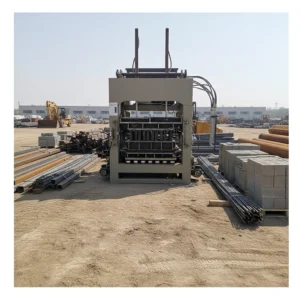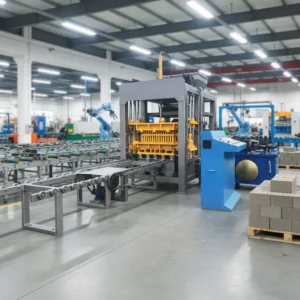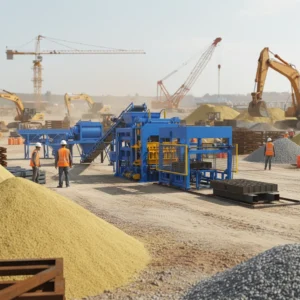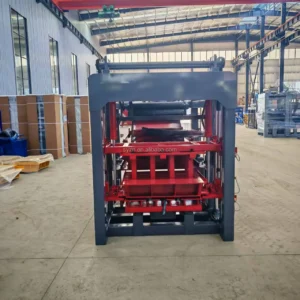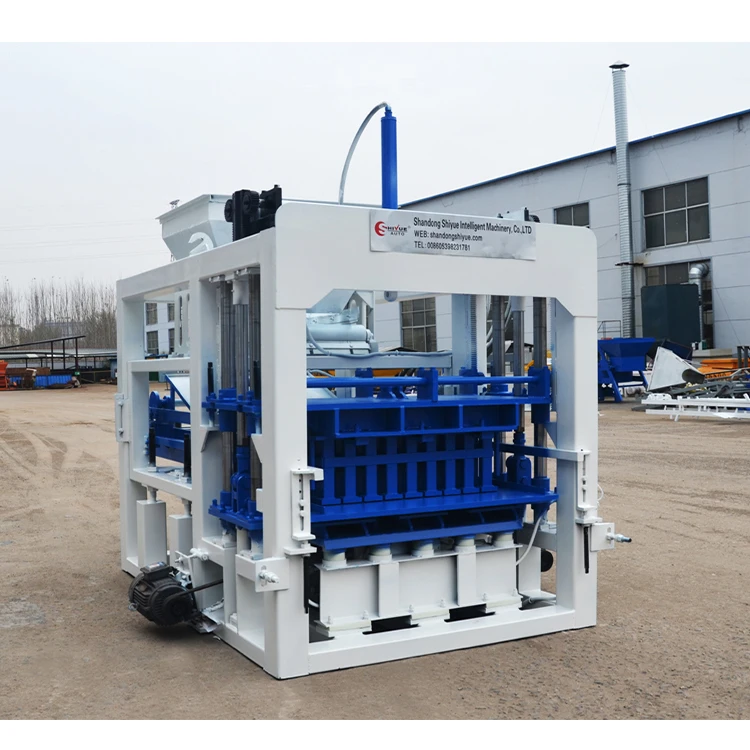
Matched system design — every station from raw material feed to curing rack is timed to the QT5-15 press cycle so no single point chokes daily output.
Technical Specifications
| Parameter | Value |
|---|---|
| Model | QT5-15 |
| Product Type | Automatic Cement Block Making Machine |
| Overall Dimensions (L×W×H) | 7400 × 1950 × 2800 mm |
| Total Mass | 5000 kg |
| Overall Power | 32 kW |
| Vibration Force | 80 kN |
| Vibration Frequency | 0–60 Hz |
| Vibration Form | Platform Vibration |
| Moulding Mode | Automatic loading, vibration moulding |
| Demolding Method | Hydraulic |
| Pallet Size | 1100 × 550 mm |
| Molding Cycle | 15–20 s |
| Hydraulic System | Independent integrated hydraulic station |
| Control System | PLC with touch screen interface |
| Block Compressive Strength | ≥ 15 MPa |
| Recommended Factory Area | 1000 m² |
| Raw Material Compatibility | Fly ash (up to 70%), slag, gangue, sand, crushed stone, cement, water |
| Output — Hollow Block 400×200×200 mm | 7200–9600 pcs/8hr (5 pcs/mould, 15–20 s cycle) |
| Output — Hollow Block 400×150×200 mm | 8640–11520 pcs/8hr (6 pcs/mould, 15–20 s cycle) |
| Output — Solid Brick 240×115×53 mm | 46080–61440 pcs/8hr (32 pcs/mould, 15–20 s cycle) |
| Output — Rectangular Paver 200×100×60 mm | 28800–36000 pcs/8hr (25 pcs/mould, 20–25 s cycle) |
| Output — Zigzag Paver 225×112.5×60 mm | 18432–23040 pcs/8hr (16 pcs/mould, 20–25 s cycle) |
Application Suitability
| Application | Material or Output |
|---|---|
| Hollow block production for masonry walls | Crushed stone, sand, cement with fly ash or slag addition |
| Solid brick manufacturing | Sand and cement blend with gangue or industrial residue |
| Rectangular and zigzag paver production | Fine aggregate and cement for high-density paving units |
| On-site block production for housing projects | Locally sourced sand, crushed stone and cement |
| Building material plant expanding product range | Multiple formats from one press with mould change |
What a Quoted Cycle Time Actually Means for Your Daily Output
A press rated at 15–20 seconds per cycle only reaches that figure when pallet feeding, material dosing and block stacking keep pace without interruption.
Buyers routinely receive a quotation showing the press cycle alone and assume daily volume follows directly. In practice, if the pallet return loop takes longer than the press cycle, the host machine sits idle every few strokes. I have watched a West African plant lose the equivalent of two thousand blocks before lunch because the pallet conveyor was never included in the scope and workers were dragging boards back by hand [NEED_CITE: typical pallet circulation time vs press cycle in block lines]. When the supporting stations are specified as one matched automatic block machine production line, the 15–20 second cycle translates into the output table above. When they are not, the real number is whatever the slowest manual station allows.
How Station Timing Governs the Press Cycle
The QT5-15 press completes one moulding stroke in 15–20 seconds, but the full sequence demands a pallet arrive, material dose into the mould box, vibration and hydraulic compaction finish, and the finished block exit — all within that window. The PLC coordinates pallet feeding, material dosing, vibration onset and demoulding as one continuous sequence. If any station runs late, the controller holds the press, and throughput drops proportionally. This is why the automatic block machine production line must be quoted with every conveyor and feeder included, not assembled from separate orders after the press arrives.
Pallet Circulation as the Real Bottleneck
Pallet size is 1100 × 550 mm, chosen to match the curing rack spacing and forklift capacity already present on site. When pallets are specified without regard to the curing area, boards pile up at the end of the line because there is no rack to receive them, and workers resort to hand stacking. A matched turnkey block making system includes the pallet feed machine, return conveyor and stacking station so boards loop back to the press without manual intervention [NEED_CITE: pallet return loop design in block production]. The result is a continuous flow where the press never waits for the next board.
Reading the Numbers Behind the Output Table
Vibration force at 80 kN and platform vibration at 0–60 Hz determine how densely the mix is compacted, which directly sets block compressive strength at ≥ 15 MPa. The hydraulic station is physically separated from the vibration zone to keep oil temperature and valve response stable through a full shift, preventing pressure drift that would otherwise weaken later blocks. Pallet dimensions at 1100 × 550 mm also dictate how many blocks fit per board — five for a 400×200×200 mm hollow block, thirty-two for a standard solid brick — so the per-mould count in the output table is a function of both pallet area and block footprint. An independent hydraulic circuit means the system can maintain consistent demoulding speed regardless of which format is running, keeping cycle time within the 15–20 second band.
What Missing Line Equipment Costs in Practice
When supporting equipment is left out of the initial order, the buyer typically adds it later at higher cost and longer lead time. A mixer purchased separately may not match the dosing speed the press demands, causing the mould box to underfill and produce undersized blocks. Pallets ordered from a local supplier often arrive in the wrong thickness, jamming the return conveyor. I have seen plants where the curing rack was never specified, so finished blocks sat on the ground absorbing moisture and cracking before they reached strength [NEED_CITE: curing conditions effect on early block strength]. Every one of these gaps turns a quoted automatic block machine production line into a collection of mismatched stations.
Why Sourcing the Full Line From One Supplier Matters
Block machinery is our single focus, so the QT5-15 press, mould, pallet and handling equipment are specified as one matched system rather than assembled from separate suppliers. Configuration is set against the buyer’s actual mix design and local aggregate, not a catalogue default. Mould design covers the formats the buyer’s market actually sells, including custom drawings to buyer specifications. Automation level is selectable, allowing a buyer to start with semi-automatic pallet handling and add stacking later. Installation includes on-site commissioning with operator training so the line reaches its rated cycle time from the first production run.
Documentation & Verification
- Line layout showing every station with cycle time per format
- Machine specification sheet matching the shipped configuration
- Hydraulic and electrical schematic for on-site maintenance
- Factory test record on buyer’s selected block format before dispatch
- Pallet specification matched to curing rack and forklift dimensions
- Voltage and PLC language confirmation signed before production
Installation, Commissioning & Support
- 1000 m² factory area with level concrete slab and drainage for the full line
- 32 kW total power supply with dedicated circuit breaker at buyer’s confirmed voltage
- Press and supporting stations shipped assembled for rapid line connection
- PLC touch screen configured in buyer’s language before commissioning
- Operator training on mould change, pallet loop and daily maintenance schedule
- Wear parts list covering hydraulic seals, vibration springs and mould liners
Before You Request a Quote
To size the complete line accurately, we need the block format you plan to sell, your daily volume target, and the raw materials available locally. Share your site voltage, frequency and the PLC display language your operators require. Let us know the curing area dimensions and forklift capacity already on site so pallet flow is designed around your existing infrastructure.
Frequently Asked Questions
Q: How are cycle times balanced across every station so the press is never left waiting?
A: Each feeder, conveyor and pallet return loop is timed against the 15–20 second press cycle during line design. The PLC coordinates the full sequence so material dosing, pallet arrival and block exit happen within the same window, preventing idle strokes.
Q: What supporting equipment is included in the line quotation?
A: The quotation covers pallet feed machine, storage hopper, conveyor, hydraulic unit and PLC control cabinet as one turnkey block making system. Raw material mixing and curing rack handling are specified if the buyer requests them, with clear scope boundaries noted.
Q: How is pallet size matched to the buyer’s existing curing setup?
A: The 1100 × 550 mm pallet is checked against the buyer’s curing rack spacing and forklift tine width before production. This ensures boards move from press to rack to stacking without a secondary handling step or manual repositioning.
Q: What factory area and utilities does the complete line require?
A: The recommended area is 1000 m² to accommodate the press, pallet circulation loop, raw material storage and curing zone. A 32 kW power supply with confirmed voltage and frequency is required, along with water access for mix preparation.