
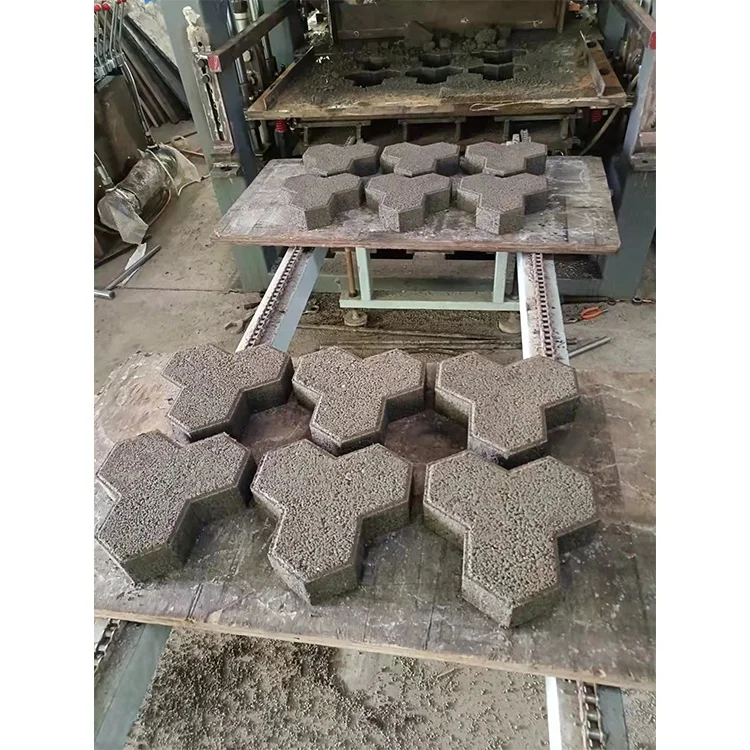
Integrated line balance — QT5-15 press, JS500 mixer, pallet feeder and brick conveyor are specified as one system, so cycle times align across stations instead of each unit running at its own pace.
Technical Specifications
| Parameter | Value |
|---|---|
| Model | QT5-15 |
| Product Type | Automatic Hydraulic Block Making Machine |
| Overall Dimensions (L×W×H) | 7100 × 1600 × 2610 mm |
| Total Weight | 5 T |
| Total Power | 33.5 kW |
| Molding Cycle | 15 s (basis not stated in source — confirm block format) |
| Vibration Frequency | 0–60 Hz |
| Vibration Force | 40 kN |
| Pallet Size | 1100 × 550 mm |
| Mixer Model | JS500 |
| Control System | PLC control system |
| Hydraulic Station | Included, high-pressure |
| Automation Level | Fully automatic |
| Included Line Equipment | Block making machine, hydraulic station, PLC control system, pallet feeder, brick conveyor, block sweeper |
| Applied Products | Paver, solid block, hollow block, curbstone |
| Raw Materials | Crushed stones, sand, cement, dust, fly ash |
| Output — Hollow Block 400×200×200 mm | 5 pcs/mould, 450 pcs/h, 3600 pcs/8 hr |
| Output — Hollow Block 400×150×200 mm | 6 pcs/mould, 540 pcs/h, 4320 pcs/8 hr |
| Output — Solid Brick 400×100×200 mm | 8 pcs/mould, 720 pcs/h, 5760 pcs/8 hr |
| Free Accessories | Manual hydraulic trolley, spare parts and tools |
Application Suitability
| Application | Material or Output |
|---|---|
| Hollow block production for wall construction | Crushed stone, sand, cement, fly ash — formats 400×200×200 mm and 400×150×200 mm |
| Solid brick manufacturing | Cement-based mixes with local aggregate, 400×100×200 mm format |
| Paver and interlocking block production | Crushed stone and sand blends for pedestrian and vehicular surfaces |
| Curbstone forming | High-density concrete mixes for roadside and drainage kerbs |
| On-site block production for housing projects | Locally sourced sand and crushed stone with cement binder |
Why the Pallet Feeder Question Matters Before You Sign
A block press that outpaces its pallet supply is a block press standing idle half the shift.
I have walked into plants across Southeast Asia where the automatic block making machine production line was rated for hundreds of blocks per hour, yet the pallet station was a manual bench at the end of the conveyor. Operators scrambled to slide pallets into position, the press waited, and half-cured blocks piled up on the belt until they cracked under their own weight. The quotation listed a fast cycle time, but nobody asked how pallets would keep up [NEED_CITE: common mismatch between press cycle and pallet handling speed in small block plants].
Station-to-Station Timing Across the QT5-15 Line
The QT5-15 automatic block making machine production line is configured so that the JS500 mixer discharge rate, pallet feeder indexing speed, and press cycle are calculated against each other before the line ships. If the mixer dumps a batch faster than the press can consume it, material stiffens in the hopper. If the press cycles faster than the feeder can deliver a fresh pallet, the press pauses and the stated output drops. Each station is therefore timed to the slowest realistic step in the sequence, not to a catalogue peak.
How the Conveyor and Sweeper Close the Loop
Once the press releases a loaded pallet, the brick conveyor carries it away at a speed matched to the mould cycle so the next pallet can enter without collision. The block sweeper clears residual material from the pallet surface before it returns to the feeder, preventing buildup that would tilt the next brick and cause uneven curing. Together these stations form a continuous loop that the PLC monitors in real time, flagging any station that falls behind before a bottleneck becomes a pile of broken green blocks [NEED_CITE: PLC coordination of multi-station block lines].
Reading the Specs That Actually Shape Your Output
The 40 kN vibration force works in tandem with the hydraulic station to compact the concrete mix inside the mould cavity; vibration liquefies the mix while hydraulic pressure squeezes out air voids, and both must be matched to your specific aggregate size and cement ratio. The 1100 × 550 mm pallet size determines how many cavities fit per cycle and must match the forklift tine spacing and curing rack dimensions already in your yard. The JS500 mixer carries a batch volume sized so one discharge fills the press hopper for roughly one mould cycle, avoiding the situation where a larger mixer dumps a full load that sits and begins to set before the press is ready. Voltage and frequency — which vary widely across export markets — must be confirmed before production starts, because rewiring a 33.5 kW control panel on site is neither quick nor cheap [NEED_CITE: voltage and frequency standards by export market].
The Cost of Ignoring Line Balance
I once visited a plant in Java where the owner bought a fast press but kept his old gravity mixer. The mixer could not feed the hopper quickly enough, so the press ran at roughly half its cycle rate for most of the morning. The owner blamed the press manufacturer, but the real gap was the mixer-to-press handoff that no one had calculated. When stations are sourced from different suppliers without a shared timing sheet, each vendor delivers equipment that meets its own spec — and the line as a whole underperforms. Pallets stack up, green blocks crack, and the daily tally falls well short of what the quotation promised [NEED_CITE: block plant throughput loss from unsynchronized equipment].
Why Buyers Source the Full Line Here
Block machinery is the sole focus of SHIYUE’s production floor, so the QT5-15 press, JS500 mixer, pallet feeder, brick conveyor, and block sweeper are built and tested together rather than assembled from unrelated vendors. Configuration starts from your actual mix design and local aggregate, not a catalogue default, which means vibration force and hydraulic pressure are set to match what you can actually source. Pallet size is confirmed against your curing area and forklift before the pallet feeder is fabricated. Mould options cover the hollow block, solid brick, paver, and curbstone formats your market actually buys, with custom drawings available for non-standard sizes. The automation level is selectable, so a buyer starting with semi-automatic pallet handling can plan an upgrade path without replacing the press.
Documentation & Verification
- Line layout drawing showing station spacing and capacity per block format
- Machine specification sheet with confirmed voltage, frequency, and PLC language
- Hydraulic and electrical schematic covering the full line from mixer to conveyor
- Factory test record run on your target block format before dispatch
- Mould drawing and format list matching your market requirements
- Packing photographs and customs documentation support for export
Installation, Commissioning & Support
- Foundation plan aligned with the 7100 × 1600 mm press footprint and 5 T operating weight
- Dedicated power circuit sized for 33.5 kW total draw with confirmed voltage and frequency
- Machine dismantled for container loading and reassembled on site with alignment checks
- PLC parameters set against your block format and mould during first commissioning run
- Operator training covering mould change, pallet feeder adjustment, and daily maintenance points
- Wear parts and hydraulic seal list supplied for first replacement order
What to Include in Your Inquiry
To size this automatic block making machine production line correctly, share your target block format and daily volume, the aggregate and sand you can source locally, and your existing curing area dimensions. Confirm the voltage, frequency, and preferred PLC display language at your site. If you already have forklifts or curing racks, provide their specifications so the 1100 × 550 mm pallet system can be verified for compatibility.
Frequently Asked Questions
Q: How are line stations synchronized so the press cycle is not bottlenecked?
A: The JS500 mixer discharge rate, pallet feeder index speed, and brick conveyor belt speed are each set against the QT5-15 mould cycle time. The PLC monitors all stations and pauses the press if any upstream or downstream station falls behind, preventing pile-ups and green block damage.
Q: Which stations are included and which need separate specification?
A: The quotation covers the block making machine, hydraulic station, PLC system, pallet feeder, brick conveyor, and block sweeper. Automatic stacking, curing rack handling, and cubing systems are separate items that can be added once your curing layout is confirmed.
Q: How does the 1100 × 550 mm pallet size affect my existing setup?
A: Pallet dimensions must match your curing rack spacing and forklift tine width. If your yard already uses a different pallet size, the feeder and press tooling can be reviewed before production to avoid incompatibility after the line arrives on site.
Q: How is the JS500 mixer output matched to the QT5-15 press demand?
A: The JS500 batch volume is calculated so one discharge fills the press hopper for approximately one mould cycle. This prevents material from sitting in the hopper too long and beginning to set, which would reduce block density and increase waste.
Q: When must voltage, frequency, and PLC language be confirmed?
A: These must be locked before production starts. Changing the electrical configuration or PLC language after the control panel is wired requires component replacement and rewiring, which delays shipment and adds cost at the factory.



