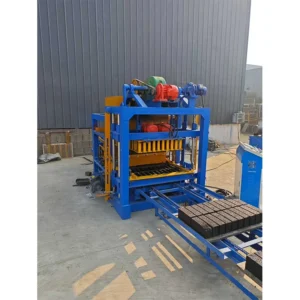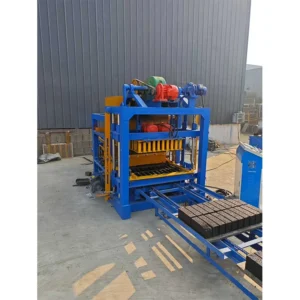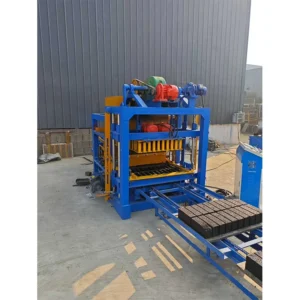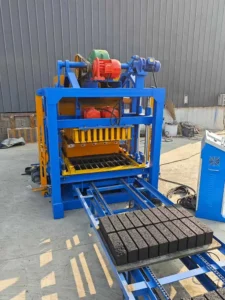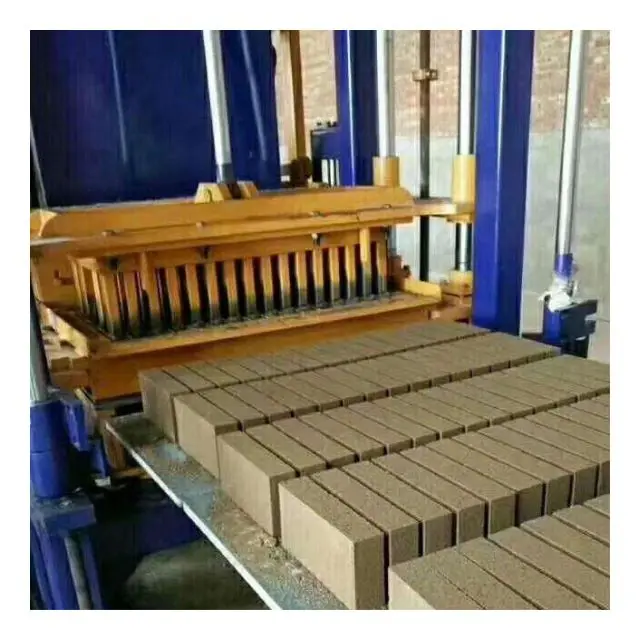
Single-Focus Line Design — The QT5-15 automatic block machine production line is specified as one matched system where press, mixer, conveyor and pallet feeder cycle times are verified together before quotation, preventing the bottleneck traps that occur when stations are sourced separately.
Technical Specifications
| Parameter | Value |
|---|---|
| Product Type | Automatic Concrete Block Making Machine |
| Model | QT5-15 |
| Overall Dimensions (L×W×H) | 7400 x 1950 x 2800 mm |
| Vibration Form | Platform Vibration |
| Vibration Frequency | 4500-5100 RPM |
| Brick Height Range | 50-200 mm |
| Pallet Size | 1100 x 550 mm |
| Molding Cycle | 15-20 s |
| Rated Power | 30.5 kW |
| Net Weight | 6200 kg |
| Control System | PLC with touch screen interface, safety logic interlocking, built-in fault diagnosis |
| Hydraulic System | Independent integrated hydraulic pump station |
| Output Capacity | 1200 pcs/h (based on 400×200×200mm hollow block, 5 pcs/mold) |
| Output Capacity | 1437 pcs/h (based on 400×150×200mm hollow block, 6 pcs/mold) |
| Output Capacity | 2880 pcs/h (based on 240×115×90mm porous brick, 16 pcs/mold) |
| Output Capacity | 7680 pcs/h (based on 240×115×53mm solid brick, 32 pcs/mold) |
| Output Capacity | 2000 pcs/h (based on 225×112.5×60mm interlocking paver, 16 pcs/mold) |
| Output Capacity | 4800 pcs/h (based on 200×100×60mm paver, 20 pcs/mold) |
| Raw Materials | Fly ash, cinder, coal gangue, river sand, gravel, cement, industrial waste residue |
| Compressive Strength of Output | ≥15 MPa |
| Key Features | Optional color material feeding machine; full automatic intelligent electronic control; independent hydraulic pump station isolated from vibration |
Application Suitability
| Application | Material or Output |
|---|---|
| Hollow block production for building walls | Crushed stone, river sand, cement and fly ash mixes |
| Solid brick manufacturing for load-bearing masonry | Gravel, coal gangue and cement blends |
| Paving block and kerbstone production for roads | High-density aggregate and cement formulations |
| Interlocking and grassing brick for landscaping | Permeable aggregate mixes with optional pigment feed |
| Porous brick for thermal insulation walls | Lightweight industrial waste residue and cement |
| Slope protection brick for civil engineering | Heavy aggregate blends requiring high compressive strength |
What the Quoted Capacity Figure Hides About Your Turnkey Block Making Line
The press cycle is only one station in the chain; if the mixer discharge or pallet feeder runs slower, the real daily output of your automatic block machine production line falls well below the brochure number.
A buyer once showed me a block plant where the press was rated for a strong cycle time, yet the pallet feeder could not return pallets fast enough. The press sat idle between cycles, and the line produced barely half its nameplate capacity. That mismatch was not visible on the quotation because the pallet station was listed as optional. [NEED_CITE: typical mismatch between quoted press cycle and actual line throughput in block production]
When sourcing an automatic block machine production line, the honest question is not how fast the press cycles in isolation, but whether every upstream and downstream station can sustain that pace across a full shift. The QT5-15 line approach addresses this by stating the molding cycle at 15-20 seconds and checking the mixer batch size, belt conveyor speed and pallet return loop against that same window.
How Stations Connect Across the QT5-15 Line
The host machine operates on a 15-20 second molding cycle, but that figure only holds if the mixer delivers a fresh batch and the pallet feeder places a clean pallet within the same window. On the QT5-15 automatic block machine production line, the mixer capacity and conveyor belt speed are sized so the press hopper never starves between cycles, and the pallet return loop clears finished blocks before the next mold drops.
The PLC touch screen coordinates these stations through safety logic interlocking. If the pallet feeder jams or the mixer hopper level drops below threshold, the press pauses rather than cycling empty, protecting both the mold and the hydraulic system from damage that would otherwise go unnoticed until the next shift.
Where Bottlenecks Actually Form in a Block Plant
Most turnkey block making line shortfalls trace back to one station running slower than the press expects. The pallet size on the QT5-15 is 1100 x 550 mm, which dictates the curing rack spacing, the forklift tine width and the stacking pattern on the curing floor. If the curing area was planned around a different pallet dimension, pallets pile up at the press exit and the line chokes within the first hour. [NEED_CITE: common pallet sizing mismatches in concrete block curing yards]
Raw material flow is the other hidden constraint. The QT5-15 handles fly ash, cinder, coal gangue, river sand and gravel, but each material has a different bulk density and moisture sensitivity. The mixer must be configured for the specific blend the buyer sources locally; a mixer tuned for dry sand will stall on wet fly ash, and the press will wait for material that never arrives on time.
Reading the Specs That Actually Shape Your Output
The platform vibration frequency of 4500-5100 RPM works with the independent hydraulic pump station to compact the mix into the mold cavity. Higher vibration frequency improves surface finish on pavers, but hollow blocks need sustained hydraulic pressure through the full cycle to reach the rated compressive strength of ≥15 MPa. The QT5-15 hydraulic station sits isolated from the host vibration, which preserves seal life and pressure consistency across consecutive shifts — a detail that matters when the line runs two shifts and the hydraulic temperature climbs.
The 1100 x 550 mm pallet size is fixed by the machine frame, and it governs how many blocks fit per mold cavity. At 5 cavities for a 400×200×200mm hollow block, the line produces 1200 pcs/h based on that format. Switch to a 240×115×53mm solid brick at 32 cavities, and the same press cycle yields 7680 pcs/h based on that smaller format. The difference is not a speed change but a mold cavity count change, and both figures assume the supporting stations keep pace.
The PLC control with built-in fault diagnosis logs alarms when a station drifts outside its expected cycle window. Rather than guessing why output dropped, the operator reads the fault code on the touch screen and traces it to the specific sensor or valve, cutting troubleshooting from hours to minutes.
The Cost of Skipping the Line-Level Check
When a buyer specs only the press and sources the mixer, conveyor and pallet feeder separately, each supplier delivers equipment that works perfectly on its own. The problem surfaces only when the stations are wired together and the cycle times do not align. Retrofitting a faster pallet feeder or a wider conveyor after installation means pulling cable, pouring new foundations and rewriting PLC logic — work that costs more than specifying the line correctly in the first place. [NEED_CITE: cost of retrofitting mismatched stations in block production lines]
Voltage and frequency mismatches add another layer. If the local supply is confirmed late, the motor windings and PLC power supply may arrive wrong, delaying commissioning by weeks while replacement components ship.
Why Buyers Spec the Whole Line Through One Source
The QT5-15 line is configured against the buyer’s actual mix design and target block format, not pulled from a catalogue default. Each station — press, mixer, conveyor, pallet feeder — is selected so the 15-20 second cycle holds under real material conditions.
Mold design covers the formats the buyer’s market actually sells, from 400×200×200mm hollow blocks to 200×100×60mm pavers, and custom mold drawings are supported when standard formats do not match local demand. The pallet specification is checked against the buyer’s existing curing racks and forklift before production begins.
Automation level is selectable, so a buyer can start with semi-automatic pallet handling and add an automatic stacker later without replacing the press or the PLC. The integrated hydraulic station and vibration system are matched to the buyer’s local aggregate, ensuring block strength meets the ≥15 MPa target without excess cement usage.
Documentation & Verification
- Line layout drawing with capacity calculation stated per block format and cavity count
- Pallet specification sheet cross-referenced to your curing rack spacing and forklift dimensions
- Hydraulic and electrical schematics showing station interlocks and sensor positions
- Factory test record on your target block format and local raw material blend before dispatch
- Voltage, frequency and PLC display language confirmation document signed before production
- Wear parts and mold list with part numbers for first-year replacement planning
Installation, Commissioning & Support
- Foundation plan sized to the 7400 x 1950 mm machine footprint and 6200 kg operating weight
- Power supply circuit rated for 30.5 kW with voltage and frequency confirmed to your site standard
- Machine arrives in modular sections for container loading and on-site reassembly
- First-run commissioning covers mold alignment, hydraulic pressure setting and PLC language verification
- Operator training on touch screen fault diagnosis, mold changeover and daily lubrication points
- Wear parts inventory recommendation based on your target block format and production volume
What to Include With Your Inquiry
To size the QT5-15 automatic block machine production line accurately, share your target block format with dimensions, the daily output you need for that specific format, and the raw materials available locally including aggregate type and moisture range. Confirm your site voltage, frequency and preferred PLC display language so the electrical package is built correctly before shipping. If you have existing curing racks or forklifts, send the pallet dimensions they accept so the 1100 x 550 mm pallet can be verified or adapted.
Frequently Asked Questions
Q: How is the line capacity verified, and which block format does each output figure assume?
A: Every output figure on the QT5-15 is tied to a specific block format and cavity count. For example, 1200 pcs/h assumes a 400×200×200mm hollow block with 5 cavities per mold, while 7680 pcs/h assumes a 240×115×53mm solid brick with 32 cavities. The line layout document states the assumed format for each number so you can verify daily throughput against your actual product mix before committing to purchase.
Q: Which stations are included in the quotation, and which are priced separately?
A: The QT5-15 line quotation covers the host press, mixer, belt conveyor and pallet feeder as standard stations. The automatic stacker and color material feeding machine are optional additions. Each station included is listed with its cycle time so you can confirm the line runs as a matched system rather than a collection of standalone machines.
Q: How do the supporting stations match the 15-20 second press cycle?
A: The mixer batch size, conveyor belt speed and pallet return loop are all calculated against the 15-20 second molding cycle so the press hopper receives material and the pallet feeder delivers a clean pallet within the same window. If any station falls behind, the PLC safety interlock pauses the press to prevent empty cycles and mold damage.
Q: What voltage, frequency and PLC language options are available before shipment?
A: Voltage and frequency are configured to your site electrical standard and confirmed in writing before production begins. The PLC touch screen display language is selected from available options at the same stage. Both parameters are documented in a signed confirmation sheet so the electrical package arrives ready for immediate commissioning.
Q: How does the 1100 x 550 mm pallet align with my existing curing setup?
A: The pallet size governs curing rack slot width, stacking pattern and forklift handling. Before production, your existing curing rack dimensions and forklift tine spacing are checked against the 1100 x 550 mm pallet. If a mismatch is found, the curing layout is adjusted or an alternative pallet size is evaluated to ensure smooth block transfer from press to curing yard.