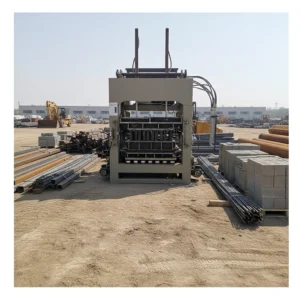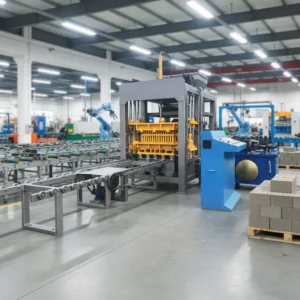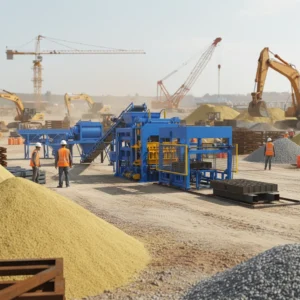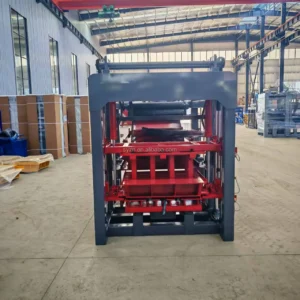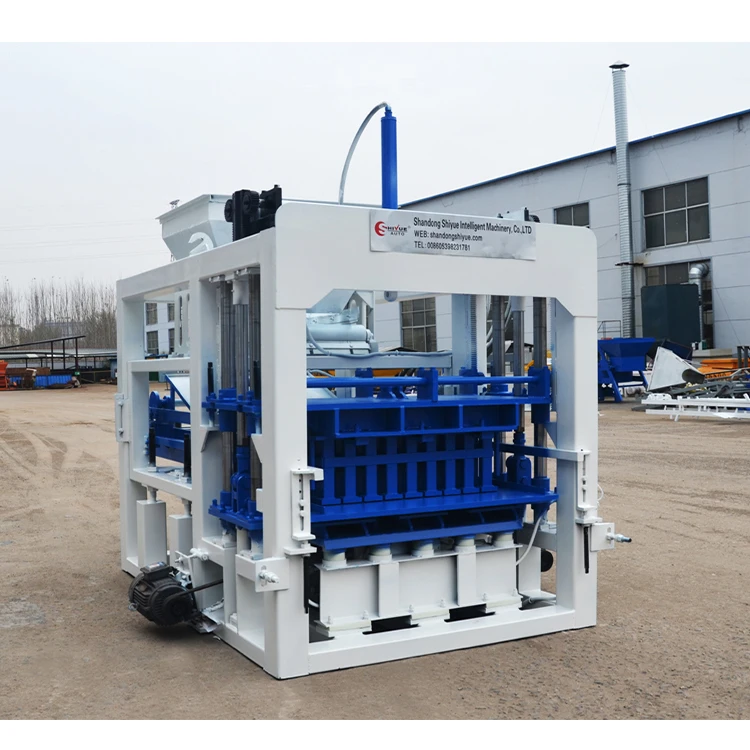
Matched System Engineering — The QT5-15 block machine, pallet feed, storage hopper and stacking stations are configured as one line so upstream cycles never starve the press.
Technical Specifications
| Parameter | Value |
|---|---|
| Model | QT5-15 |
| Product Type | Automatic Cement Block Making Machine |
| Overall Dimensions | 7400×1950×2800 mm |
| Total Mass | 5000 kg |
| Overall Power | 32 kW |
| Vibration Frequency | 0-60 Hz |
| Vibration Force | 80 kN |
| Vibration Form | Platform Vibration |
| Moulding Mode | Automatic loading, vibration moulding |
| Demolding Method | Hydraulic |
| Pallet Size | 1100×550 mm |
| Molding Cycle | 15-20 s (basis to be confirmed per block format and mix) |
| Control System | PLC with touch screen interface |
| Flyash Compatibility | Up to 70% flyash content in mix |
| Block Compressive Strength | >15 MPa |
| Output: Hollow block 400×200×200 mm | 900-1200 pcs/h (7200-9600 pcs/8hr) |
| Output: Hollow block 400×150×200 mm | 1080-1440 pcs/h (8640-11520 pcs/8hr) |
| Output: Solid brick 240×115×53 mm | 5760-7680 pcs/h (46080-61440 pcs/8hr) |
| Output: Rectangular paver 200×100×60 mm | 3600-4500 pcs/h (cycle 20-25 s) |
| Output: Zigzag paver 225×112.5×60 mm | 2304-2880 pcs/h (cycle 20-25 s) |
| Recommended Factory Area | 1000 m² |
| Automation Level | Automatic (PLC controlled pallet feed, material feed, vibrating, demoulding) |
| Line Components | Pallet feed machine, block making machine, storage hopper, conveyor, hydraulic unit, PLC control cabinet |
Application Suitability
| Application | Material or Output |
|---|---|
| Hollow block production | Crushed stone, sand, cement, water; up to 70% flyash substitution |
| Solid brick production | Fine aggregate, cement, water for high-density 240×115×53 mm bricks |
| Rectangular paving block | Coarse aggregate mix for 200×100×60 mm pavers |
| Zigzag interlocking paver | Cement-bound aggregate for 225×112.5×60 mm interlocking format |
| Flyash brick from industrial residue | Flyash, slag, gangue combined with sand and cement |
| On-site contractor production | Mobile plant setup for housing or infrastructure project block supply |
Why the Line Matters More Than the Press Alone
A block machine is only as productive as the slowest station feeding it.
I spent years watching plants in Southeast Asia run automatic presses at half capacity because the mixer could not discharge fast enough or the pallet feeder jammed every few cycles. A QT5-15 block machine production line rated at 900-1200 hollow blocks per hour based on 400×200×200 mm format is meaningless when the upstream conveyor delivers material at a rate that forces the press to idle. Buyers sign contracts for a press and receive a press, then discover on commissioning day that stacking, curing rack handling and pallet return were never part of the quotation [NEED_CITE: common scope gaps in block machine quotations]. That realization usually arrives after the deposit is paid and the foundation is poured.
Stations That Keep Pace with the Press
The QT5-15 automatic block making line with supporting equipment includes a dedicated pallet feed machine, storage hopper and conveyor sized so the press never waits for a pallet or a batch of material. Each station’s cycle is coordinated through the central PLC cabinet, which sequences material discharge, pallet advance, vibration and demoulding as one continuous loop. When upstream and downstream stations are specified separately from different suppliers, timing mismatches appear during the first week of production.
Independent Hydraulic Isolation
The hydraulic station sits apart from the press frame so vibration from the 80 kN platform does not travel through the hoses and fittings. Dust and slurry from the moulding area stay away from the valve block. In the humid workshops I have worked in across the Philippines and Vietnam, hydraulic failures trace back to contaminated fluid far more often than to pump wear [NEED_CITE: hydraulic contamination as leading cause of press downtime]. Keeping the unit isolated extends seal life and keeps pressure stable across a full shift.
Reading the Numbers Behind the Output
Vibration frequency adjustable from 0 to 60 Hz lets the operator dial in the right energy for different mix designs — a dry, low-cement flyash mix needs higher frequency to consolidate, while a wetter paver mix requires less to avoid segregation. The 80 kN vibration force works together with the hydraulic demolding system: enough pressure to compact the mix into dense blocks exceeding 15 MPa compressive strength, then clean hydraulic release so green blocks leave the mould without corner damage. Pallet size at 1100×550 mm determines how many blocks cure per rack level, which in turn dictates curing area footprint and forklift capacity. A pallet that does not match the buyer’s existing rack spacing forces either new racks or wasted curing space. The PLC touch screen coordinates all these variables from one interface, removing the timing guesswork from the operator’s routine.
When One Undersized Station Stops the Whole Line
A mixer that discharges slower than the QT5-15 cycle time forces the press to sit idle between batches. A pallet return conveyor that cannot keep up means the operator is pulling pallets by hand off the curing racks. I have seen plants where the press was rated for high output but the stacking station required two workers to move every pallet of green blocks, cutting realistic daily throughput well below the quoted figure [NEED_CITE: impact of manual stacking on block plant throughput]. The bottleneck is never the machine that appears on the quotation — it is the one that was left out.
Why Sourcing the Full Line from One Supplier Changes the Outcome
Block machinery is the single focus here, so the QT5-15 press, mould, pallet and handling equipment are specified as one matched system rather than assembled from separate vendors. The line layout is built around the buyer’s actual mix design and local aggregate, not a catalogue default. Mould design covers the formats the buyer’s market sells, with custom drawings available when standard options do not fit. Automation level is selectable, so a plant can start with semi-automatic pallet handling and add automatic stacking later. Installation and commissioning include operator training on the full line, not just the press controls.
Documentation & Verification
- Line layout and capacity calculation stating the block format assumed for each output figure
- Machine specification sheet with QT5-15 dimensional and electrical data
- Mould drawing and format list for every block type ordered
- Pallet specification matched to curing rack dimensions and forklift capacity
- Hydraulic and electrical schematic for on-site troubleshooting
- Factory test record on buyer’s selected block format before dispatch
Installation, Commissioning & Support
- Foundation plan sized to the 7400×1950 mm QT5-15 footprint and 5000 kg mass
- Power supply confirmation for 32 kW total load with dedicated circuit breaker
- Machine dismantled for container loading with reassembly guidance on arrival
- PLC touch screen language set to operator preference before commissioning
- Operator training covering mould change, cycle adjustment and daily maintenance
- Wear parts and mould list provided for first reorder planning
What We Need to Configure Your Line
To build an accurate QT5-15 block machine production line proposal, share the target block formats and realistic daily output you need to hit. Tell us about local raw materials — aggregate type, cement grade, whether flyash or slag is available — and the dimensions of your curing area and existing forklift capacity. Confirm the local voltage and frequency at the installation site so the electrical cabinet is wound correctly before production begins.
Frequently Asked Questions
Q: How do upstream stations match the QT5-15 press cycle to prevent bottlenecks?
A: The storage hopper, conveyor and pallet feed machine are sized so material and pallets arrive before the press completes its current cycle. The PLC coordinates timing across all stations, adjusting feeder speed to match the selected block format cycle. This prevents the press from idling while waiting for input.
Q: What supporting equipment is included and what must the buyer supply separately?
A: The quotation covers the pallet feed machine, storage hopper, conveyor, hydraulic unit, PLC cabinet and the QT5-15 press itself. The buyer typically provides the mixer, curing racks, forklift and raw material stockpile area. We confirm these items during the layout stage so interfaces align.
Q: How is pallet size selected relative to curing rack layout and forklift?
A: The 1100×550 mm pallet is the default, but the final size is confirmed against the buyer’s curing rack spacing and forklift fork width. A mismatch here means buying new racks or wasting curing floor space. We request rack drawings early in the sales process.
Q: What is the line footprint and factory area requirement?
A: The QT5-15 press alone occupies roughly 7400×1950 mm, but the complete line including material feed, pallet circulation and stacking area calls for the recommended 1000 m² factory space. The exact layout depends on the curing method and stacking configuration chosen.
Q: How does the automation level affect labour count across the full line?
A: With full automatic operation, the PLC handles pallet feeding, material dosing, vibration and demoulding. Labour is concentrated on raw material loading, quality checks and fork-lift movement of cured blocks. A semi-automatic configuration requires additional manual pallet handling between the press and curing area.