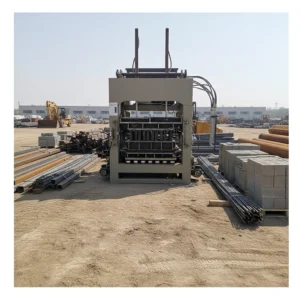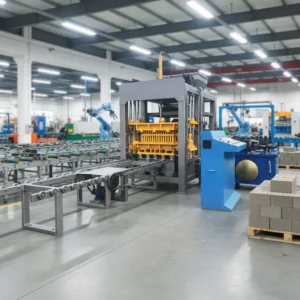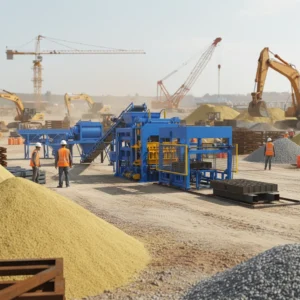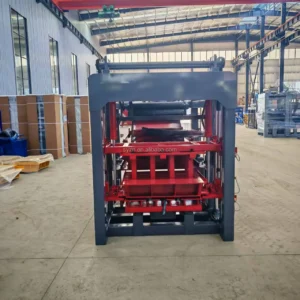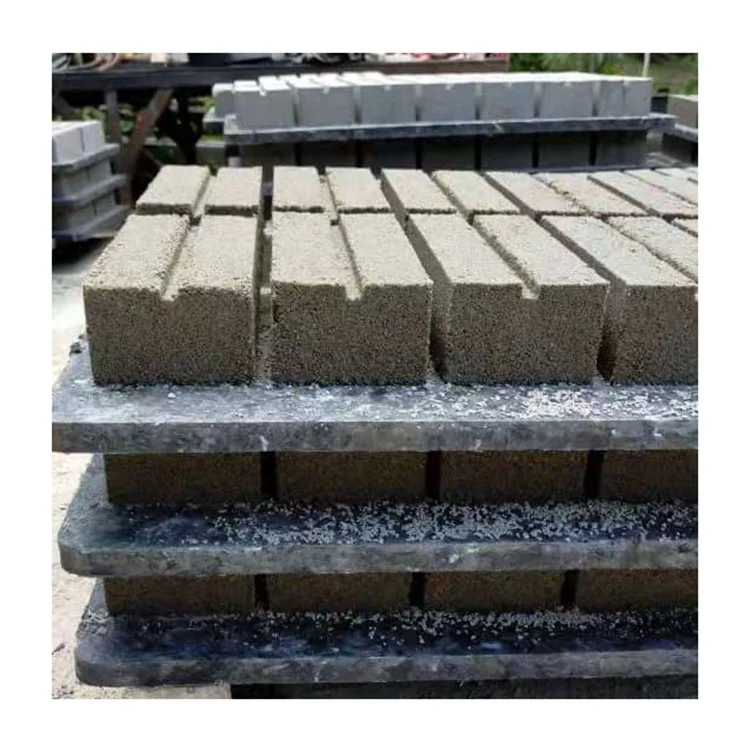
Integrated Line Engineering — every station from raw material feeding to stacking is specified against the QT4-25 cycle rate so the press is never left waiting for pallets or mix.
Technical Specifications
| Parameter | Value |
|---|---|
| Model | QT4-25 |
| Product Type | Automatic Block Making Machine |
| Rated Power | 27.5 kW |
| Voltage & Frequency | 380V or configurable to buyer requirements (frequency to be confirmed) |
| Vibration Force | 60 kN |
| Pallet Size | 1020 × 850 × 40 mm |
| Overall Dimensions (L×W×H) | 7100 × 1600 × 2610 mm |
| Net Weight | 5800 kg |
| Mould Formats | 400×200×200 mm hollow, 400×150×200 mm hollow, 225×112.5×53 mm solid brick |
| Output (400×200×200 mm hollow, 4 pcs/mould) | 960 pcs/hour, 7680 pcs/day (basis to be confirmed) |
| Output (400×150×200 mm hollow, 6 pcs/mould) | 1440 pcs/hour, 11520 pcs/day (basis to be confirmed) |
| Output (225×112.5×53 mm solid, 16 pcs/mould) | 3840 pcs/hour, 30720 pcs/day (basis to be confirmed) |
| Control System | PLC or MCC (configuration to be confirmed) |
| Automation Level | Automatic (stacking and cubing scope to be confirmed) |
| Standards | ISO 9001:2008, CE |
Application Suitability
| Application | Material or Output |
|---|---|
| Standard hollow block plant | Crushed stone, sand, cement, water mix for 400×200 and 400×150 formats |
| Solid brick production | Fine aggregate and cement blend for 225×112.5×53 mm bricks |
| On-site contractor block yard | Local aggregate and cement for project-specific hollow and solid formats |
| Building material distributor | Mixed format runs across hollow and solid moulds for regional market supply |
What a Cycle Time Figure Hides About Line Throughput
The press cycle means nothing when pallets are still being moved by hand.
I have walked onto sites where the automatic block making machine production line was rated for a certain output, but the crew was spending half the shift carrying wet blocks on pallets to the curing yard because no pallet circulation or stacking equipment was included in the order. The press sat idle waiting for the next pallet to come back. That gap between quoted cycle time and actual daily throughput is where most block plant disappointments start [NEED_CITE: typical block plant throughput losses from manual pallet handling]. The QT4-25 must be specified alongside its upstream and downstream stations so that mix arrives on time, pallets cycle back without a bottleneck, and cured product leaves the rack area clear.
Matching Raw Material Feed to the Press Cycle
The automatic block making machine production line begins well before the press itself. Raw material feeding and mixing must deliver a consistent batch at a rate that keeps pace with each press cycle. If the mixer discharges too slowly, the press waits. If it discharges too fast, mix sits and begins to set before reaching the mould. The QT4-25 configuration should therefore include a mixer sized to the 27.5 kW press demand and a feeding system that meters aggregate and cement in the right sequence for the buyer’s local mix design.
Synchronizing Pallet Circulation With Each Station
Downstream from the press, pallet handling determines whether the line flows or stalls. The 1020 × 850 × 40 mm pallet must travel from the press to the curing rack, cure, return clean, and be ready for the next cycle. If any segment of that loop is slower than the press itself, throughput drops regardless of vibration force or hydraulic pressure. Specifying pallet feeders, rack handlers, and return conveyors as part of the line — rather than as optional extras — is what separates a working plant from a bottlenecked one [NEED_CITE: production line synchronization principles for concrete block manufacturing].
Reading the Specification Sheet Against Your Actual Product
The vibration force of 60 kN and the pallet dimensions interact directly with the buyer’s target block format. Hollow blocks at 400×200×200 mm require different compaction energy and mould dwell than solid bricks at 225×112.5×53 mm. A specification sheet that lists output without stating which format it assumes leaves the buyer guessing at real capacity. The QT4-25 figures for each format — 4-piece hollow, 6-piece hollow, 16-piece solid — should each be evaluated against the format the buyer’s market actually purchases, not averaged into a single headline number. Mould change time further affects usable production hours in a multi-format plant.
When One Missing Station Stops the Entire Line
A buyer once ordered a block press alone, assuming the existing site crew could handle pallet movement and curing manually. Within weeks, the press was running only a fraction of its available hours because pallets were not returning fast enough, and broken blocks from rough handling were eating into saleable output. The cost of adding pallet circulation and stacking after the fact exceeded what a matched line quotation would have been from the start [NEED_CITE: hidden costs of retrofitting pallet handling onto standalone block presses]. This pattern repeats across regions where labour appears inexpensive until throughput losses are calculated against project deadlines.
Why Sourcing the Whole Line From One Scope Matters
Block machinery is the single focus here, which means the press, mould, pallet, and handling equipment are specified as one matched system rather than assembled from separate suppliers. The QT4-25 line is configured against the buyer’s actual mix design and local aggregate, not a catalogue default. Mould design covers the formats the buyer’s market sells, including custom drawings where needed. Pallet size is chosen to match the curing rack spacing and forklift the buyer already operates on site. Voltage, frequency, and PLC display language are confirmed before production begins so that commissioning is not delayed by electrical mismatches at arrival.
Documentation & Verification
- Line layout showing capacity per block format for the QT4-25 press and all stations
- Machine specification sheet with vibration force and pallet size matched to buyer mix
- Mould drawing and format list covering hollow and solid configurations ordered
- Voltage, frequency, and control language confirmation sheet signed before production
- Hydraulic and electrical schematic for the complete line as delivered
- Factory test record run on buyer’s specified block format before dispatch
Installation, Commissioning & Support
- Foundation plan aligned to 7100 × 1600 × 2610 mm footprint and 5800 kg static load
- Dedicated circuit for 27.5 kW rated power with voltage confirmed at 380V or local equivalent
- Assembly and levelling of press, pallet feeder, and mixer stations on prepared slab
- First-run parameter setting for vibration force and cycle time per chosen mould format
- Operator training covering mould change, pallet handling sequence, and daily checks
- Wear parts and mould list provided with initial spares for hydraulic and vibration components
What We Need to Size Your Line
To configure the QT4-25 within a complete production line, share your target block formats and the daily volume your market absorbs. Tell us what local aggregate and cement are available so that the mixer and feeding system can be matched to your actual mix. Confirm the voltage, frequency, and control language your operators will use, along with any existing curing racks or forklifts the pallet system must interface with.
Frequently Asked Questions
Q: How is line capacity calculated per block format and what stations must match the press?
A: Capacity is stated separately for each mould format — 400×200 hollow, 400×150 hollow, and 225×112.5 solid — because cycle time and pieces per mould differ. The mixer output rate, pallet circulation speed, and stacking pace must each match or exceed the press cycle so that no station creates idle time.
Q: What supporting equipment is included in the quotation versus left to the buyer?
A: The quotation scope should define raw material feeding, mixing, pallet circulation, and stacking alongside the QT4-25 press. Items left undefined become the buyer’s responsibility and risk. Confirm exactly which stations appear on the line layout before placing the order.
Q: How is pallet size selected to match existing curing racks and forklifts?
A: The 1020 × 850 × 40 mm pallet dimension must clear the curing rack spacing and sit properly on the buyer’s forklift tines. Selecting pallet size after reviewing the buyer’s existing rack and handling equipment prevents costly mismatches once the line is running.
Q: What voltage, frequency, and control language options are confirmed before shipment?
A: Voltage and frequency are confirmed against the buyer’s site supply before production begins. PLC display language is agreed at the same stage. This prevents commissioning delays caused by electrical incompatibility or operators unable to read the control interface on arrival.