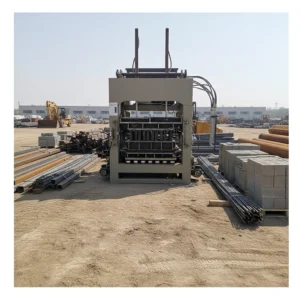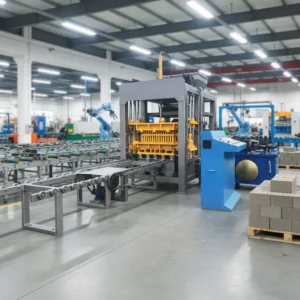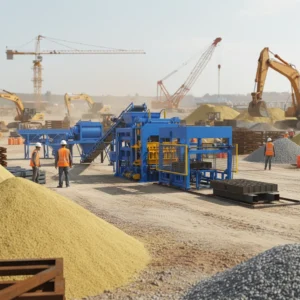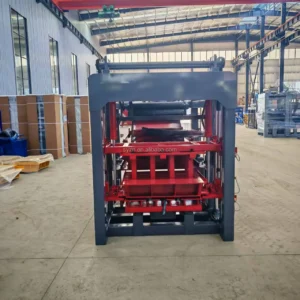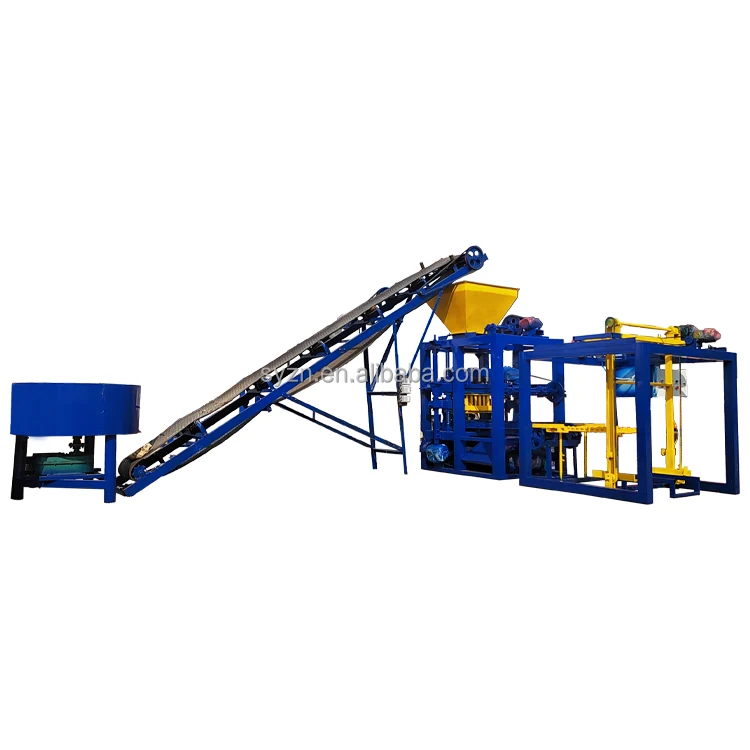
Matched System Engineering — QTJ4-26 configured with JQ350 mixer and 850×450mm pallet feed so the 26-second press cycle never waits on upstream or downstream stations.
Technical Specifications
| Parameter | Value |
|---|---|
| Product Type | Semi-Automatic Concrete Block Making Machine |
| Model | QTJ4-26 |
| Overall Dimensions (L×W×H) | 2060×1730×2580 mm |
| Net Weight | 1800 kg |
| Rated Power | 14.25 kW |
| Vibration Frequency | 4200 r/min |
| Exciting Force | 35.5 kN |
| Molding Cycle Time | 26 s |
| Pallet Size | 850×450×20 mm |
| Mixer Model | JQ350 |
| Control System | Semi-automatic (four guide pillars, automatic mould movement) |
| Applied Products | Hollow block (8 inch, 6 inch), solid brick |
| Raw Materials | Crushed stones, sand, cement, dust, fly ash |
| Output Capacity (Hollow Block 390×190×190 mm) | 4 pcs/mould, 480 pcs/h, 3800 pcs/8hr |
| Output Capacity (Hollow Block 400×150×200 mm) | 5 pcs/mould, 600 pcs/h, 4800 pcs/8hr |
| Output Capacity (Solid Brick 240×115×53 mm) | 18 pcs/mould, 2100 pcs/h, 17000 pcs/8hr |
| Voltage & Frequency | (basis not stated in source — confirm block format / material / thickness) |
| Automation Level | Semi-automatic |
Application Suitability
| Application | Material or Output |
|---|---|
| Small to medium block plant | Hollow blocks from crushed stone, sand, cement, fly ash |
| On-site contractor production | Solid bricks for housing projects using local aggregate |
| Product range expansion | Adding 8-inch and 6-inch hollow formats to existing catalogue |
| Regional building supply | Consistent daily volumes across hollow block and solid brick formats |
What a 26-Second Cycle Actually Requires from the Rest of the Line
A press cycle means nothing if the mixer is still blending or the pallet rack is empty when the mould opens.
Buying a block press based on its cycle time alone is where most concrete block production line planning goes wrong. I have watched a QTJ4-26 sit idle for eight seconds every cycle because the JQ350 mixer could not discharge fast enough, and the daily throughput dropped to nearly half the quoted figure. The press itself was performing exactly as designed — the surrounding stations were not [NEED_CITE: typical line bottleneck causes in small block plants]. Matching the upstream feed rate and downstream pallet handling to that 26-second rhythm is the entire job of line layout, and it is the part most quotations leave to the buyer to figure out on site.
How the Stations Around the Press Connect
The JQ350 mixer must deliver a fresh batch to the hopper before the 26-second mould cycle completes, otherwise the concrete block production line stalls at the most expensive station. We calculate the mixer discharge volume against the mould cavity fill requirement for each block format — 4 cavities for a 390×190×190 hollow block, 18 cavities for a standard solid brick — so the mixer and press share a common tempo rather than fighting each other.
Pallet Supply and What Happens When It Fails
The 850×450×20 mm pallet feeds into the press from a dedicated rack. When that rack runs dry, the press waits, and a block making line supporting equipment problem becomes a press problem. We specify the pallet stack capacity and the manual reload interval so the operator knows exactly when to replenish. The pallet dimensions also match standard curing rack widths, which means the forklift moves cured product without rehandling [NEED_CITE: pallet dimension standards for block curing racks].
Reading the Numbers That Actually Matter
Vibration frequency at 4200 r/min combined with 35.5 kN exciting force is what compacts the concrete mix into the mould cavity. On a semi-automatic machine with four guide pillars, that vibration must be uniform across the 850×450 mm mould area — uneven vibration means one side of a hollow block is dense and the other crumbles during curing. The rated power of 14.25 kW covers both vibrating motors and the hydraulic mould lift; running the line on a generator that cannot sustain that load causes voltage sag and inconsistent compaction across the shift.
The Cost of Skipping Line Balance
When the mixer output, pallet feed rhythm, and stacking pace are not calculated together, the symptoms do not appear on the quotation — they appear in week two of production. Blocks stack up on the floor because nobody specified a curing rack system. The mixer burns out because it runs continuously instead of cycling with the press. Operators spend half the shift moving pallets by hand because the semi-automatic line was sold as a standalone press [NEED_CITE: common production losses from incomplete block line specifications]. These are not machine faults; they are planning gaps that show up as lost tonnage and missed delivery dates.
Why This Line Configuration Exists
Every station around the QTJ4-26 is specified as part of the same system, not sourced from separate catalogues and bolted together on arrival. The JQ350 mixer is selected because its batch volume matches the mould fill across all three listed block formats. Pallet dimensions are confirmed against the buyer’s existing curing area and forklift before the order is placed, not assumed. The semi-automatic architecture leaves a clear upgrade path — automatic pallet feeding and stacking can be added later without replacing the press itself. Factory testing runs the mixer, press, and pallet stations together so the cycle balance is verified before the machine leaves the workshop.
Documentation & Verification
- Line layout drawing showing station spacing and pallet flow for QTJ4-26
- Capacity calculation per block format with assumed cycle time at each station
- Pallet specification sheet matched to buyer’s curing rack dimensions
- Factory test record covering mixer-to-press-to-pallet sequence
- Voltage, frequency and control language confirmation before production
Installation, Commissioning & Support
- Foundation plan for 2060×1730 mm footprint with vibration isolation for 35.5 kN force
- Dedicated 14.25 kW circuit with voltage and frequency confirmed to site supply
- Mixer, press and pallet rack assembled and cycle-tested together on site
- Operator training on mould change sequence for hollow block and solid brick formats
- Wear parts list for vibration motors, guide pillar bushings and mould liners
Before You Request a Quotation
Tell us the block format you sell most — hollow 390×190×190, hollow 400×150×200, or solid 240×115×53 — and the daily volume your market requires. Share your available raw materials and the local aggregate grading, plus your curing area dimensions and forklift capacity so the pallet specification fits what you already have. Confirm the site voltage, frequency and the control panel language your operators need before we lock the production order.
Frequently Asked Questions
Q: How is line capacity calculated per block format, and what cycle time is assumed at each station?
A: Each output figure is tied to a specific block dimension — for example, 480 pieces per hour assumes the 390×190×190 mm hollow block at four pieces per mould and a 26-second press cycle. We calculate mixer discharge time and pallet feed interval against that same cycle so no station becomes a bottleneck. The capacity sheet you receive lists every format separately.
Q: Does the quotation include pallet feeding, stacking and curing rack handling, or only the press?
A: The QTJ4-26 line configuration includes the JQ350 mixer, pallet feed rack and the pallet specification matched to your curing area. Stacking is manual at the semi-automatic level, and the quotation states this clearly so you can plan labour or discuss an automatic stacking upgrade before ordering.
Q: How do upstream mixer output and downstream pallet handling match the 26-second press cycle?
A: The JQ350 batch volume is sized so one full mix discharges within the press cycle for the target block format. The pallet rack holds enough pallets to cover a set number of cycles before manual reload. If your daily target requires faster throughput, we adjust the mixer or add a second pallet station rather than overpromising on the press.
Q: Can the semi-automatic line be upgraded to automatic pallet feeding and stacking later without replacing the press?
A: Yes. The QTJ4-26 semi-automatic architecture uses a standard pallet interface, so automatic pallet feeding and stacking stations can be integrated later. The press frame, mould system and vibration assembly remain unchanged — only the upstream and downstream stations are modified to reduce manual handling.