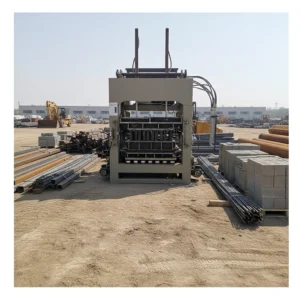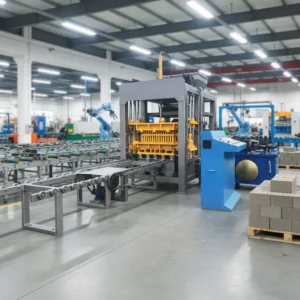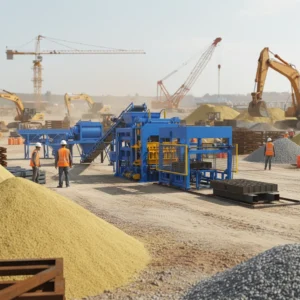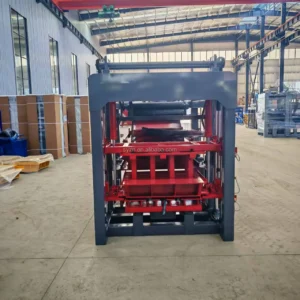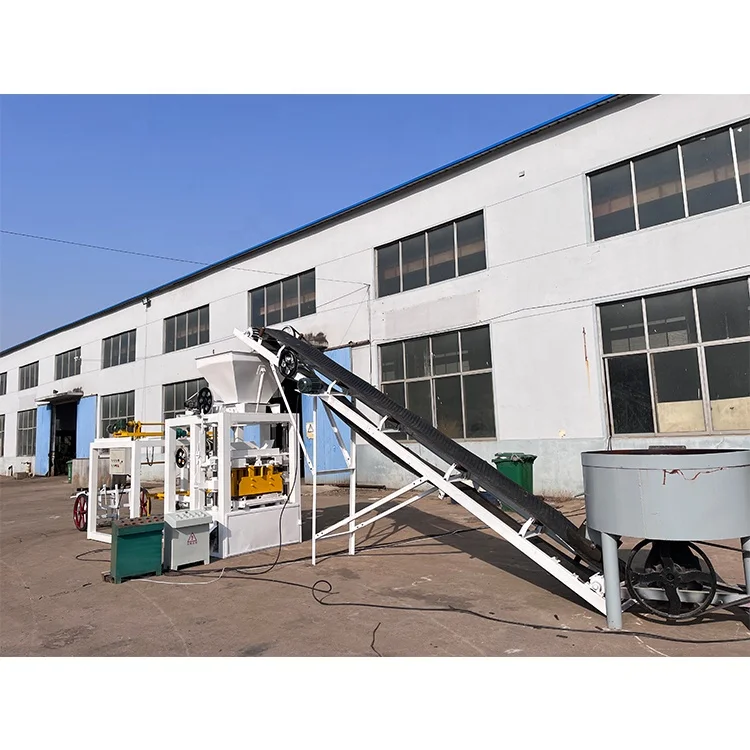
Matched System Integration — every station from mixer to pallet trolley is specified together so the press never waits for material or handling, verified by cycle-time calculation per block format.
Technical Specifications
| Parameter | Value |
|---|---|
| Model | QTJ4-24 |
| Product Type | Semi-Automatic Concrete Block Making Machine |
| Overall Dimensions (L×W×H) | 2060×1730×2580 mm |
| Molding Cycle | 24 s |
| Vibration Frequency | 4200 r/min |
| Exciting Power (Vibration Force) | 35.5 kN |
| Rated Power | 14.25 kW |
| Mixer Model | JQ350 |
| Pallet Size | 850×450×20 mm |
| Net Weight | 1800 kg |
| Hydraulic Station | Equipped, high-pressure |
| Vibration System | Bed mould vertical vibration + upper mould compression vibration |
| Automation Level | Semi-automatic |
| Applied Products | Concrete hollow blocks, solid bricks, pavers |
| Raw Materials | Crushed stone, sand, cement, dust, fly ash |
| Assembly State | Nude packing in 20GP container |
| Standards | CE |
Application Suitability
| Application | Material or Output |
|---|---|
| Small to medium block plants | Crushed stone, sand, cement, fly ash |
| On-site contractor production | Local aggregate and cement blends |
| Format diversification for distributors | Hollow blocks, solid bricks, pavers via mould change |
| First-plant entrepreneur setup | Lower investment, semi-automatic operation |
What "Daily Output" Figures Leave Out When Stations Are Not Matched
A block making machine production line only reaches its stated capacity when every upstream and downstream station keeps pace with the press cycle.
I have watched a well-tuned host press sit idle for seconds at a time because the mixer discharged material too slowly or the pallet feeder jammed. Over an eight-hour shift, those small pauses add up to thousands of missing blocks. The QTJ4-24 block making machine production line addresses this by pairing the JQ350 mixer and conveyor with the 24-second moulding cycle so material arrives just as the previous cycle finishes. [NEED_CITE: impact of station mismatch on daily block output]
Station Synchronization From Mixing to Pallet Return
The JQ350 mixer is sized to hold enough batch volume for continuous pressing without overflow or starvation. Material travels by conveyor to the host hopper at a rate calculated against the 24-second cycle, preventing the press from idling while waiting for the next charge. This block making machine production line configuration keeps the rhythm steady across a full shift.
Pallet Handling Sized to the Curing Area
The 850×450×20 mm pallet is not an arbitrary choice; it must match the curing racks and forklifts already on site. When pallet dimensions are confirmed before shipment, the line connects smoothly to downstream handling. Fresh blocks move off the press on pallets that slot directly into the buyer’s existing curing infrastructure, avoiding costly re-racking. [NEED_CITE: pallet size compatibility with curing rack systems]
Dual Vibration for Consistent Block Density
Bed mould vertical vibration at 4200 r/min works together with upper mould compression vibration to compact the mix from both directions. This dual action produces blocks with more uniform density throughout the cross-section, reducing weak spots that lead to breakage during curing and transport. The 35.5 kN exciting power is matched to common aggregate gradations found in small-to-medium plant operations.
Reading the Numbers That Actually Matter on Site
The 14.25 kW rated power covers the host press motor, vibration system, and hydraulic pump running simultaneously. Buyers should verify that their site transformer and cable run can sustain this load continuously, not just at startup. The 2060×1730×2580 mm footprint defines the minimum bay width and overhead clearance needed, and the 1800 kg net weight determines the foundation slab thickness required to absorb vibration without cracking. Voltage and frequency must be confirmed before production so the motor winding and control panel match the local grid.
The Hidden Cost of Underspecifying the Line
When a quotation covers only the host press, buyers discover after arrival that pallets, mixers, and conveyors must be sourced separately — often at higher local prices and with mismatched cycle times. A conveyor that feeds too slowly forces the operator to wait, cutting real output well below the brochure figure. Pallets bought locally may not fit the press rails, causing jams and block damage. [NEED_CITE: consequences of incomplete line quotation on commissioning delays]
Why Sourcing the Full Line Here Makes Sense
Block machinery is our single focus, which means the mixer, conveyor, press, pallets, and trolley are specified as one matched system rather than assembled from separate suppliers. Configuration is set against the buyer’s actual mix design and local aggregate, not a catalogue default. Mould design covers the formats the buyer’s market actually sells, including custom drawings when standard moulds do not fit. Automation level is selectable, so a buyer can start semi-automatic and add automatic stacking later. Installation support includes on-site commissioning and operator training so the line runs correctly from the first day.
Documentation & Verification
- Line layout and capacity calculation stating the block format assumed for each output figure
- Machine specification sheet with voltage and control language confirmation
- Mould drawing and format list showing included and custom options
- Pallet specification matched to buyer’s curing area dimensions
- Hydraulic and electrical schematic for on-site troubleshooting
- Factory test record on the buyer’s target block format before dispatch
Installation, Commissioning & Support
- Foundation slab poured to support 1800 kg static weight plus dynamic vibration load
- Dedicated power circuit sized for 14.25 kW continuous draw at confirmed voltage and frequency
- Nude packing in 20GP container requires on-site reassembly of hopper and conveyor frame
- First-run commissioning includes cycle time verification with the buyer’s actual raw material mix
- Operator training covers mould change procedure and daily vibration system inspection
- Wear parts list supplied with recommended replacement intervals for vibration springs and hydraulic seals
Before You Send an Inquiry
To configure this block making machine production line accurately, share your target block formats and the daily volume you need for each. Tell us about your local aggregate type and cement supply so we can adjust the mix recommendation. Confirm your site voltage, frequency, and the language your operators read on the control panel so the machine arrives ready to run.
Frequently Asked Questions
Q: How are the mixer, conveyor, and press cycle times matched so the line runs without bottlenecks?
A: The JQ350 mixer batch volume and conveyor belt speed are calculated against the QTJ4-24 host press 24-second moulding cycle. This ensures a fresh charge of material reaches the hopper just as the previous cycle completes, keeping the press running continuously through a shift rather than idling between cycles.
Q: What block formats are covered and how is daily output calculated per format?
A: The line produces hollow blocks, solid bricks, and pavers by changing moulds. Daily output is calculated separately for each format based on the number of cavities per mould and the 24-second cycle, then stated in the capacity document so buyers plan against realistic figures rather than a single blanket number.
Q: Is pallet quantity and material included in the line quotation or sourced separately?
A: Pallets are included as part of the matched line configuration. The 850×450×20 mm size is confirmed against the buyer’s curing racks and handling equipment before production, so pallets arrive ready to slot into the existing infrastructure without modification or local re-purchasing.
Q: How does the line connect to downstream curing and stacking stations?
A: Fresh blocks exit the press on pallets that travel by trolley to the curing area. The pallet dimensions and block height are coordinated with the buyer’s rack spacing so pallets stack directly without rehandling. For semi-automatic operation, workers transfer pallets manually; an automatic stacker can be added later.
Q: What voltage, frequency, and control language should be confirmed before the line ships?
A: Buyers must confirm local grid voltage and frequency so the motor winding and control panel are built to match. The control panel display language is set during production to match the operator’s reading language, preventing commissioning delays caused by mislabeled buttons or error messages on arrival.