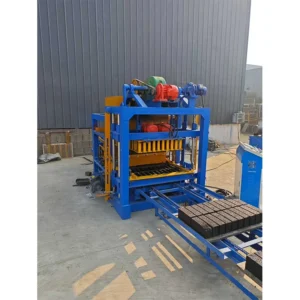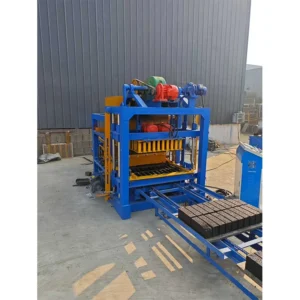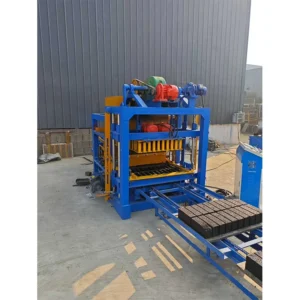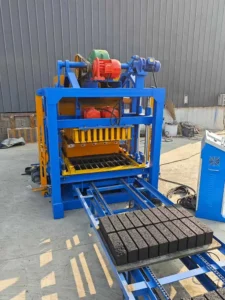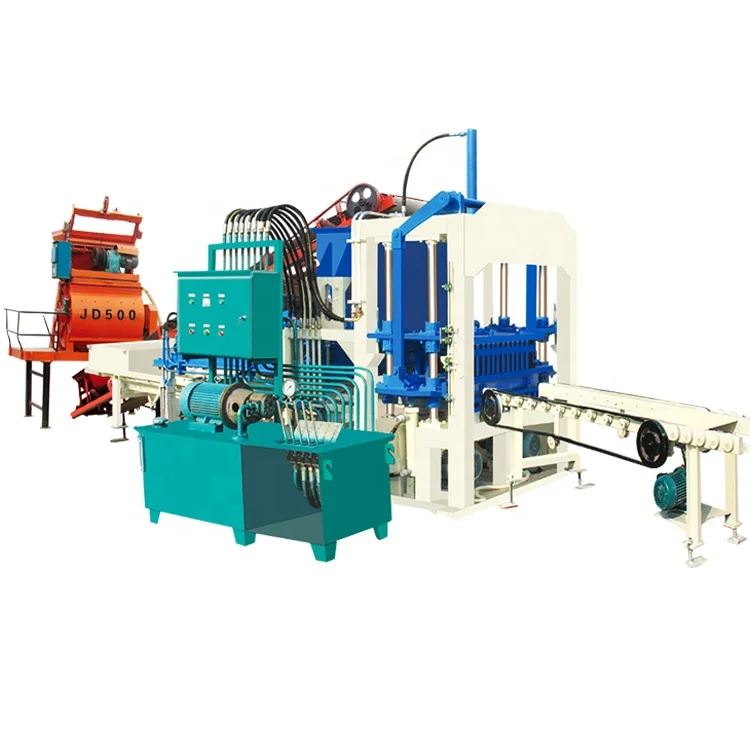
Line-first engineering — Every station from raw material feed to stacking is balanced to the QT4-20 press cycle so no single point dictates your actual daily throughput.
Technical Specifications
| Parameter | Value |
|---|---|
| Product Type | Automatic Concrete Block Making Machine |
| Model | QT4-20 |
| Overall Dimensions | 7100 × 1600 × 2610 mm |
| Rated Hydraulic Pressure | 21 MPa |
| Main Vibration Form | Platform Vibration |
| Vibration Frequency | 2800 – 4500 r/min |
| Vibration Force | 60 KN |
| Pallet Size | 1020 × 570 mm |
| Molding Cycle | 15 – 25 s (basis not stated in source) |
| Overall Power | 27.5 kW |
| Total Mass | 5.8 T |
| Demolding Method | Hydraulic |
| General Water Consumption | 8 T / Day |
| Recommended Factory Area | 500 m² |
| Control System | PLC with person-machine conversation interface |
| Applied Products | Hollow / solid blocks, pavers, interlocking blocks, curbstones |
| Raw Materials | Crushed stone, sand, cement, fly ash, gravel, slag |
Application Suitability
| Application | Material or Output |
|---|---|
| Hollow block production for residential and commercial walls | Crushed stone, sand, cement, fly ash blends |
| Solid block manufacturing for load-bearing structures | Gravel, sand, cement with local aggregate |
| Paver and interlocking brick production for roads and plazas | Colored pigments, fine aggregate, cement |
| Curbstone and kerb production for municipal infrastructure | Coarse aggregate, cement, slag mixes |
| On-site block production for housing development projects | Site-sourced gravel and sand with cement |
What the Press Cycle Means When Stations Fall Out of Sync
The automatic block making machine production line only runs as fast as its slowest station, and that station is rarely the press itself.
I remember an overseas buyer who invested in a mid-range block press, only to watch it sit idle while the mixer struggled to deliver a consistent batch. The press was rated for a certain cycle, but without matched feeding, pallet return, and stacking, the real daily output dropped dramatically. The buyer had paid for capacity the rest of the line could not support [NEED_CITE: common causes of throughput loss in block production lines]. When you evaluate an automatic block making machine production line, the question is never just what the press can do in isolation — it is whether every upstream and downstream station can keep pace.
Coordinating Material Feed, Mixing, and Press Timing
The QT4-20 operates on a 15 to 25-second molding cycle, which means the mixer must deliver a fresh batch to the hopper within that window, every cycle, without variation in moisture or consistency. If the raw material feeding system delivers unevenly, the press compensates with incomplete compaction. The PLC-controlled system coordinates station timing so that the mixer discharge, material hopper level, and press cycle remain locked together, preventing the press from cycling on a starved or overloaded mix.
Pallet Circulation and Stacking as a Timing Constraint
Each completed block leaves the press on a 1020 × 570 mm pallet. Those pallets must travel through the curing rack system and return to the press station before the next cycle completes. If pallet return is delayed by manual handling or an undersized rack system, the press waits. The automatic block making machine production line includes pallet feeding and return logic in the PLC sequence, ensuring that pallet availability is treated as a cycle constraint rather than an afterthought [NEED_CITE: pallet circulation rates in block curing systems].
Reading the Numbers Behind Vibration and Pressure
The 21 MPa hydraulic pressure works in concert with 60 KN of platform vibration to compact the mix into dense, structurally sound blocks. Vibration frequency is adjustable between 2800 and 4500 r/min, which matters because different block formats and aggregate sizes respond to different frequencies. A hollow block with coarse gravel needs a lower frequency and longer vibration time than a fine-aggregate paver. The platform vibration form transfers energy through the pallet rather than the mould walls, producing more uniform density across the block face. The 27.5 kW total power draw reflects the combined load of the hydraulic pump, vibration motor, and conveyor drives, so buyers should confirm their site electrical supply can sustain continuous draw at that level.
The Cost of Ignoring Line Balance
When a buyer specifies only the press and leaves supporting equipment to local sourcing, mismatches emerge quickly. A mixer with insufficient capacity forces the press into idle cycles. Pallets specified without considering the existing curing area layout lead to bottlenecks during peak production. The result is a line that technically runs but never reaches the throughput the press specification suggested was possible [NEED_CITE: impact of mismatched line equipment on block plant output]. These issues are rarely visible until the line is running under full load.
Why Specifying the Full Line Here Matters
The QT4-20 is configured as part of a matched system where raw material feeding, mixing, pallet handling, and stacking are all specified against the same cycle time and block format. The pallet size is selected to align with standard curing rack dimensions and common forklift fork widths, not chosen arbitrarily from a catalogue. Mould options cover hollow blocks, solid blocks, pavers, interlocking bricks, and curbstones on a single machine, with changeover procedures documented for each. Voltage, frequency, and PLC display language are confirmed against your local grid and operator requirements before production begins. Factory testing runs the complete line sequence, not just the press, so cycle coordination is verified before shipment.
Documentation & Verification
- Line layout drawing showing every station from raw material feed to stacking
- Capacity calculation stating the exact block format assumed for each output figure
- Pallet specification matched to your curing rack dimensions and forklift type
- Hydraulic and electrical schematic for on-site maintenance reference
- Voltage and PLC control language confirmation signed before production
- Factory test record demonstrating full line cycle coordination before dispatch
Installation, Commissioning & Support
- Foundation layout provided based on the 7100 × 1600 mm press footprint and curing rack plan
- Dedicated electrical circuit required for the 27.5 kW total connected load
- Press and supporting stations shipped in marked sections for sequenced on-site assembly
- Full line commissioning includes PLC parameter tuning for your specific block format
- Operator training covers mould change procedures across all specified product formats
- Wear parts list with reorder codes for hydraulic seals and vibration platform components
What We Need to Configure Your Line
To specify the QT4-20 and its supporting stations accurately, provide your target block formats with dimensions, your local aggregate types and available cement grades, and the daily output volume you need per format. Include your site voltage and frequency standard, preferred PLC display language, and the dimensions of your planned curing area so pallet and rack sizing align with your space. If you have existing handling equipment such as forklifts or conveyors, share the specifications so the line integrates cleanly.
Frequently Asked Questions
Q: How is daily output calculated and which block format does it assume?
A: The 15 to 25-second molding cycle is a base figure. Actual daily output depends entirely on the block format, wall thickness, and mix design being produced. Our capacity calculation states the assumed format and dimensions for every output number so you can compare against your real product range rather than a generic headline figure.
Q: Which line stations are included and which are optional?
A: The standard automatic block making machine production line includes raw material feeding, mixing, pallet feed, the press, and stacking. Curing rack handling and cubing systems are configurable based on your site layout. Each station is timed against the QT4-20 cycle so no single point becomes the bottleneck.
Q: What pallet size and material are specified for this line?
A: The QT4-20 uses a 1020 × 570 mm pallet. Material selection depends on your curing method and local climate. We match pallet specification to your existing curing area dimensions and forklift capacity to avoid handling conflicts after installation.
Q: How is the line configured around my local raw materials?
A: Mix design drives vibration frequency selection, hydraulic pressure tuning, and cycle timing. We work from your actual local aggregate samples — crushed stone, sand, fly ash, or slag — rather than a default catalogue mix, so the line performs correctly from the first production run.
Q: What does installation and commissioning cover for the full line?
A: Commissioning covers every station from material feed through stacking, not just the press. Our team sets PLC parameters for your block formats, trains operators on mould change and daily maintenance, and verifies cycle coordination across all stations before handover.