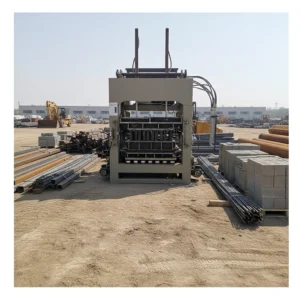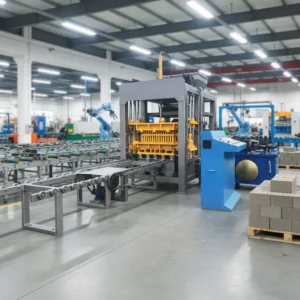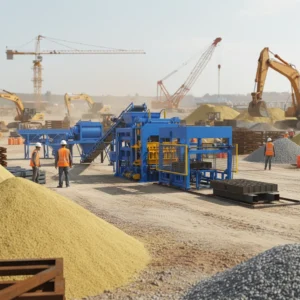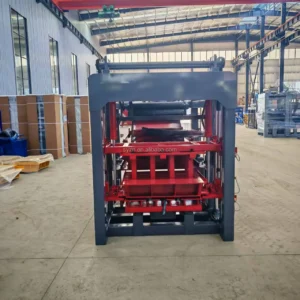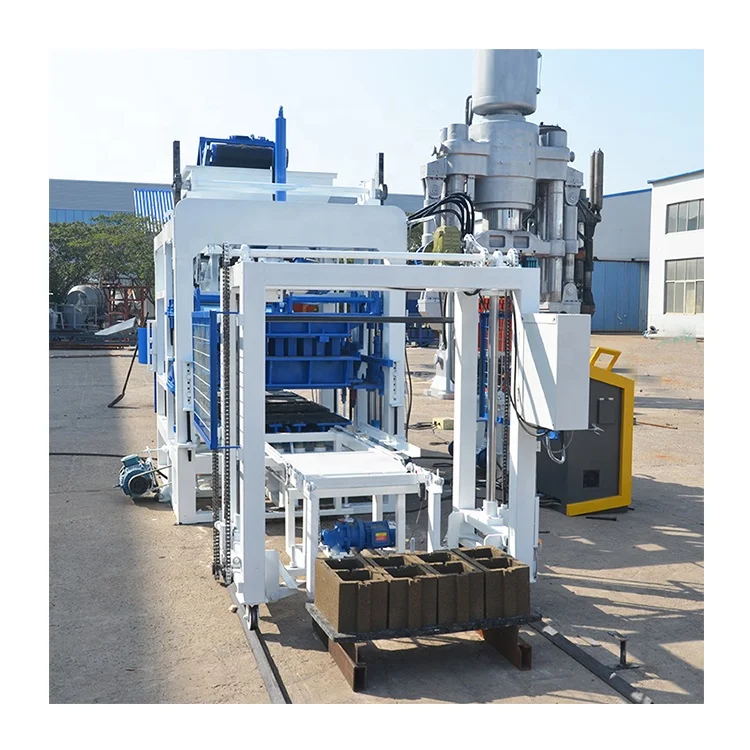
Integrated line configuration — The QT4-18 press is specified alongside its mixer, pallet feeder, and stacker as one timed system, so no station waits on another.
Technical Specifications
| Parameter | Value |
|---|---|
| Model | QT4-18 |
| Product Type | Hydraulic Concrete Block Making Machine |
| Overall Dimensions (L×W×H) | 3900 × 1600 × 2300 mm |
| Total Weight | 3 T |
| Rated Power | 24 kW |
| Exciting Force (Vibration) | 40–50 kN |
| Molding Cycle | 15–25 s |
| Pallet Size | 850 × 550 × 25 mm |
| Mixer Model | JQ350 |
| Applied Products | Hollow block, solid brick, paver, curbstone |
| Raw Materials | Crushed stone, sand, cement, fly ash, dust |
| Output (400×200×200 mm hollow, 4 pcs/mould) | 9,600–13,440 pcs / 8 hr |
| Output (400×150×200 mm hollow) | 14,400–19,200 pcs / 8 hr |
| Output (240×115×53 mm solid brick) | 16,200–19,440 pcs / 8 hr |
| Automation Level | Semi-automatic |
| Stacking Method | Automatic stacker |
| Assembly & Shipment | Nude packing in 20GP container |
Application Suitability
| Application | Material or Output |
|---|---|
| Hollow block production for wall construction | Crushed stone, sand, cement, fly ash — 400×200×200 mm or 400×150×200 mm formats |
| Solid brick manufacturing for load-bearing and partition walls | Sand, cement, stone dust — 240×115×53 mm standard brick |
| Paver and curbstone production for roads and landscaping | Aggregate and cement mixes — format dependent on mould selection |
| On-site block production for housing projects | Locally sourced aggregate blended with cement and fly ash |
| Entry-level block plant setup | Full line output matched to first-year volume targets |
What a "Cycle Time" Figure Leaves Out About Your Daily Output
A press cycle of 15–25 seconds only translates to real daily output when the mixer, pallet return, and stacker keep pace without interruption.
Many buyers receive a quote stating cycles per hour, then discover the actual number of blocks cured and stacked by end of shift falls well short. The gap is rarely the press itself — it is the pallet feeder running out of boards, the mixer batching too slowly, or wet blocks waiting on the floor because no stacker was included in the line. On a concrete block making machine production line built around the QT4-18, every upstream and downstream station is matched to the press cycle so the machine never sits idle waiting for material or pallets. [NEED_CITE: common causes of block plant throughput shortfall]
How Each Station Feeds the Next
The JQ350 mixer is sized to deliver a fresh batch within the molding window of the QT4-18, preventing the press from pausing between cycles. Raw material feeding, mixing, and pallet delivery are sequenced so that one station completing its task triggers the next, rather than each running on an independent timer. This coordination is what turns a nominal cycle time into a reliable shift output across hollow block, solid brick, and paver formats.
Pallet Handling as the Bottleneck Nobody Quotes
A block press can only produce as fast as pallets move through the system. The 850 × 550 × 25 mm pallet size on this line is chosen to match standard curing rack dimensions and forklift tine spacing at small-to-medium plants. The automatic stacker collects finished blocks off the press, freeing operators from hand-stacking wet product and keeping the pallet return loop continuous. Without this link, the concrete block making machine production line slows to the speed of manual labour regardless of how fast the press cycles. [NEED_CITE: pallet handling impact on block plant output]
Reading the Specification Sheet Against Your Actual Product
Vibration force of 40–50 kN combined with hydraulic pressure determines the density and compressive strength of each block, but only when matched to the buyer’s specific mix design and local aggregate. The 15–25 second molding cycle varies by format: a 400×200×200 mm hollow block requires a different dwell than a 240×115×53 mm solid brick. Output figures of 9,600–13,440 pieces per eight-hour shift for large hollow blocks versus 16,200–19,440 pieces for standard bricks reflect these cycle differences. Buyers should confirm which format their market demands before comparing capacity numbers across suppliers, and verify that the quoted mould set covers all formats they intend to produce.
The Cost of Treating the Press as a Standalone Purchase
When a buyer orders only the press and sources supporting equipment separately, mismatched cycle times create idle periods that compound across every shift. A mixer that batches too slowly starves the hopper; a pallet system that cannot keep up forces the operator to pause the press. On one project I supported in Europe, a buyer took delivery of a block press without specifying pallet return or stacking equipment — wet blocks were carried off the line by hand, the curing area jammed within hours, and actual daily output dropped to a fraction of the quoted capacity. [NEED_CITE: block line integration failures from unmatched equipment]
Why Line-Level Specification Matters Here
Block machinery is the single focus of this supply operation, which means the press, mould, pallet, and handling equipment are specified as one matched system rather than assembled from separate vendors. The line layout and capacity calculation state the block format assumed for each output figure, so buyers can verify projections against their own product mix. Mould design covers the formats the buyer’s market actually sells, including custom drawings when standard sizes do not apply. Automation level is selectable — a buyer can start with the semi-automatic QT4-18 configuration and add higher automation stations later without replacing the press. Installation includes operator training so the crew understands cycle dependencies across the full line, not just the press controls. [NEED_CITE: block machinery single-focus supply model]
Documentation & Verification
- Line layout drawing with capacity calculation stated per block format
- Pallet specification sheet including material grade and recommended quantity
- Mould drawing and format list confirming all block sizes in the quoted set
- Hydraulic and electrical schematic for local maintenance reference
- Factory test record run on buyer’s target block format before dispatch
- Voltage, frequency, and control language confirmation documented before shipment
Installation, Commissioning & Support
- Foundation plan sized to the 3900 × 1600 mm press footprint and vibration load
- Power supply matched to 24 kW rated draw with dedicated circuit breaker sizing
- Nude packing in 20GP container with dismantling sequence documented for reassembly
- First-run commissioning with molding cycle tuned to buyer’s local aggregate and mix
- Operator training covering mould changeover, pallet loading, and stacker operation
- Wear parts list and mould maintenance schedule provided at handover
What to Include in Your Inquiry
Provide the block formats your market sells, the daily volume you need to hit, and the raw materials available locally — including aggregate type and any fly ash or dust you plan to use. Confirm the voltage and frequency at your site, the language required for the control display, and the dimensions of your curing area so pallet size and stacker output can be matched. If you have existing mixers, conveyors, or forklifts, list their specifications so the concrete block making machine production line can be configured around them.
Frequently Asked Questions
Q: How is the daily output calculated for each block format?
A: Each output figure is tied to a specific block size and mould cavity count. For example, 9,600–13,440 pieces per eight-hour shift assumes a 400×200×200 mm hollow block with four cavities per mould. Switching to a smaller solid brick format changes the cycle time and cavity count, which is why the line layout document states the format behind every capacity number.
Q: What supporting equipment is included, and what must I source locally?
A: The standard line includes the JQ350 mixer, pallet feeder, automatic stacker, and pallet return system. Items typically sourced locally are curing racks, forklifts, raw material storage silos, and water supply infrastructure. The quotation specifies exactly which stations are included so there are no gaps when the line arrives on site.
Q: Can the pallet size be matched to my existing curing racks and forklift?
A: The standard pallet is 850 × 550 × 25 mm, but pallet dimensions can be adjusted to align with the curing rack spacing and forklift tine width already in use at your plant. Confirming these measurements during the inquiry stage ensures pallets, stacker, and curing area all work together from day one.
Q: How long does a mould changeover take between block formats?
A: Mould change procedure and time depend on the format pair being switched. The mould drawing and format list provided with the quotation documents the changeover steps for each mould set. Buyers producing multiple formats should confirm changeover expectations against their planned production schedule so format flexibility translates into real output.
Q: Is the mixer capacity matched to the press so it never waits for material?
A: The JQ350 mixer is selected to batch within the QT4-18 molding cycle window. If a buyer’s mix design requires longer blending or a higher volume per batch, the mixer specification is adjusted accordingly during line configuration so the press hopper stays charged throughout the shift.