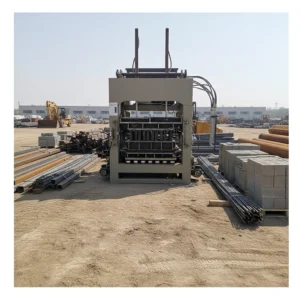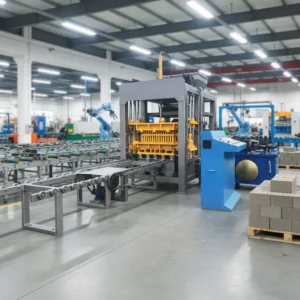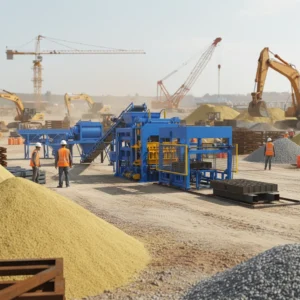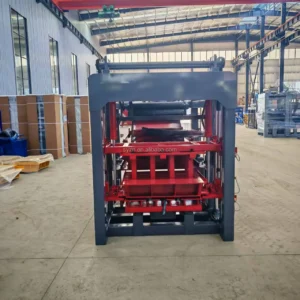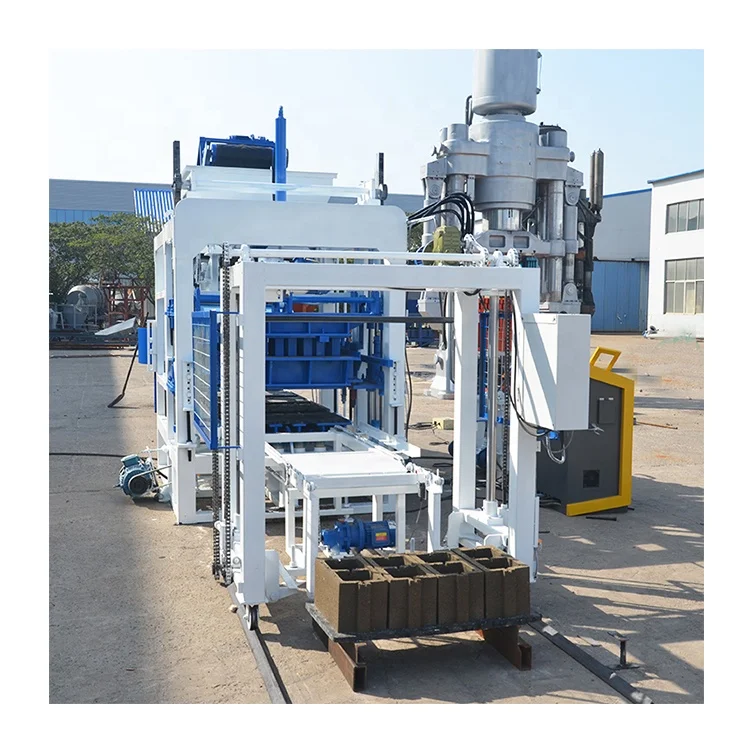
Matched Line Synchronization — every station from the JQ350 mixer through the automatic stacker is timed against the QT4-18 press cycle so material and pallets arrive without idle gaps.
Technical Specifications
| Parameter | Value |
|---|---|
| Model | QT4-18 |
| Product Type | Hydraulic Concrete Block Making Machine |
| Overall Dimensions (L×W×H) | 3900×1600×2300 mm |
| Total Weight | 3T |
| Rated Power | 24KW |
| Exciting Force | 40-50KN |
| Molding Cycle | 15-25s (basis not stated in source — confirm block format and material) |
| Mixer Model | JQ350 |
| Pallet Size | 850×550×25 mm |
| Automation Level | Semi-automatic |
| Hydraulic Station | Equipped (pressure rating not stated in source) |
| Vibration Type | Bed mould vertical vibration + upper mould compression vibration |
| Mould Change | Manual |
| Output Capacity | 2880 pcs/day based on 400×200×200mm hollow block, 8-hour shift |
| Output Capacity | 3240 pcs/hour based on 240×115×53mm solid brick |
| Line Configuration | Main press + mixer + conveyor + automatic stacker |
| Raw Materials | Crushed stones, sand, cement, dust, fly ash |
| Standards | CE (confirm applicability to this model) |
Application Suitability
| Application | Material or Output |
|---|---|
| Hollow block production (8", 6", 5", 4") | Crushed stone, sand, cement, fly ash blends |
| Solid brick manufacturing | Fine aggregate and cement mixes for 240×115×53mm format |
| Paving block production | High-density aggregate blends for interlocking and rectangular pavers |
| Kerbstone forming | Coarse aggregate with cement for roadside and drainage profiles |
| On-site contractor production | Local aggregate sourcing for project-specific block formats |
| First-time plant setup | Semi-automatic line for entrepreneurs entering block manufacturing |
Why Quoted Capacity Rarely Survives the First Week on Site
A block making machine production line rated at a certain number of cycles per hour means nothing if the mixer cannot deliver fresh material before the next press stroke begins.
When I first started commissioning lines in West Africa, I watched plants sit idle for hours every shift because the conveyor belt dropped material too slowly for the press cycle, or the stacker arm lagged behind and forced the operator to pull wet pallets off the press table by hand. The press was never the bottleneck — the stations around it were. Most quotations list the press capacity in isolation and treat everything upstream and downstream as optional extras, which is why buyers end up stacking blocks manually and wondering where the promised output disappeared to [NEED_CITE: common causes of block line throughput shortfall in semi-automatic plants].
The QT4-18 block making machine production line approaches this differently. The JQ350 mixer, belt conveyor, host press, and automatic stacker are specified together so their individual cycle times align with the 15-25 second molding window. Material arrives at the hopper before the press completes its current stroke, and the stacker clears the pallet before the next one is fed. This is not a collection of standalone machines — it is a synchronized sequence where every station’s rhythm is calculated against the press.
Station-by-Station Flow from Raw Material to Curing Area
The production sequence begins at the JQ350 mixer, where crushed stone, sand, cement, and fly ash are blended to the consistency required by the buyer’s target block format. The mixed material travels via conveyor to the press hopper, timed so the hopper never runs dry mid-cycle and never overfills between cycles. Once the QT4-18 completes its molding stroke, the wet block on its 850×550×25 mm pallet moves to the automatic stacker, which lifts and places it onto the curing trolley. The entire block making machine production line is designed so that no single station forces the press to wait.
Pallet Dimensions Drive the Entire Curing Layout
The 850×550×25 mm pallet size is not an arbitrary choice — it determines how many pallets fit on a standard curing rack, how the forklift tines engage the stack, and how much floor space the curing area consumes. I have seen buyers purchase a press with a pallet size that their existing forklift could not handle, forcing them to buy new handling equipment they had not budgeted for. Before the QT4-18 line ships, the pallet specification is checked against the buyer’s curing yard dimensions, rack spacing, and available forklift capacity so that pallets flow smoothly from press to curing and back without modification [NEED_CITE: pallet handling considerations in block production facility planning].
Reading the Specifications That Actually Matter
The 40-50KN exciting force works in combination with the hydraulic station pressure to compact the mix into a dense, consistent block. Vibration alone cannot achieve structural strength — the hydraulic compression from above and the vertical vibration from the bed mould together ensure that aggregate particles settle tightly across the entire block cross-section, whether you are producing a thin 53mm solid brick or a thick 200mm hollow block. The dual vibration system — bed mould vertical vibration plus upper mould compression vibration — addresses the density gradient problem that single-direction vibration creates, where the bottom of the block is denser than the top.
The 24KW rated power must be read alongside the voltage and frequency requirements of the destination country. A 24KW draw at 380V/50Hz behaves very differently from the same machine wired for 440V/60Hz, and the electrical schematic must confirm the correct configuration before the machine leaves the factory. The 3900×1600×2300 mm overall dimensions tell you the minimum bay width and ceiling height required, but the line layout drawing must also account for conveyor length, stacker swing radius, and trolley transfer space around the press.
The Hidden Cost of Treating Line Stations as Optional
Skipping the automatic stacker to save on the initial quotation means every pallet leaves the press table by hand. In a semi-automatic line running at full cycle speed, this forces the operator to pull, carry, and place wet blocks continuously — and the moment fatigue slows them down, the press sits idle waiting for the table to clear. Similarly, specifying a mixer with insufficient batch volume for the press cycle means the hopper starves between batches, creating dead time that no amount of press speed can recover. These are not theoretical problems; they are the most common reasons buyers report that their line never reaches the quoted daily output [NEED_CITE: block plant productivity losses from mismatched auxiliary equipment].
Why Procurement Through This Channel Works
Block machinery is the single focus here, so the QT4-18 press, JQ350 mixer, conveyor, stacker, pallets, and trolleys are specified as one matched system rather than assembled from separate suppliers who do not coordinate cycle times. The line configuration is set against the buyer’s actual mix design, local aggregate availability, and target block format — not pulled from a catalogue default. Mould design covers every format the buyer’s market demands, including custom drawings for non-standard profiles. Automation level is selectable, so a buyer can start with this semi-automatic line and add fully automatic batching and cubing later as production volume grows. Installation includes operator training at the buyer’s site, covering mould change procedure, daily maintenance checkpoints, and troubleshooting routines specific to the QT4-18 configuration.
Documentation & Verification
- Line layout drawing showing station spacing, pallet flow direction, and curing rack placement relative to QT4-18 output rate
- Capacity calculation document stating daily output per block format with assumed mix design and pallet count
- Pallet material and quantity recommendation matched to curing ventilation requirements and forklift capacity
- Electrical schematic confirming voltage, frequency, and control language for the complete line before shipment
- Factory test record demonstrating molding cycle and block density on buyer’s specified format before dispatch
- Hydraulic and electrical wiring diagrams for the press, mixer, and stacker as one integrated system
Installation, Commissioning & Support
- Foundation pad leveled to support 3T machine weight with anchor bolt pattern matching the 3900×1600 mm footprint
- Dedicated electrical circuit rated for 24KW draw with voltage and frequency confirmed to local supply standards
- Line arrives in dismantled modules requiring on-site assembly of conveyor, stacker, and mixer to press connections
- First-day commissioning covers molding cycle tuning, vibration force adjustment, and hydraulic pressure calibration per block format
- Operator training on manual mould change procedure, daily greasing points, and pallet return inspection routines
- Wear parts list covering hydraulic seals, vibration springs, and mould liner plates with recommended reorder quantities
What to Share When Requesting a Line Proposal
Send the specific block formats your market sells — hollow, solid, paver, kerbstone — along with the daily volume you need for each. Include your local aggregate type and any material constraints, the dimensions of your available workshop and curing yard, and the voltage and frequency at your site. If you already own a mixer or forklift, share the model and specifications so the block making machine production line can be configured around your existing equipment rather than duplicating it.
Frequently Asked Questions
Q: How are the mixer, conveyor, press and stacker cycle times matched so the press is never left waiting?
A: Each station’s throughput is calculated against the QT4-18 molding cycle of 15-25 seconds. The JQ350 mixer batch size and discharge rate are sized so fresh material reaches the hopper before the current stroke completes. The conveyor speed is set to match, and the automatic stacker clears the pallet within the same window. The result is continuous press operation without idle gaps between stations.
Q: How many pallets do I need, and does pallet size affect my curing area and forklift choice?
A: Pallet count depends on your curing cycle length and daily output — typically several hundred pieces to keep pallets rotating between press and curing without bottlenecks. The 850×550×25 mm pallet size determines rack spacing, stacking height, and forklift tine engagement. We confirm these dimensions against your existing curing layout before the line ships.
Q: What is the realistic daily output for my target block format?
A: Output varies significantly by format. The line produces up to 2880 pieces per day based on 400×200×200mm hollow blocks in an 8-hour shift, and up to 3240 pieces per hour based on 240×115×53mm solid bricks. Your actual output depends on mix design, operator pace, and pallet return speed. We provide a capacity calculation per format with your quotation.
Q: Which stations can I skip if I already own a mixer or stacking system?
A: The line can be configured without the JQ350 mixer or automatic stacker if your existing equipment matches the required cycle time. We need your current mixer batch volume and discharge rate, or your stacker’s lift speed and pallet compatibility, to confirm whether they synchronize with the QT4-18 press without creating bottlenecks.
Q: How does the semi-automatic line upgrade path work if I later want fully automatic batching and cubing?
A: The QT4-18 line supports incremental automation. You can add automatic batching, pallet return conveyors, and cubing systems as separate modules without replacing the press or mixer. The upgrade is planned during initial layout so floor space and electrical capacity are reserved for future stations.