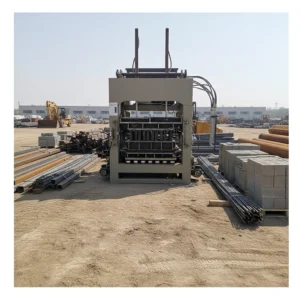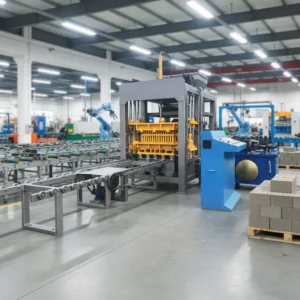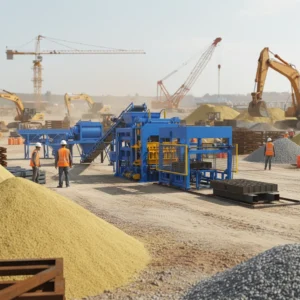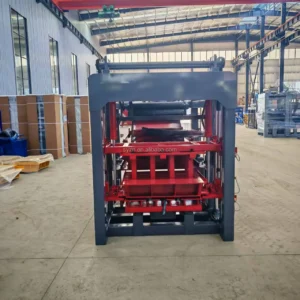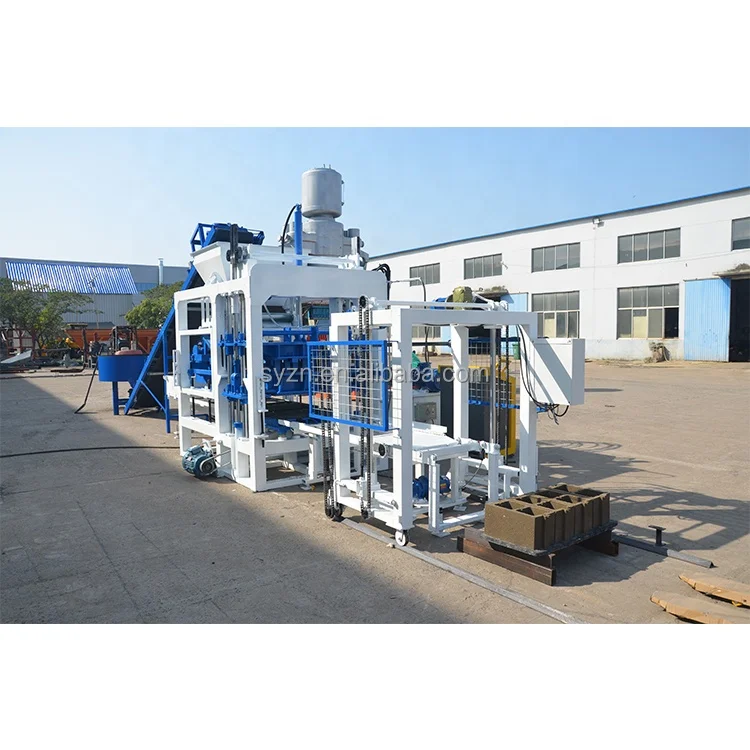
Matched System Design — The QT4-18 press, pallet feeder, brick conveyor and sweeper are scoped as one block production line equipment package, so cycle times between stations are calculated together before the line ships.
Technical Specifications
| Parameter | Value |
|---|---|
| Product Type | Hydraulic Block Making Machine |
| Model | QT4-18 |
| Overall Dimensions (L×W×H) | 3900×1600×2300 mm |
| Molding Cycle | 15-25 s |
| Vibration Force | 40-50 kN |
| Rated Power | 24 kW |
| Mixer Model | JQ350 |
| Pallet Size | 850×550×25 mm |
| Net Weight | 3 T |
| Control System | PLC control system (language to confirm before commissioning) |
| Hydraulic Station | Included |
| Pallet Feeder | Included |
| Brick Conveyor | Included |
| Block Sweeper | Included |
| Automation Level | Semi-automatic (manual hydraulic trolley for pallet handling) |
| Output Capacity (Hollow Block 400×200×200 mm) | 1200-1680 pcs/hr (basis: 15-20s cycle, 4 pcs/mould) |
| Output Capacity (Hollow Block 400×150×200 mm) | 1800-2400 pcs/hr (basis: 15-20s cycle) |
| Output Capacity (Solid Brick 240×115×53 mm) | 3240 pcs/hr (basis: 15-20s cycle) |
| Applied Products | Paver, solid block, hollow block, curbstone |
| Raw Materials | Crushed stones, sand, cement, dust, fly ash |
| Voltage & Frequency | To be confirmed before production |
Application Suitability
| Application | Material or Output |
|---|---|
| Hollow block production for small-to-medium plants | Crushed stone, sand, cement, fly ash blends on 850×550 mm pallets |
| Solid brick runs for masonry supply | Cement and sand mixes, 240×115×53 mm format |
| Paver and curbstone manufacturing | Aggregate-rich mixes requiring 40-50 kN vibration force |
| On-site construction block production | Compact 3900×1600 mm footprint with matching conveyor and sweeper |
What "Pieces per Hour" Means When the Line Stations Are Not Balanced
A press rating means nothing if the pallet feeder cannot keep up or the conveyor backs up before the sweeper clears the surface.
I have stood on job sites where the block making machine supporting equipment was sourced piecemeal. The press cycled fine on its own, but the pallet feeder lagged by several seconds, and the brick conveyor jammed because the sweeper was not timed to the molding cycle. The operator ended up pulling pallets by hand, and the daily output dropped to a fraction of the quoted number [NEED_CITE: block line station synchronization and actual output variance]. When block production line equipment is specified as a matched set — press, feeder, conveyor and sweeper — the cycle times are calculated together so no station sits idle waiting for the next pallet.
How the Pallet Feeder and Conveyor Match the 15-25s Press Cycle
The QT4-18 molding cycle runs between 15 and 25 seconds depending on block format and mix density. The included pallet feeder is timed to deliver the next 850×550×25 mm pallet within that window, so the press does not wait empty between strokes. The brick conveyor then carries the loaded pallet away at a speed matched to the sweeper station, preventing a backlog that would force the operator to intervene manually. This station-to-station timing is where block production line equipment either holds its rated rhythm or falls apart.
Where the JQ350 Mixer Fits in the Upstream Flow
Before material reaches the press hopper, the JQ350 mixer must discharge a consistent batch within the same cycle window. If the mixer batch time is longer than the press cycle multiplied by the hopper capacity, the press starves and the entire block production line equipment sequence breaks down [NEED_CITE: mixer discharge rate and press hopper capacity matching]. The line layout should show mixer discharge interval, belt conveyor travel time and hopper volume as a single calculation, not three separate numbers on different pages of the quotation.
Reading the Specs That Actually Determine Daily Output
Vibration force at 40-50 kN and the hydraulic station work together to compact the mix into the mould. Higher vibration force with insufficient hydraulic pressure produces blocks that crack during curing; too much pressure without enough vibration leaves voids in hollow block walls. The 850×550×25 mm pallet size dictates how many blocks fit per cycle and must match the buyer’s existing curing racks and forklift tine spacing — a mismatch here means buying new pallets or re-racking the entire curing yard. The PLC control system governs the timing sequence between press, feeder, conveyor and sweeper, and its display language should be confirmed before the unit leaves the factory.
The Cost of Ignoring Downstream Handling in the Quotation
Buyers who focus only on press tonnage often discover after delivery that pallets must be moved by hand from the conveyor to the curing area. The semi-automatic configuration of the QT4-18 includes a manual hydraulic trolley, but without an automatic stacker the output still requires an operator at the end of the line [NEED_CITE: manual versus automatic stacking labor allocation in block plants]. If the pallet size was not checked against the curing rack spacing, the buyer may find that standard racks do not accept the 850×550 mm pallets, adding an unplanned capital cost before the first block is even sold.
Why Sourcing the Full Line from One Supplier Matters Here
Block machinery is the single focus of the supply scope, so the QT4-18 press, mould, pallet, feeder, conveyor and sweeper are specified as one matched system rather than assembled from separate vendors. The configuration is set against the buyer’s actual mix design and local aggregate, not a catalogue default. Mould design covers the formats the buyer’s market sells, and custom drawings are available. Pallet size and material are chosen with the buyer’s curing area and forklift in mind. Voltage, frequency and PLC display language are confirmed before production so the line powers up correctly on arrival.
Documentation & Verification
- Line layout showing cycle time per station for the chosen block format
- Pallet specification sheet with 850×550×25 mm size, material and load rating
- Voltage, frequency and PLC language confirmation before production
- Hydraulic and electrical schematic for site utility integration
- Factory test record on buyer’s target block format before dispatch
- Wear parts and mould list with first-replacement intervals
Installation, Commissioning & Support
- Foundation pad must accommodate 3900×1600 mm footprint plus conveyor run length
- Dedicated power circuit rated for 24 kW plus mixer and conveyor loads
- Press ships with hydraulic station pre-assembled; pallet feeder bolted on site
- PLC cycle timing calibrated to buyer’s mix during on-site commissioning
- Operator training covers mould change, pallet loading and sweeper adjustment
- Hydraulic seals and vibration springs listed in wear parts schedule
What to Include with Your Inquiry
Provide the block formats you plan to produce, the daily output target per format, and the raw materials available locally including aggregate gradation. Confirm your site voltage and frequency, the PLC display language your operators need, and whether your existing curing racks and forklift are compatible with 850×550×25 mm pallets. If you have an existing mixer or upstream conveyor, share its model and discharge rate so the block making machine supporting equipment can be timed to match.
Frequently Asked Questions
Q: How do the pallet feeder, conveyor and sweeper cycle times match the 15-25s press cycle?
A: Each station is timed so the pallet feeder delivers the next pallet before the press completes its stroke, the conveyor removes the loaded pallet at matching speed, and the sweeper clears the surface before the next cycle begins. The PLC coordinates all three to prevent idle gaps.
Q: Is the 850×550×25 mm pallet compatible with my existing curing racks?
A: Check your rack slot width and forklift tine spacing against these dimensions before ordering. If your current racks use a different pallet size, the line can be reconfigured, but the pallet feeder, conveyor width and sweeper must all be adjusted together to maintain station timing.
Q: What voltage, frequency and PLC language are confirmed before shipping?
A: These are confirmed during the quotation stage. The buyer specifies site voltage and frequency, and the PLC display language is set to match the operator team. Production does not begin until written confirmation is received on all three parameters.
Q: How is daily output calculated per block format?
A: Output figures are based on a 15-20 second cycle. For 400×200×200 mm hollow blocks, the press produces 4 pieces per mould at 1200-1680 pieces per hour. For 240×115×53 mm solid bricks, the rate is 3240 pieces per hour. Daily totals depend on shift length and actual cycle achieved with your mix.
Q: Which raw materials does the JQ350 mixer handle for this line?
A: The JQ350 handles crushed stone, sand, cement, fly ash and dust blends typical for hollow block and paver production. Mix moisture range should be confirmed with sample testing so the vibration force and hydraulic pressure are matched to the actual batch consistency.