
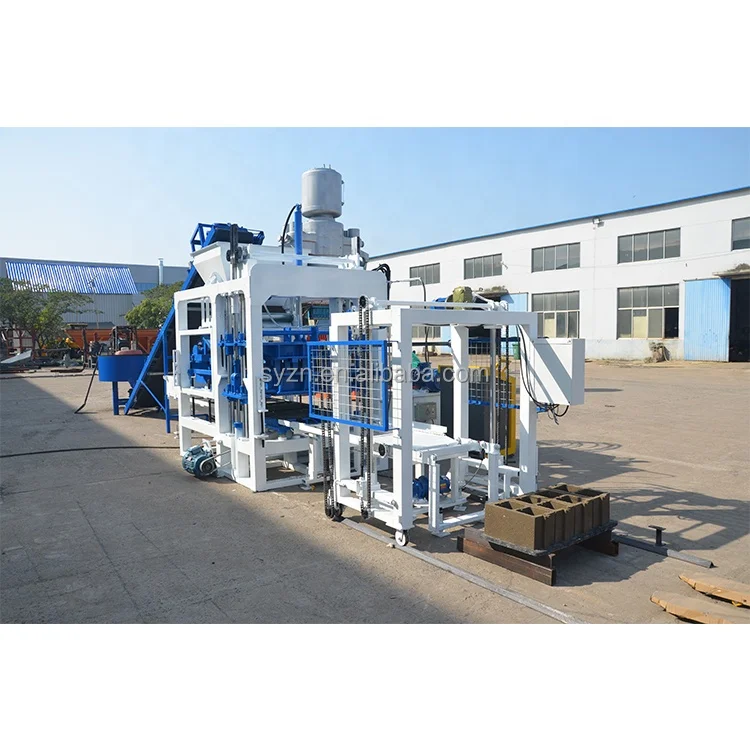
Line-Wide Cycle Matching — The QT4-18 is configured not as a standalone press but as one station within a synchronized block making machine supporting equipment layout, so mixer discharge, pallet feed and stacker cadence are calculated against the press cycle to eliminate idle time.
Technical Specifications
| Parameter | Value |
|---|---|
| Model | QT4-18 |
| Product Type | Automatic Hydraulic Concrete Block Making Machine |
| Overall Dimensions (L×W×H) | 3900×1600×2300 mm |
| Total Weight | 3 T |
| Rated Power | 24 kW |
| Vibration Force (Exciting Power) | 40–50 kN |
| Molding Cycle | 15–25 s (basis not stated in source — confirm block format / material / thickness) |
| Pallet Size | 850×550×25 mm |
| Mixer Model | JQ350 |
| Automation Level | Semi-automatic |
| Hydraulic Station | Equipped |
| Output Capacity (400×200×200 mm hollow block) | 1200–1680 pcs/h |
| Output Capacity (400×150×200 mm hollow block) | 1800–2400 pcs/h |
| Output Capacity (240×115×53 mm solid brick) | 3240 pcs/h |
| Daily Output, 8 hr (400×200×200 mm hollow block) | 9,600–13,440 pcs |
| Daily Output, 8 hr (400×150×200 mm hollow block) | 14,400–19,200 pcs |
| Daily Output, 8 hr (240×115×53 mm solid brick) | 16,200–19,440 pcs |
| Raw Materials | Crushed stones, sand, cement, dust, fly ash |
| Mould Formats | Hollow block, solid brick, paver, curbstone (mould change required) |
Application Suitability
| Application | Material or Output |
|---|---|
| Hollow concrete block for load-bearing and partition walls | Crushed stone, sand, cement, fly ash blends |
| Solid brick for masonry and infill | Cement, sand, stone dust |
| Paving block for walkways and yards | Aggregate, cement, pigment where required |
| Kerbstone / curbstone for road edges | Coarse aggregate, cement |
| On-site production for housing project contractors | Locally sourced sand and crushed stone |
What "Cycle Time" Means When the Mixer Cannot Keep Up
A 15-second press cycle is only achievable when upstream mixing and downstream pallet handling are timed to the same beat.
When a block machine production line is quoted on press capacity alone, the reality on site often tells a different story. I have watched a semi-automatic line stall every third cycle because the JQ350 mixer discharged slower than the host expected, and the pallet feeder could not return a fresh board in time. The press sat idle while workers waited for material. [NEED_CITE: production line bottleneck diagnosis in block plants] The block machine production line only reaches its stated output when every station — batching, mixing, conveying, pressing, stacking — is verified against the same cycle window.
Stations That Must Agree on Timing
The block making machine supporting equipment around the QT4-18 starts with the JQ350 pan mixer, which feeds the host press through a belt conveyor. If the mixer batch size and discharge rate do not match the press hopper demand per cycle, the press starves. Downstream, the 850×550×25 mm pallet must travel from the press bed to the stacker and back within the same window. A block machine production line is only as fast as its slowest station, and that station is rarely the press itself.
Pallet Flow as the Hidden Bottleneck
Every pallet carrying a fresh block must reach the curing area before the next empty pallet is needed at the press. With the 850×550 mm pallet size, the trolley and rack system must accommodate enough boards to keep the press running through a full shift while earlier boards are still curing. [NEED_CITE: pallet quantity calculation for continuous block production] If pallet count is under-estimated, the line stops — not because the press failed, but because there are simply no boards left to feed. This is why the quotation must cover pallet specification, quantity and transport hardware as part of the block making machine supporting equipment package rather than leaving it as a separate afterthought.
Reading the Numbers Behind the Output Table
The QT4-18 vibration force of 40–50 kN works together with the hydraulic station to compact the mix into the mould cavity. Higher vibration amplitude drives denser blocks, but only when the hydraulic hold pressure is matched to the same mix; too little pressure and the block cracks on de-moulding, too much and the surface spalls. The 24 kW rated power covers the vibration motor, hydraulic pump and conveyor drives simultaneously, so a dedicated circuit at the correct voltage and frequency is essential before first start-up. The 15–25 second molding cycle varies with block height and mix stiffness — a 240×115×53 mm solid brick compacts faster than a 400×200×200 mm hollow block because the cavity depth and fill time differ. Mould change between formats is manual, so planning which formats to run in a single shift directly affects usable output.
The Cost of Leaving Stations Off the Quotation
When pallet handling and stacking are excluded from the line proposal, the buyer discovers after arrival that finished blocks must be carried off the press bed by hand. [NEED_CITE: manual stacking labour cost in small block plants] Workers become the bottleneck, and the press cycle stretches well beyond its rated time. Similarly, if the mixer is sourced locally and its discharge gate does not match the conveyor intake height, material spills and clean-up downtime erode the shift output. These are not press failures — they are line-design gaps that show up only once production begins.
Why Procurement Here Covers the Full Line
Block machinery is the single focus, so the QT4-18 press, JQ350 mixer, pallet feeder and stacking station are specified as one matched set rather than assembled from separate suppliers. Configuration starts from the buyer’s actual mix design and local aggregate, not a catalogue default, ensuring vibration force and hydraulic pressure are set to produce consistent density. Mould design covers the formats the buyer’s market actually sells — hollow, solid, paver, kerbstone — with custom drawings available for non-standard sizes. Automation level is selectable, so a buyer can begin with semi-automatic pallet handling and add an automatic stacker later as volume grows. Documentation includes a line layout drawing that shows every station and the conveyor flow between them, so there are no surprises at installation.
Documentation & Verification
- Line layout drawing with every station and pallet flow path marked
- Capacity calculation stating the block format assumed at each output tier
- Pallet specification sheet covering size, material and required quantity
- Hydraulic and electrical schematic with voltage and frequency confirmed
- Factory test record run on the buyer’s chosen block format before dispatch
Installation, Commissioning & Support
- Foundation pad sized for the 3900×1600 mm press footprint and vibration load
- Dedicated 24 kW circuit with confirmed voltage and frequency before energizing
- Mixer and conveyor assembled on-site and aligned to the press hopper intake
- First-cycle test run with buyer’s local aggregate to verify mould fill and block density
- Operator training covering mould change procedure between hollow, solid and paver formats
- Wear parts list identifying hydraulic seals and vibration springs for first reorder
Before You Send the Inquiry
To size the supporting equipment correctly, it helps to know which block format you will produce most often, the daily volume target for that format, and the raw materials available locally. Share your workshop floor area and ceiling height so the curing rack layout can be drawn around existing columns and doors. Confirm the site voltage, frequency and preferred PLC display language so the control panel is wired correctly before the line ships.
Frequently Asked Questions
Q: How do I verify that mixer output, conveyor speed and press cycle time are matched so no station becomes the bottleneck?
A: Request a line timing chart that shows the JQ350 mixer discharge volume per batch against the QT4-18 hopper demand per cycle, and the pallet return time against the molding cycle. If any station exceeds the press cycle window, it must be resized before the order is finalized.
Q: What pallet size and material does the line require, and how many pallets do I need for continuous operation?
A: The line uses 850×550×25 mm pallets across the press bed, stacker and trolley. The quantity depends on curing time and shift length; a typical eight-hour shift running hollow blocks requires enough pallets to cover press output plus curing inventory before boards return empty.
Q: Is the automatic stacker included in the quotation, or is stacking still manual?
A: The QT4-18 is listed as semi-automatic, which means stacking method must be confirmed before order. If automatic stacking is required, the stacker station must be added to the line layout and quotation explicitly rather than assumed.
Q: How does the line layout change if I want to produce multiple block formats on the same press?
A: Each format — hollow, solid, paver, kerbstone — requires its own mould and may need a different pallet spacing at the stacker. The line layout drawing should show mould storage position and change procedure so that format switches fit within a planned shift break.



