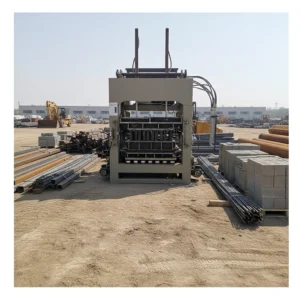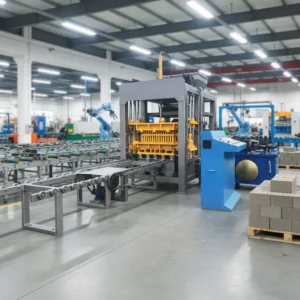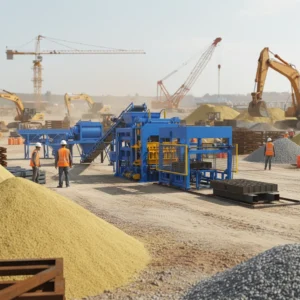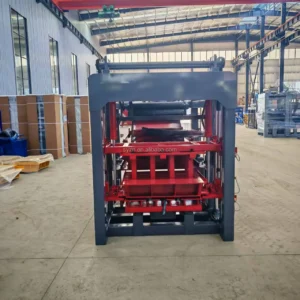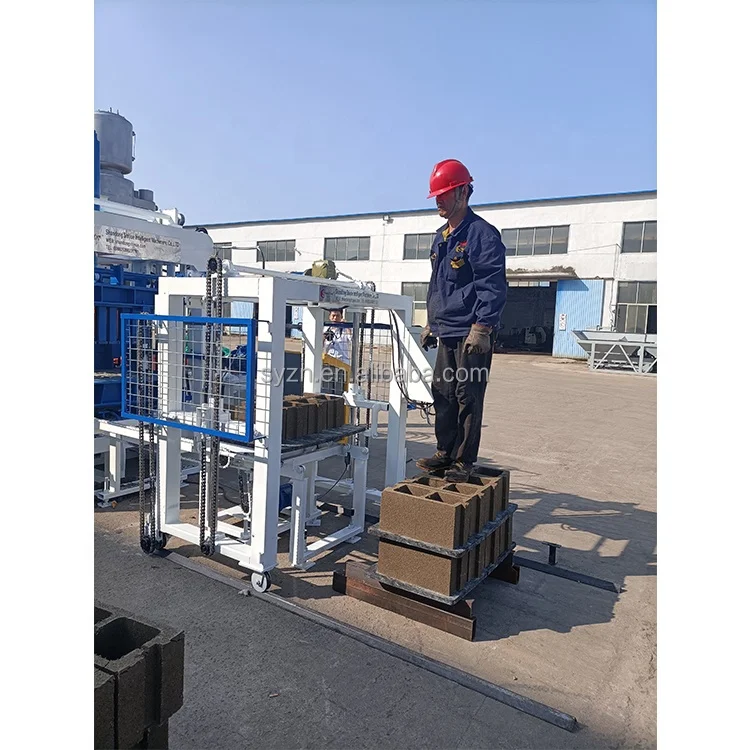
Integrated Line Engineering — every station around the QT4-18 is sized against the same cycle time and block format, so the press never waits on a mixer or stacker.
Technical Specifications
| Parameter | Value |
|---|---|
| Model | QT4-18 |
| Product Type | Automatic Hollow Block Making Machine |
| Machine Type | Hydraulic and vibration block making machine |
| Vibration Mode | Multiaxis synchronizer vibration (vertically downward) |
| Control System | Computer controlled, fully automatic |
| Hydraulic System | High thermal efficiency, low heat productivity |
| Mixer System | Multiaxis forced mixer |
| Guide System | Long-period over-length guide bearing |
| Rack Construction | High strength steel with special welding technique |
| Automation Level | Fully automatic |
| Mould Format | Hollow brick (other formats subject to confirmation) |
| Output Capacity | (basis not stated in source — confirm block format and cycle time) |
| Voltage & Frequency | Configurable to site supply (confirm before commissioning) |
| Pallet Size | To match curing area and forklift (confirm at order) |
| Cycle Time | Dependent on block format and mix design |
Application Suitability
| Application | Material or Output |
|---|---|
| Hollow block production plants | Crushed stone, sand, cement, fly ash, water |
| On-site block manufacturing for contractors | Locally sourced aggregate blended with cement |
| Concrete product facilities adding hollow formats | Standard concrete mixes with varied aggregate grading |
| Building material distributor demonstration lines | Common regional raw materials per market requirement |
What "Fully Automatic" Means When the Line Stops at the Press
A press labelled fully automatic only removes labour at the moulding station — pallet feeding, stacking, and curing still need bodies unless the surrounding line is specified to match.
I spent three weeks on a site in West Africa where the host press ran flawlessly in isolation. The bottleneck was twenty metres upstream: the mixer could not feed the hopper fast enough, and the press sat idle between cycles waiting for material. Downstream, two workers moved wet blocks by hand because no stacker had been quoted. The daily output fell well short of the buyer’s projection because the quotation covered the press alone, not the connected stations. The QT4-18 block production line turnkey configuration addresses this by mapping each station’s throughput against the press cycle before anything ships. [NEED_CITE: common causes of line throughput shortfall in concrete block plants]
Station-by-Station Throughput Alignment
The QT4-18 block production line turnkey layout begins with the raw material feeding and multiaxis forced mixer. This mixer handles aggregate of varying nature, but its discharge rate must match the press hopper consumption per cycle. If the mixer empties slower than the press draws, every cycle extends by the refill wait. We calculate the mixer batch size and discharge interval against the press cycle time for the specific block format the buyer intends to produce.
Downstream Handling That Keeps Pace
Once blocks leave the press, pallet feed rate, wet block stacking speed, and curing rack handling must all absorb output without accumulation. A stacker rated for fewer cycles per hour than the press creates a queue that eventually forces the press to pause. The QT4-18 block production line turnkey specification includes pallet return conveyors and stacking stations sized to the same cycle assumption stated in the line layout drawing. [NEED_CITE: pallet handling and stacking requirements in automatic block lines]
Why Vibration and Feed Uniformity Are Linked
The multiaxis synchronizer vibration system delivers vertically downward force to compact the mix inside the mould box. Consistent block density depends on the forced mixer delivering a uniform blend to every cycle. If the upstream batching station delivers inconsistent proportions, the vibration force compacts variable material and block strength drifts from batch to batch. The long-period over-length guide bearing keeps the upper mould aligned with the mould box through thousands of vibration cycles, but alignment alone cannot correct a poorly mixed feed.
Reading the Specification Sheet Against Your Actual Site
The hydraulic system on this press is designed for high thermal efficiency and low heat build-up, which matters in continuous production across long shifts in warm climates. The high-strength steel rack with special welding technique absorbs vibration shock cycle after cycle, but the pallet return conveyor and stacking station must be isolated from transferring shock back through the line. Voltage and frequency must be confirmed against the buyer’s site supply before production begins — arriving with a 380V motor on a 415V site delays commissioning until a transformer is sourced locally. The PLC display language should be agreed at order so the operator can read fault codes on day one.
The Cost of Leaving Stations Out of the Quotation
When pallet handling, stacking, and curing rack handling are not included in the initial quotation, the buyer discovers the gap at installation. Wet blocks pile up on pallets at the press exit, requiring manual labour that the "fully automatic" label implied was unnecessary. Pallets accumulate on the floor because no return conveyor was specified, and workers carry them back to the feed side by hand. The QT4-18 performs exactly as engineered, but the line around it operates at a fraction of its capacity because the missing stations were never costed. [NEED_CITE: hidden costs of incomplete block line quotations]
Why Source the Complete Line Here
Block machinery is the single focus of this operation, so the press, mixer, pallet system, and stacker are specified as one matched set rather than assembled from separate suppliers. The configuration is set against the buyer’s actual mix design, local aggregate, and target block format — not a catalogue default. Mould design covers the hollow brick formats the buyer’s market sells, with custom drawings available where needed. Automation level is selectable, meaning a buyer can begin with semi-automatic pallet handling and add automatic stacking later. Installation and commissioning support includes operator training on the connected line, not just the press in isolation.
Documentation & Verification
- Line layout drawing stating block format assumed for each station’s capacity
- Machine specification sheet with hydraulic and electrical schematic
- Voltage, frequency, and PLC language confirmation recorded before production
- Factory test record run on buyer’s confirmed block format
- Mould drawing and format list with pallet specification
- Packing photographs and customs documentation support
Installation, Commissioning & Support
- Foundation plan matching the QT4-18 rack footprint and vibration load path
- Electrical supply confirmed for the specified voltage and dedicated circuit rating
- Mixer and pallet system assembled and aligned to the press on arrival
- First production run supervised with cycle time verified per block format
- Operator training covering PLC fault codes and mould change procedure
- Wear parts and mould list supplied with the initial shipment
Before You Send the Inquiry
To size the complete line around the QT4-18, the starting point is the block format and the daily output target stated per format. Confirm the local aggregate type and grading available, the site voltage and frequency, and the PLC display language your operators will read. If an existing mixer, pallet system, or forklift will remain in use, share the specifications so the new stations can be matched to what is already on the floor.
Frequently Asked Questions
Q: How is daily output for the QT4-18 calculated and which format does it assume?
A: Output depends on the block format, cycle time, and mix design. A figure quoted without stating the assumed format and cycle time is not comparable across suppliers. We calculate daily capacity per format and show it in the line layout so you know which block size the number refers to.
Q: How do the mixer, pallet feeder, and stacker connect without creating a bottleneck?
A: Each station’s throughput is calculated against the press cycle time for the confirmed block format. The mixer batch size, pallet feed rate, and stacker speed are all specified to absorb press output without queue or idle time between cycles.
Q: Can the forced mixer adapt if my local aggregate differs from the original mix?
A: The multiaxis forced mixer handles materials of varying nature, but the mix design must be confirmed before the line is configured. If local aggregate differs, the batching ratios and mixer cycle time are adjusted so block strength remains consistent.
Q: Is pallet handling and stacking included or only the press?
A: The quotation scope is stated explicitly. When the complete line is requested, pallet feeding, stacking, and curing rack handling are included with throughput matched to the press. If only the press is quoted, the surrounding stations are listed as optional additions.
Q: How long does commissioning take and is operator training included?
A: Commissioning covers assembly, electrical connection, and supervised production runs on the confirmed block format. Operator training is included, covering PLC operation, mould change, and daily maintenance. Duration depends on line complexity and site readiness upon arrival.