
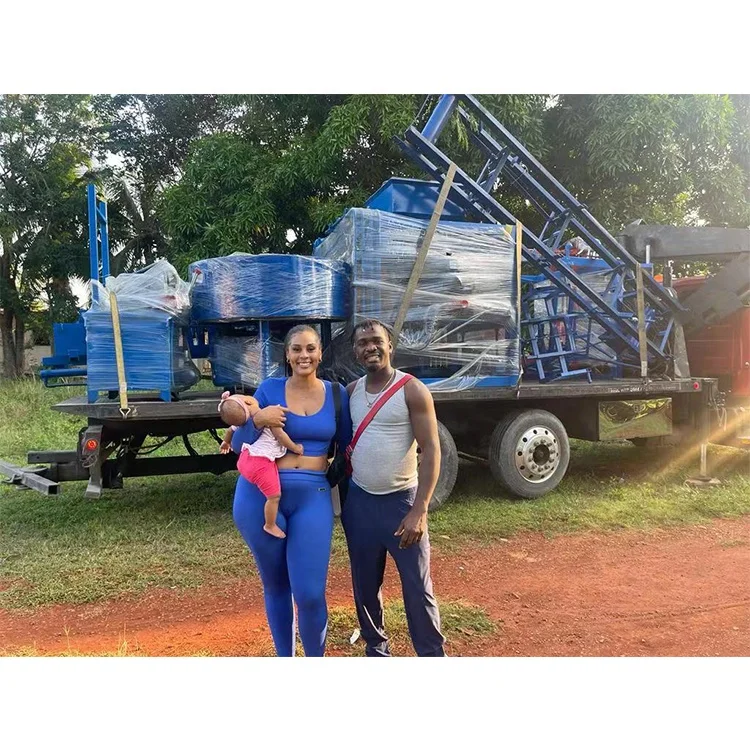
Station-Synchronized Line Engineering — mixer, press, and stacker configured as one timing-matched system so no single station bottlenecks the entire concrete block production line.
Technical Specifications
| Parameter | Value |
|---|---|
| Model | QT4-15A |
| Product Type | Fully Automatic Concrete Block Making Machine |
| Overall Dimensions (L×W×H) | 7100 × 1600 × 2610 mm |
| Molding Cycle | 15–25 s |
| Vibration Frequency | 4600 r/min |
| Vibration Force | 40–50 kN |
| Total Power | 18.45 kW |
| Mixer Model | JQ350 |
| Pallet Size | 850 × 550 × 25 mm |
| Total Weight | 3 T |
| Vibration Type | Bed mould vertical vibration + upper mould compression vibration |
| Hydraulic System | Hydraulic station for high-pressure forming |
| Stacking Method | Automatic stacker with trolley transfer |
| Pallet Material | Fiber glass (wooden pallets also compatible) |
| Recommended Pallet Quantity | 300–500 pieces |
| Applied Products | Paver, solid block, hollow block, curbstone |
| Raw Materials | Crushed stone, sand, cement, dust, fly ash |
| Output Capacity (Hollow Block 400×200×200 mm) | 408 pcs/hr, 3264 pcs/8hr |
| Output Capacity (Hollow Block 400×150×200 mm) | 510 pcs/hr, 4080 pcs/8hr |
| Output Capacity (Solid Brick 240×115×53 mm) | 2100 pcs/hr, 17000 pcs/8hr |
| Automation Level | Semi-automatic configuration (upgradeable) |
| Mould Change | Changeable moulds for hollow, solid, paver, curbstone |
| Certification | CE declaration where applicable |
Application Suitability
| Application | Material or Output |
|---|---|
| Hollow block production plant | Crushed stone, sand, cement, fly ash; 400×200×200 mm and 400×150×200 mm formats |
| Solid brick manufacturing | Cement and fine aggregate; 240×115×53 mm standard brick |
| Paver and curbstone production | Dense aggregate mixes for interlocking pavers and road kerbstones |
| On-site contractor block making | Local sand and crushed stone for housing development wall blocks |
| Fly ash brick production | Fly ash blended with cement and dust for lightweight building units |
What Quoted Cycle Times Leave Out About Your Daily Output
Real throughput depends on every station in the block making machine supporting equipment chain keeping pace with the press.
I learned this the hard way in Mauritania. A client ran a QT4-15 class press with fly ash brick, but the upstream mixer could not discharge fast enough. Material sat in the hopper, started setting, and the whole concrete block production line stalled twice a day. The press was rated for a certain cycle, but daily output fell well short because nobody calculated the mixer-to-press handoff. That line matching failure cost them more than any machine spec could predict [NEED_CITE: common causes of block plant throughput loss in field conditions].
How Every Station Connects From Feed to Stack
The QT4-15A concrete block production line treats each station as a timed link in one chain. The JQ350 mixer must batch and discharge within the window the press needs to complete a molding cycle. If the conveyor delivers raw material slower than the mixer batches, the press starves. If the pallet feeder cannot place a board before the mould descends, every cycle adds seconds of dead time. Shiyue Machinery specifies these intervals together so the block making machine supporting equipment never forces the host press to idle.
Pallet Circulation as the Hidden Bottleneck
Block presses are often rated without accounting for pallet return speed. On this line, the automatic stacker lifts cured boards onto trolleys while fresh pallets feed back to the press. The recommended 300–500 fiber glass pallets must circulate through curing and back before the press exhausts the available stock. When pallet quantity or return logistics fall short, operators start stacking by hand — and daily output drops regardless of how fast the press cycles [NEED_CITE: pallet circulation requirements for continuous block production].
Reading the Numbers That Actually Matter
The vibration system combines bed mould vertical vibration at 4600 r/min with upper mould compression, generating 40–50 kN of exciting force. In practice, this dual action compacts the concrete from both directions, producing consistent density across the pallet surface rather than hard edges with a soft core. The hydraulic station maintains steady pressure through each stroke, which matters especially when fly ash or fine dust makes up a large portion of the mix — materials that can segregate under uneven pressure.
The pallet dimension of 850 × 550 × 25 mm determines how many blocks form per cycle and how your forklift and curing yard must be arranged. Fiber glass pallets resist moisture warping compared to wood, but if your local market only stocks timber boards, the machine accepts those too. The molding cycle of 15–25 seconds varies by block format and mix stiffness, which is why capacity is stated per dimension: 408 pieces per hour for 400×200×200 mm hollow blocks, 510 for the narrower 400×150×200 mm variant, and 2100 for solid 240×115×53 mm bricks.
When Stations Fall Out of Sync
A mismatched line does not just produce fewer blocks — it produces worse ones. When the mixer delivers inconsistent batch sizes because it is rushing to keep up, the mould fills unevenly. Blocks come out with density variation across the same pallet. When pallets arrive late, the press holds the mix too long and partial setting begins inside the hopper. These defects are invisible in a quotation that lists only the press cycle time [NEED_CITE: effects of upstream equipment mismatch on block density consistency].
Why Line Matching Happens Here
The block machinery focus means the press, mould, pallet, and handling equipment are specified as one system rather than assembled from separate suppliers. Each configuration is set against your actual mix design and local aggregate, not a catalogue default. Mould design covers the formats your market sells, including custom drawings. The automation level is selectable, so a buyer can start with the semi-automatic QT4-15A configuration and add pallet feeding or cubing upgrades later. Installation includes operator training so your crew understands how station timing affects output.
Documentation & Verification
- Line layout drawing showing station spacing and conveyor lengths for the QT4-15A configuration
- Capacity calculation sheet stating block format assumed for each output figure
- Pallet specification matched to your curing yard dimensions and forklift capacity
- Hydraulic and electrical schematic with confirmed voltage and frequency
- Factory test record showing the press running your selected mould before dispatch
Installation, Commissioning & Support
- Foundation plan sized to the 7100 × 1600 mm footprint with vibration isolation requirements
- Power supply confirmed for 18.45 kW total load with dedicated circuit and correct voltage
- Machine arrives with hydraulic station pre-assembled; on-site connection and pressure calibration included
- JQ350 mixer positioned and timed to the press cycle during commissioning
- Operator training covers mould change procedure for all included block formats
- Wear parts list with reorder codes for hydraulic seals and vibration components
Before You Request a Quote
Tell us which block formats your market actually sells and the daily volume you need. Share your local aggregate type — whether it is river sand, crushed stone, or fly ash — and any existing equipment like forklifts or curing racks the new line must integrate with. Confirm your site voltage, frequency, and preferred control display language so the concrete block production line ships ready to commission.
Frequently Asked Questions
Q: How do I verify real daily output for my specific block format?
A: Output must be stated per block dimension, not as a generic cycles-per-hour figure. The QT4-15A produces 408 hollow blocks per hour at 400×200×200 mm but 510 at 400×150×200 mm. Multiply by your actual shift length and subtract time for mould changes, pallet restocking, and planned maintenance to get a realistic daily number for your product mix.
Q: What supporting equipment comes with the line, and what do I source locally?
A: The quotation includes the host press, JQ350 mixer, conveyor, pallet feeder, automatic stacker, and trolleys. You typically provide the forklift, curing rack structures, water supply, and compressed air if needed. Confirm exactly which stations are listed in your proposal before placing the order to avoid surprises at commissioning.
Q: How does pallet size and material affect my existing curing area?
A: The 850 × 550 mm pallet must fit your forklift tines and curing rack slots. Fiber glass pallets resist warping in humid climates, while wooden pallets may be cheaper to replace locally. Order 300–500 pieces to maintain continuous circulation through curing and back to the press without the line stopping to wait for boards.
Q: What voltage and control language will the machine ship with?
A: Electrical configuration and display language must be confirmed in writing before production begins. Different markets require different voltage and frequency standards. If the PLC or relay panel arrives with an unfamiliar language or wrong voltage, commissioning stalls until replacements are sourced — a delay that is entirely avoidable with upfront confirmation.
Q: Can I upgrade from semi-automatic to fully automatic later?
A: The QT4-15A ships in a semi-automatic configuration that covers mixing, pressing, and stacking. As volume grows, additional automation for pallet feeding and cubing can be integrated. Discuss the upgrade path when placing the initial order so the base frame and control panel leave room for future expansion without a full replacement.



