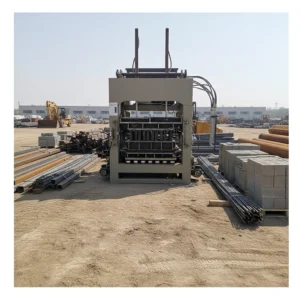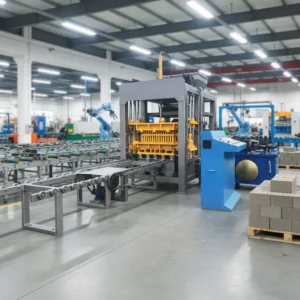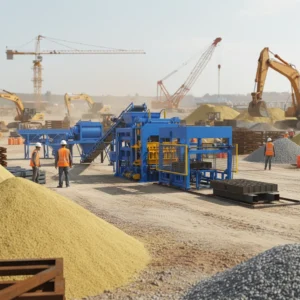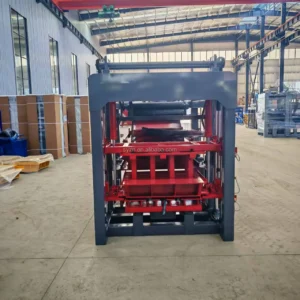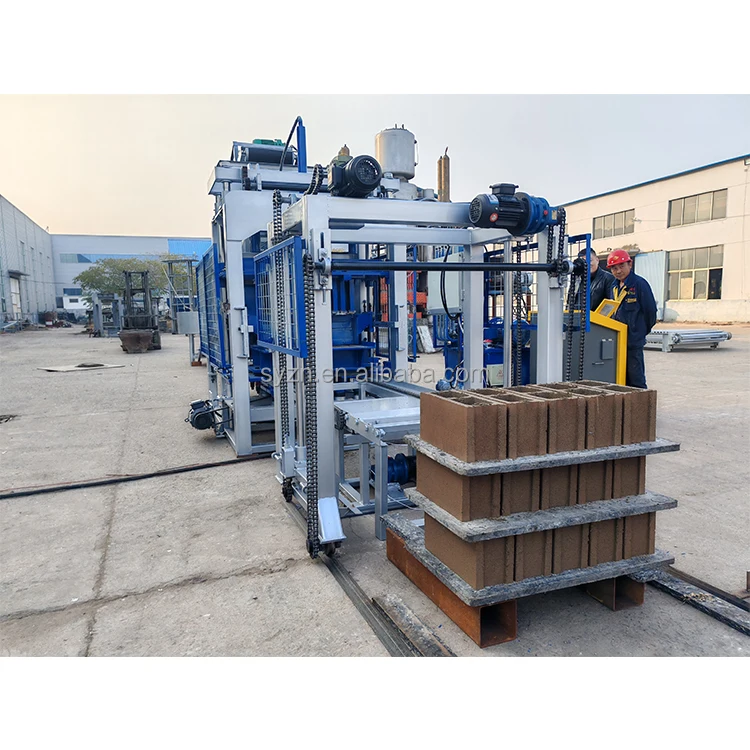
Line-Matched Integration — Every upstream and downstream station is timed against the QT4-15A press cycle, eliminating idle waits that quietly drain daily output.
Technical Specifications
| Parameter | Value |
|---|---|
| Model | QT4-15A |
| Product Type | Fully Automatic Concrete Block Making Machine |
| Overall Dimensions (L×W×H) | 4100×1600×2600 mm |
| Rated Hydraulic Pressure | 16–21 MPa |
| Vibration Form | Platform Vibration |
| Vibration Frequency | 4200 r/min |
| Vibration Force | 55 kN |
| Pallet Size | 880×550 mm |
| Molding Cycle | 25–30 s (basis not stated in source — confirm block format / material / thickness) |
| Overall Power | 18.45 kW |
| Total Mass | 4 T |
| Demolding Method | Hydraulic |
| Recommended Factory Area | 300 m² |
| Control System | PLC (language options available on request) |
| Automation Level | Fully automatic |
| Shipment Configuration | 1×40HQ container (basic equipment) |
| Warranty | 1 year for the whole machine (excluding spare parts) |
Application Suitability
| Application | Material or Output |
|---|---|
| Hollow block production for building walls | Crushed stone, sand, cement, fly ash |
| Solid block manufacturing for load-bearing structures | Gravel, sand, cement, slag |
| Paving block and interlocking paver production | Crushed stone, cement, colored pigments |
| Kerbstone and curb production for road projects | Coarse aggregate, sand, cement |
| Porous and permeable paver production | Open-graded aggregate, cement, dust |
What "25–30 Seconds Per Cycle" Leaves Out of Your Output Calculation
The press cycle only sets the pace if every station upstream and downstream can actually keep up.
When I first visited block plants across Southeast Asia, the most common complaint was never about the press itself. It was about the concrete block making machine production line stalling because the mixer could not deliver a fresh batch in time, or the pallet return conveyor jammed under wet concrete dust. A 25–30 second molding cycle means nothing if the pallet feeder needs 40 seconds to reset. The entire line drops to the speed of its slowest station, and daily output quietly falls well below what the brochure promised. [NEED_CITE: synchronization of cycle times across block production line stations]
Synchronizing Raw Material Feeding and Mixing to the Press Rhythm
The QT4-15A completes a molding cycle in 25–30 seconds, which sets the target throughput for every upstream component. The batch mixer must discharge a full charge within that same window, and the raw material feeding system must replenish the mixer before the next cycle begins. When specifying a concrete block making machine production line around this press, we calculate mixer drum capacity and discharge time against the actual block format being produced, not a catalogue default.
Pallet Circulation as the Hidden Bottleneck
Pallets travel from the press to the curing area, through curing, and back to the press in a continuous loop. With a pallet size of 880×550 mm, the return conveyor speed and the stacking station retrieval rate must both align with the 25–30 second press cycle. If the curing rack handling system cannot accept a fresh rack in time, pallets queue up and the press idles. This is where most line layouts fail — the press specification is detailed, but the pallet loop is treated as an afterthought. [NEED_CITE: pallet circulation design in automatic block production lines]
Reading the Specifications Beyond the Press Alone
The 55 kN vibration force at 4200 r/min paired with 16–21 MPa hydraulic pressure determines block density and green strength. But density consistency across a production run also depends on the batching accuracy of the raw material feeding system. If the cement-to-aggregate ratio drifts between batches, the same vibration and pressure settings will produce blocks of varying strength. The PLC control system coordinates batching, mixing, pressing, and pallet handling as one sequence, so that each station receives its trigger signal at the correct point in the cycle rather than operating on independent timers.
The Cost of Stations That Do Not Talk to Each Other
I have seen plants where the stacker was rated for a faster cycle than the press, running half-empty most of the day while consuming full power. Others had mixers sized for peak demand but no variable discharge control, flooding the press hopper on one cycle and starving it on the next. These mismatches do not show up in individual equipment quotations — they only appear during trial production, when the daily tally falls short and nobody can point to a single faulty component. The problem is the gap between stations, and it is invisible until the line runs under real conditions. [NEED_CITE: impact of station mismatch on block plant daily output]
Why Sourcing the Full Line From One Supplier Matters
Block machinery is our single focus, so the QT4-15A press, moulds, pallets, and handling equipment are specified as one matched system rather than assembled from separate vendors. We configure the line against your actual mix design and local aggregate, not a generic template. Pallet size and material are chosen with your existing curing area dimensions and forklift capacity in mind. Automation level is selectable — a buyer can start semi-automatic and add automatic stacking or pallet feeding stations later without replacing the press. Voltage, frequency, and PLC display language are confirmed before production begins, preventing commissioning delays after the container arrives on site. [NEED_CITE: advantages of single-supplier block production line configuration]
Documentation & Verification
- Line layout and capacity calculation stating the block format assumed for each station
- Machine specification sheet covering press, mixer, and handling equipment
- Mould drawing and format list matching your local market product range
- Hydraulic and electrical schematic with confirmed voltage and frequency
- Factory test record on your specified block format before dispatch
- Pallet specification matched to your curing area and forklift capacity
Installation, Commissioning & Support
- 300 m² factory footprint plan showing station placement for the QT4-15A line
- Dedicated power circuit for 18.45 kW total load with confirmed voltage and frequency
- Equipment shipped in 1×40HQ container with dismantling guide for reassembly
- PLC parameter setup and cycle timing calibration during on-site commissioning
- Operator training on press, mixer, pallet feeder, and stacking station controls
- Wear parts and mould list supplied with the machine for first replacement planning
Before You Request a Quotation
Tell us which block formats you plan to produce and your target daily output per format, so we can calculate station cycle times accordingly. Share your local raw material sources and typical aggregate grading so the mixer and feeding system are sized correctly. Confirm your site voltage, frequency, and preferred PLC display language so the control system is configured before shipment.
Frequently Asked Questions
Q: How is the capacity of each line station calculated for the QT4-15A?
A: Each station is timed against the 25–30 second molding cycle, but that cycle figure depends on the specific block format, material mix, and thickness being produced. We provide a written capacity calculation that states the assumed format for every station’s throughput, so daily output projections are transparent and format-specific rather than a single blanket number.
Q: How do mixing output and stacking speed stay synchronized with the press?
A: The PLC control system triggers each station in sequence based on the press cycle position, not on independent timers. The mixer discharge, pallet feeder advance, and stacker retrieval are all coordinated so that no station waits for the previous one to finish. This sequencing is calibrated during on-site commissioning with your actual block format running on the line.
Q: What pallet size is recommended and how does it affect the curing area?
A: The standard pallet size is 880×550 mm, but the material and thickness are selected based on your curing rack dimensions and forklift capacity. A pallet that is too heavy for your forklift or too large for your curing racks creates a bottleneck that has nothing to do with the press itself, so we confirm these details before finalizing the pallet specification.
Q: Can the automation level be upgraded in stages?
A: Yes. A buyer can start with semi-automatic pallet handling and manual stacking, then add automatic pallet feeding or an automatic stacker as production volume grows. The QT4-15A PLC architecture supports station-by-station upgrades without requiring a press replacement or a full control system swap.
Q: What electrical details are confirmed before the machine ships?
A: Voltage, frequency, and PLC display language are confirmed in writing before production begins. This prevents the common situation where a machine arrives on site and cannot be powered up because the local supply does not match the factory-default configuration, or the operator cannot read the control interface.