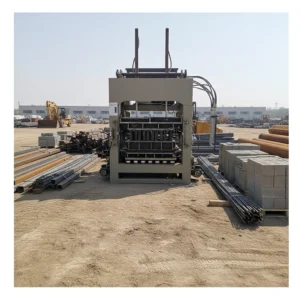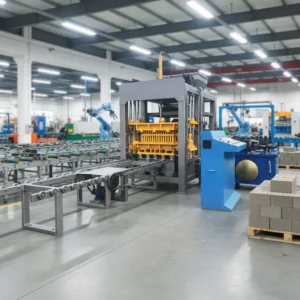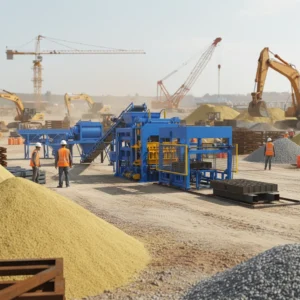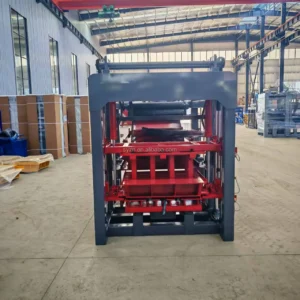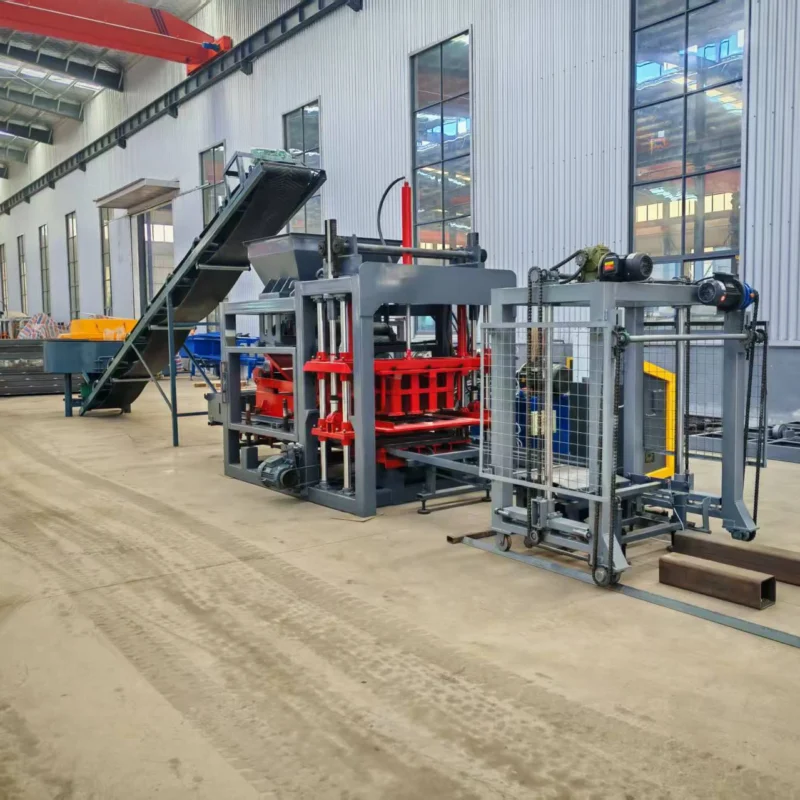
Matched Line Rhythm — every upstream feeder, mixer, and downstream stacker in this concrete block making machine production line is timed to the press cycle before dispatch, so the host machine never idles waiting for material or pallets.
Technical Specifications
| Parameter | Value |
|---|---|
| Model | QT4-15A |
| Product Type | Fully Automatic Concrete Block Making Machine |
| Overall Dimensions (L×W×H) | 4100 × 1600 × 2600 mm |
| Rated Pressure | 16–21 MPa |
| Main Vibration Form | Platform Vibration |
| Vibration Frequency | 4200 r/min |
| Vibration Force | 55 kN |
| Pallet Size | 880 × 550 mm |
| Molding Cycle | 25–30 s (basis not stated in source — confirm block format / material / thickness) |
| Overall Power | 18.45 kW |
| Total Mass | 4 T |
| Demolding Method | Hydraulic |
| Factory Area | 300 m² |
| Automation Level | Fully automatic |
| Control System | PLC |
| Raw Materials | Crushed stone, sand, cement, dust, fly ash, gravel, slag |
| Applied Products | Concrete blocks, hollow/solid blocks, pavers, interlocking blocks, curbstone, colored pavers |
| Warranty | 1 year (whole machine, excluding spare parts) |
Application Suitability
| Application | Material or Output |
|---|---|
| Hollow block production for residential and commercial walls | Crushed stone, sand, cement, fly ash |
| Solid block manufacturing for load-bearing structures | Gravel, sand, cement blends |
| Paving brick and colored paver runs for driveways and walkways | Fine aggregate, cement, pigment additives |
| Interlocking brick and kerbstone for municipal projects | Slag, crushed stone, cement mixtures |
What "25–30 Seconds per Cycle" Leaves Out When the Rest of the Line Is Missing
A press cycle only matters when every station before and after it keeps pace.
I have watched plants install a concrete block making machine production line where the host press could cycle every 25–30 seconds, yet the mixer discharged batch into the hopper every 45 seconds. The result: the press sat idle nearly half the shift. Buyers sign off on a cycle time quoted for the press alone, then discover the raw material feeder, the pallet return conveyor, and the stacking station were never part of the original scope. Daily tonnage drops, labor costs rise, and the investment case quietly unravels [NEED_CITE: typical block plant line integration gaps reported by equipment importers].
Synchronizing Raw Material Feed with Press Demand
The QT4-15A runs a 25–30 second molding cycle, which means the batch feeder and mixer upstream must deliver a fresh charge of mixed material within that same window. When a concrete block making machine production line is specified as a set of individual components rather than a single system, the feeder conveyor speed and the mixer discharge gate timing are often left to the buyer to reconcile on site. Our configuration process starts with the buyer’s target block format and mix design, then sizes the feeder screw diameter and mixer drum volume so that material arrives at the press hopper just before the previous charge is exhausted — not ten seconds late, and not twenty seconds early sitting in a hopper losing workability.
Aligning Pallet Return Speed with the Molding Window
After each press stroke, a finished block sits on an 880 × 550 mm pallet that must travel through the curing rack, be stripped, and return to the pallet feeder before the next cycle begins. If the pallet return loop takes 35 seconds but the press cycles at 25 seconds, the press waits ten seconds per stroke — a loss that compounds across an eight-hour shift. In our line layout, the pallet conveyor length, the rack handling speed, and the stripper station position are all calculated against the press cycle before the quotation is finalized. The goal is a continuous loop where the next pallet is in position the instant the press is ready, eliminating the micro-stoppages that erode daily output [NEED_CITE: pallet handling cycle synchronization in automatic block plants].
Reading the Specifications That Actually Affect Block Quality
The 16–21 MPa rated pressure and 55 kN vibration force at 4200 r/min together determine whether a hollow block leaves the mould at sufficient green strength to survive pallet transfer without cracking. Higher pressure alone compresses the mix but can trap air; vibration alone fluidizes the mix but without adequate pressure the block remains porous. Platform vibration transfers energy through the pallet into the full mould cavity, which is more effective for the 880 × 550 mm pallet area than mould-wall vibration that leaves dead zones in the centre. The hydraulic demolding stroke lifts the mould box vertically, reducing lateral drag on the freshly formed block and preserving edge definition — important when producing interlocking pavers or kerbstones where dimensional tolerance affects laying speed on site. Total installed power of 18.45 kW covers the main press motor, hydraulic pump, and vibration motor; buyers should confirm their site transformer can sustain this continuous draw plus the feeder, mixer, and stacker loads simultaneously.
The Cost of Leaving Line Integration to Chance
When a buyer purchases the press from one supplier, the mixer from another, and handles pallet logistics with existing workshop equipment, the cycle times of each station rarely align. The press idles, the mixer over-produces and the mix begins to set in the hopper, and pallets pile up at the end of the line because the curing rack was not designed for the actual output rate. These problems surface after installation, when the line is already bolted to the floor and the containers have sailed. The rework cost — new conveyors, resized mixers, additional pallet inventory — frequently exceeds the original savings from splitting the purchase order [NEED_CITE: post-installation line rebalancing costs in block manufacturing].
Why Specifying the Full Line at Quotation Stage Matters
Block machinery is our single focus, which means the press, moulds, pallets, and handling equipment are treated as one engineered system from the first proposal. Every line we configure is set against the buyer’s actual mix design, local aggregate availability, and target block format rather than a catalogue default — the QT4-15A is no exception. Mould design covers every format the buyer’s market demands, and custom drawings are available when standard moulds do not match local specifications. Automation level is selectable, so a buyer can begin with semi-automatic pallet handling and upgrade to full stacking and cubing later without replacing the press. Installation support includes operator training, and wear parts lists are provided so the first replacement order can be placed before stock runs out.
Documentation & Verification
- Line layout drawing showing each station position and cycle time relative to the QT4-15A press rhythm
- Capacity calculation stating the specific block format and mix assumed for the 25–30 s cycle
- Pallet specification sheet with 880 × 550 mm dimensions, material grade, and load rating
- Hydraulic and electrical schematic confirming voltage, frequency, and PLC display language before production
- Factory test record demonstrating feeder, mixer, press, and stacker running in sequence at rated cycle
Installation, Commissioning & Support
- Foundation plan based on 4100 × 1600 mm footprint and 4 T mass with vibration isolation requirements noted
- Electrical supply confirmed for 18.45 kW continuous draw plus upstream and downstream station loads
- Machine shipped in dismantled state with reassembly sequence documented for the 300 m² factory area
- PLC language and control interface set to buyer specification before dispatch from factory
- Operator training covers mould change procedure, hydraulic pressure adjustment, and daily maintenance checkpoints
- Wear parts and mould list provided at delivery so reorder planning starts from day one
Tell Us About Your Line Before We Quote
To size the concrete block making machine production line correctly, share your target block formats and the daily output you need for each one. Confirm the raw materials you can source locally — especially aggregate type and maximum particle size — and the curing yard space you have available, because that determines pallet quantity and rack layout. Let us know your site voltage and frequency, plus the PLC display language your operators will need, so the control panel is configured before the machine ships.
Frequently Asked Questions
Q: How are the upstream feeder and mixer sized so they never starve the QT4-15A press?
A: We start with your target block format and mix design, then calculate the batch volume each 25–30 second stroke consumes. The mixer drum capacity and feeder screw speed are set so a fresh charge lands in the press hopper just before the previous one is exhausted — no idle time, no material sitting and losing workability.
Q: Is pallet feeding, stacking, and curing rack handling included in the line quotation?
A: It depends on the configuration you select. The quotation clearly lists every station — feeder, mixer, press, pallet return, stacker, and rack handler — so you know exactly what is on the purchase order and what remains your responsibility before the line ships.
Q: How does the 880 × 550 mm pallet relate to my existing curing area and forklift?
A: Pallet dimensions must match your curing rack slot spacing and forklift tine width. We confirm these measurements at quotation stage so the pallet specification, rack layout, and handling equipment are planned together rather than discovered after arrival.
Q: What voltage, frequency, and PLC language are confirmed before the line ships?
A: We record your site voltage, frequency, and preferred PLC display language during the proposal stage and print them on the electrical schematic. The control panel is wired and labeled accordingly before the factory test, so no rewiring is needed after installation.
Q: How is line capacity stated — per cycle, per shift, and for which block format?
A: Our capacity calculation names the exact block format, dimensions, and mix assumed for every cycle time figure. This means you can see the realistic daily output for hollow blocks, pavers, or interlocking bricks separately rather than a single optimistic headline number.