
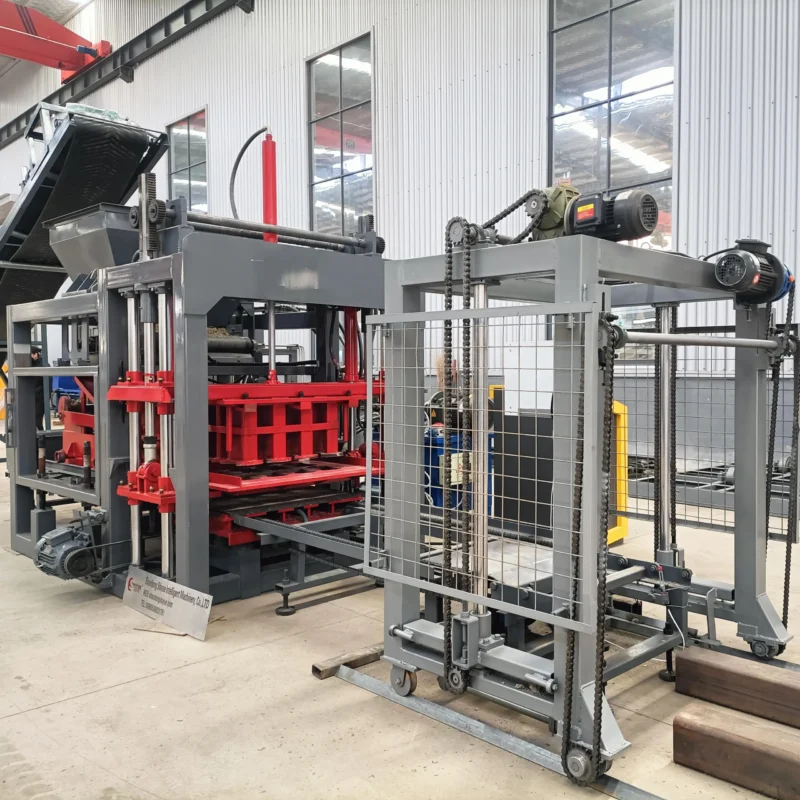
Matched System Sizing — the QT4-15A press is specified alongside its mixer, pallet circuit and stacking stations so every node in the concrete block making machine production line runs at the same cadence.
Technical Specifications
| Parameter | Value |
|---|---|
| Product Type | Fully Automatic Concrete Block Making Machine |
| Model | QT4-15A |
| Overall Dimensions (L×W×H) | 4100 × 1600 × 2600 mm |
| Rated Pressure | 16–21 MPa |
| Main Vibration Form | Platform Vibration |
| Vibration Frequency | 4200 r/min |
| Vibration Force | 55 kN |
| Pallet Size | 880 × 550 mm |
| Molding Cycle | 25–30 s (basis not stated in source — confirm block format / material / thickness) |
| Overall Power | 18.45 kW (source value listed as W — verify against manufacturer catalog) |
| Demolding Method | Hydraulic |
| Total Mass | 4 T |
| Factory Area | 300 m² |
| Automation Level | Fully automatic |
| Applied Products | Hollow blocks, solid blocks, pavers, interlocking blocks, curbstones, colored pavers |
| Raw Materials | Crushed stone, sand, cement, fly ash, gravel, slag, dust |
| Warranty | 1 year |
| Loading | 1 × 40HQ container (basic equipment) |
Application Suitability
| Application | Material or Output |
|---|---|
| Hollow block production for residential and commercial walls | Crushed stone, sand, cement, fly ash |
| Solid block manufacturing for load-bearing structures | Gravel, sand, cement blends |
| Paving block and colored paver runs for walkways and plazas | Fine aggregate with pigment additives |
| Interlocking brick and kerbstone runs for landscaping | Slag, dust, cement mixes |
| On-site production for housing project contractors | Locally sourced aggregate and cement |
Why "Cycles per Hour" Misleads Buyers on a Block Line
A press rating means nothing when the mixer, pallet return and stacker cannot keep pace.
I spent years on after-sales calls across Latin America, and the most frustrating tickets were never about the press itself. The QT4-15A would arrive, get bolted down, and start running — then the operator would stand idle because the upstream batch mixer was still blending, or the pallet return conveyor was jammed with wet concrete dust. Buyers had paid for a certain output number that assumed every surrounding station matched the press cadence [NEED_CITE: typical block line bottleneck patterns in small-to-medium plants]. When the concrete block making machine production line is quoted as a press alone, the real daily output falls far short of what the cycle time suggests.
Line Cadence Starts at the Mixer, Not the Press
A 25–30 second molding cycle demands that fresh mix arrives at the hopper before the previous cycle finishes. If the batch mixer delivers one charge every ninety seconds but the press needs a fresh charge every thirty, the press sits idle for two out of every three cycles. Sizing the mixer to the press is the first step in any concrete block making machine production line layout, and it must account for the specific mix design the buyer will actually run.
Pallet Circulation Sets the True Ceiling
The 880 × 550 mm pallet leaves the press carrying a wet block layer and must travel through the curing rack zone, be stripped, cleaned and returned before the next cycle can fire. If the pallet return path is too long or the curing rack layout forces a wide loop, the press waits for an empty pallet. Planning the pallet circuit around the buyer’s existing curing area and forklift capacity prevents this hidden bottleneck [NEED_CITE: pallet circulation design in block plant layouts].
Stacking and Curing Close the Loop
Finished blocks must be lifted off the pallet, stacked on a curing rack and moved to the yard. When stacking is done by hand, the operator becomes the slowest station in the entire line. An automatic stacker sized to the press output removes that constraint and keeps the concrete block making machine production line running at its designed rhythm.
Reading the Specs That Shape Block Quality
Platform vibration at 4200 r/min combined with 55 kN vibration force compacts the mix from below, driving aggregate particles into tight contact. The 16–21 MPa hydraulic pressure then locks that compacted shape in place during demolding. Both values must match the buyer’s mix design — a high-fly-ash blend responds differently to vibration than a pure crushed-stone mix, and mismatched force leads to inconsistent block strength across a single batch.
The 880 × 550 mm pallet size determines how many blocks fit per cycle and how the curing racks must be dimensioned. Choosing a pallet without checking the buyer’s existing rack spacing and forklift fork width creates handling delays that no press speed can recover. The 300 m² factory area figure covers the full line footprint — mixer, feeding conveyor, press, pallet return loop, stacking zone and curing rack area — not just the press footprint alone.
Hydraulic demolding lifts the mould off the green block rather than pushing the block out, reducing edge damage on thin-wall hollow blocks and interlocking paver profiles. This matters when the buyer’s market demands sharp arrises on colored pavers or kerbstones [NEED_CITE: hydraulic versus mechanical demolding effects on block edge quality].
The Hidden Cost of a Mismatched Line
When upstream and downstream stations are sourced separately, each vendor quotes a capacity that assumes ideal conditions on their equipment alone. The mixer vendor assumes instant discharge, the stacker vendor assumes perfectly spaced pallets, and the press vendor assumes a steady supply of both. In practice, the gaps between those assumptions accumulate, and the buyer ends up with a line where every station is technically working but the overall output is a fraction of the sum [NEED_CITE: integration losses in multi-vendor block lines]. Pallets pile up at one end, the press starves at the other, and the operator spends the shift moving material by wheelbarrow instead of running the control panel.
Why Sourcing the Full Line from One Supplier Matters
Block machinery is the single focus here, which means the press, mould, pallet and handling equipment are specified as one matched system rather than assembled from separate vendors. The configuration is set against the buyer’s actual mix design and local aggregate, not a catalogue default. Mould design covers the formats the buyer’s market actually sells, with custom drawings available for non-standard profiles. The automation level is selectable, so a buyer can start with semi-automatic pallet handling and add automatic stacking later without replacing the press. Installation and commissioning include operator training on the specific line layout delivered to the site.
Documentation & Verification
- Line layout drawing showing every station from material feeding through cubing with cycle time per block format
- Capacity calculation stating the exact block format and mix design assumed for the output figure
- Pallet specification sheet confirming size, material and load rating matched to curing rack dimensions
- Hydraulic and electrical schematic with voltage and control language confirmed before production
- Factory test record run on the buyer’s target block format before dispatch
- Packing photographs and customs documentation support for the 40HQ container load
Installation, Commissioning & Support
- Foundation plan sized to the 4100 × 1600 mm press footprint and 4 T operating mass
- Dedicated power circuit confirmed for the 18.45 kW total load at the buyer’s local voltage and frequency
- Press shipped in the 40HQ container with dismantling points marked for reassembly on site
- First-run commissioning covers mixer-to-press cadence tuning and pallet return path adjustment
- Operator training on the PLC panel with display language confirmed before shipment
- Wear parts list covering hydraulic seals, vibration springs and mould liners for first replacement cycle
Before You Request a Quote
Share the block formats your market sells, the daily volume you need for each format, and the raw materials available locally including aggregate gradation and cement type. Confirm your workshop dimensions, curing yard layout, existing forklift capacity and the voltage and frequency at your site. If you already run a mixer or pallet system, provide those specs so the line can be designed around them.
Frequently Asked Questions
Q: How is daily output calculated across the full line, and which block format is the cycle time based on?
A: The 25–30 second molding cycle is a press-level figure whose basis must be confirmed against the specific block format, wall thickness and mix design. Daily output is then calculated by mapping every station — mixer discharge rate, pallet return time, stacking speed — to that cycle and identifying the slowest node. The capacity document names the assumed format so real output can be verified.
Q: Are pallet feeding, stacking and curing rack handling included in the line scope, or quoted separately?
A: These stations are specified as part of the matched line, not as optional add-ons. The 880 × 550 mm pallet size, stacking method and curing rack layout are confirmed during the proposal stage so the press is never left waiting for an empty pallet or an operator to hand-stack finished blocks.
Q: How do upstream batching and mixing stations match the 25–30 s press cycle so the press is never left idle?
A: The mixer is sized so one full batch discharges within the press molding cycle, accounting for the buyer’s specific mix design and moisture content. The feeding conveyor is timed to refill the press hopper before the next cycle begins, and the line layout drawing shows these timing relationships station by station.
Q: What pallet size and material is recommended for the buyer’s existing curing area and handling equipment?
A: The 880 × 550 mm pallet is the default for the QT4-15A, but the material — timber, bamboo-composite or steel — is selected against the buyer’s curing rack spacing, yard surface and forklift fork width. A pallet spec sheet is issued with the proposal so the buyer can cross-check against existing infrastructure before production starts.
Q: What line footprint is needed, and does the 300 m² factory area cover all stations including curing?
A: The 300 m² figure covers the full line from raw material intake through the curing rack zone, including the mixer, feeding system, press, pallet return loop and stacking area. The exact layout is drawn to the buyer’s workshop dimensions, and ceiling height requirements are confirmed to accommodate the 2600 mm press height plus overhead pallet clearance.



