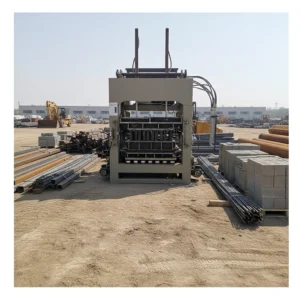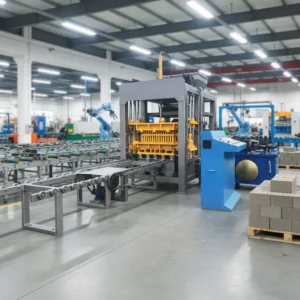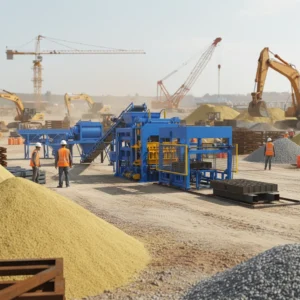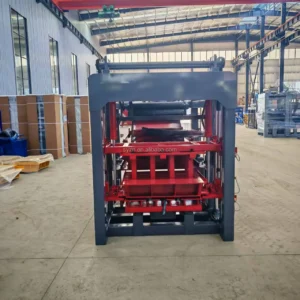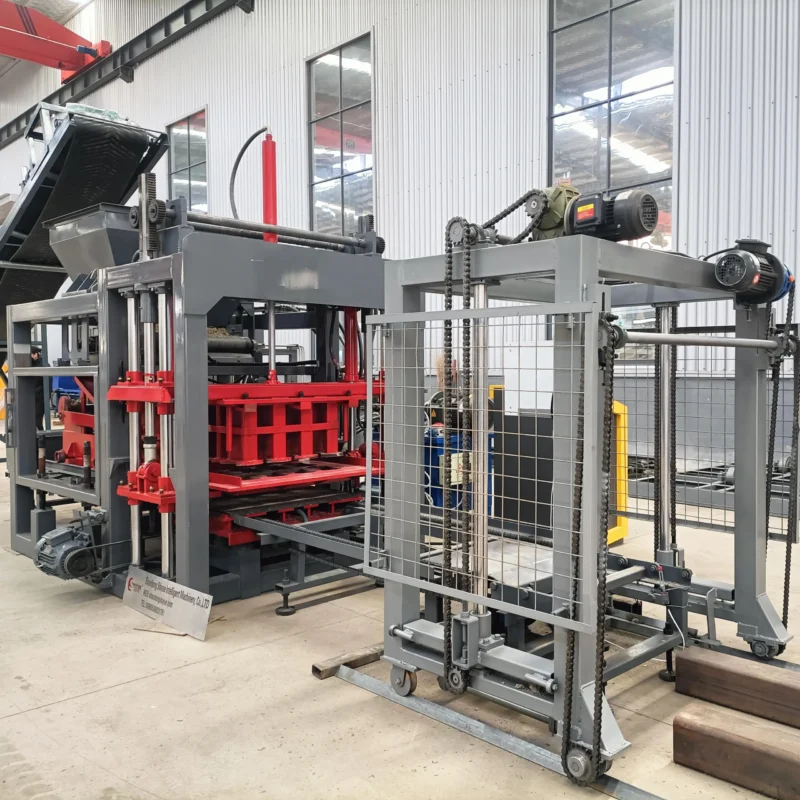
Model QT4-15A | Fully Automatic Concrete Block Making Machine
Technical Specifications
| Parameter | Value |
|---|---|
| Model | QT4-15A |
| Product Type | Fully Automatic Concrete Block Making Machine |
| Overall Dimensions (L×W×H) | 4100×1600×2600 mm |
| Total Mass | 4 T |
| Overall Power | 18.45 kW (source value — verify against manufacturer catalog) |
| Rated Pressure | 16–21 MPa |
| Main Vibration Form | Platform Vibration |
| Vibration Frequency | 4200 r/min |
| Vibration Force | 55 kN |
| Pallet Size | 880×550 mm |
| Molding Cycle | 25–30 s (basis not stated in source — confirm block format / material / thickness) |
| Demolding Method | Hydraulic |
| Factory Area | 300 m² |
| Automation Level | Fully Automatic |
| Raw Material Compatibility | Crushed stone, sand, cement, fly ash, gravel, slag, dust |
| Applied Products | Hollow/solid blocks, pavers, interlocking blocks, curbstone, colored pavers |
| Control System | not stated in source |
| Voltage & Frequency | not stated in source |
| Stacking Method | not stated in source |
| Warranty | 1 year (whole machine, excluding spare parts) |
Application Suitability
| Application | Material or Output |
|---|---|
| Hollow Block Production | Crushed stone, sand, cement, fly ash |
| Solid Block Manufacturing | Gravel, slag, dust, cement |
| Paving Block / Interlocking Paver | Fine aggregates, cement, pigments for colored pavers |
| Curbstone Production | Coarse aggregates, high-strength cement mixes |
| On-Site Project Production | Locally sourced aggregates for housing and infrastructure blocks |
Why the Rest of the Line Dictates the Press Cycle
A block press is only as fast as the slowest station feeding or clearing it.
When plant owners review a quotation for a concrete block making machine production line, the focus often lands on the press itself. But the cycle time of the QT4-15A—quoted at 25–30 seconds—only holds if the mixer delivers a fresh batch on time, the pallet feeder indexes without hesitation, and the stacker removes cured cubes before the rack backs up. I have walked into plants where a high-speed press sat idle for minutes each cycle because a single manual pallet-return station created a bottleneck [NEED_CITE: common causes of unplanned downtime in block production lines]. The line was designed around the press, but the plant ran at the speed of its weakest link.
Upstream Timing: Feeding and Mixing Synchronization
The QT4-15A demands a consistent material supply to sustain its vibration and pressure sequence. If the mixer discharges late or the raw material feed rate fluctuates, the press waits—and every second of idle time erodes the daily throughput calculation. A matched concrete block making machine production line specifies the mixer capacity, batch discharge time, and conveyor speed so that material arrives at the hopper precisely when the previous cycle completes.
Downstream Flow: Pallet Circulation and Curing Handoff
Once the press demolds, the wet block sits on an 880×550 mm pallet that must travel through stacking, curing, and return. If the curing rack layout or forklift capacity was never reconciled with that pallet size, blocks pile up on the floor and the press operator starts hand-stacking—defeating the purpose of a fully automatic line. Station spacing, rack dimensions, and pallet return speed must all be confirmed before the line layout is finalised [NEED_CITE: pallet handling best practices in concrete product plants].
Reading the Numbers That Matter
The 55 kN vibration force and 16–21 MPa rated pressure work together: vibration compacts the mix into the mould cavity, and hydraulic pressure locks density before demolding. If the local aggregate is angular or poorly graded, these forces may need adjustment to avoid weak or cracked blocks. The 880×550 mm pallet size must match the curing racks and forklift already on site; specifying a different size later means re-racking the entire curing yard. The 4 T machine mass and 4100×1600×2600 mm footprint define the foundation load and ceiling clearance—both critical before the floor is poured. Voltage, frequency, and PLC display language are not stated in the source data and must be confirmed to avoid commissioning delays [NEED_CITE: electrical standards and compliance for exported industrial machinery].
What Happens When Line Stations Are Specified Separately
Sourcing the press from one supplier and the pallet feeder, stacker, and mixer from others often leads to mismatched cycle times and incompatible control signals. The press may be ready to cycle while the pallet feeder is still indexing, or the stacker may not recognise the block format the PLC just produced. These integration gaps surface only during commissioning, turning a planned one-week startup into a multi-week troubleshooting exercise. Every hour spent resolving a signal mismatch is an hour the concrete block making machine production line is not producing saleable blocks.
Why This Line Is Specified as a Single System
Block machinery is the sole focus here, so the QT4-15A, its moulds, pallets, and handling equipment are specified as one matched set rather than assembled from separate vendors. Configuration starts with the buyer’s actual mix design and local aggregate, not a catalogue default. Mould design covers the formats the buyer’s market actually sells, including custom drawings. Automation level is selectable, so a plant can begin semi-automatic and add stacking or cubing later. Installation support includes on-site commissioning and operator training, ensuring every station is timed correctly from day one.
Documentation & Verification
- Line layout and capacity calculation stating the exact block format assumed for each throughput figure
- Pallet specification sheet confirming 880×550 mm size, material grade, and forklift compatibility
- Hydraulic and electrical schematics with voltage, frequency, and PLC language confirmed pre-production
- Factory test record verifying cycle times per mould format, not a single catalogue default
- Mould drawing and format list covering hollow, solid, paver, interlocking, and curbstone options
Installation, Commissioning & Support
- Foundation must support 4 T static load and vibration forces across the 4100×1600 mm footprint
- Electrical supply to match confirmed voltage and frequency with a dedicated circuit for the 18.45 kW load
- Machine arrives dismantled for container loading; reassembly and station alignment completed on site
- First-run commissioning includes cycle time verification per mould format and pallet indexing calibration
- Operator training covers mould change procedure, PLC navigation, and daily vibration and hydraulic checks
- Wear parts and mould inventory list provided so first replacements are on hand before they are needed
What to Share Before Quoting
Provide the target block formats, daily output goal, and the raw materials available locally—especially aggregate type and gradation. Confirm the voltage, frequency, and preferred control language for the destination country. Share the curing area dimensions and the forklift model already on site so the pallet size and rack layout can be validated. If existing upstream or downstream equipment will remain in use, list its specifications so the new line can be timed to match.
Frequently Asked Questions
Q: How is daily output calculated, and which block format does the cycle time assume?
A: The 25–30 second cycle is stated without a specific block format assumption. Realistic daily output depends on whether the target is a hollow block, solid block, or paver, each of which has a different mould cavity count and demolding time. A capacity calculation document should state the exact format and pieces-per-cycle before any throughput claim is accepted.
Q: How should raw material feeding and mixing be timed so the press is never starved?
A: The mixer batch size and discharge rate must match the press hopper consumption per cycle. Conveyor speed and feeder gate timing are set so that a fresh batch arrives just as the previous one is exhausted, eliminating idle press time and maintaining consistent material quality across shifts.
Q: Is pallet feeding, stacking, and curing rack handling included in the quotation?
A: These stations should be part of the line quotation as a matched system. If sourced separately, cycle time mismatches and control integration issues are common. Confirm that the 880×550 mm pallet size aligns with existing curing racks and forklift capacity before finalising the scope.
Q: How is voltage, frequency, and control language confirmed before production?
A: These parameters must be agreed in writing before the machine enters production. Incorrect voltage or frequency can damage motors and control boards on arrival, while a PLC display in the wrong language delays operator training and commissioning by days or weeks.