
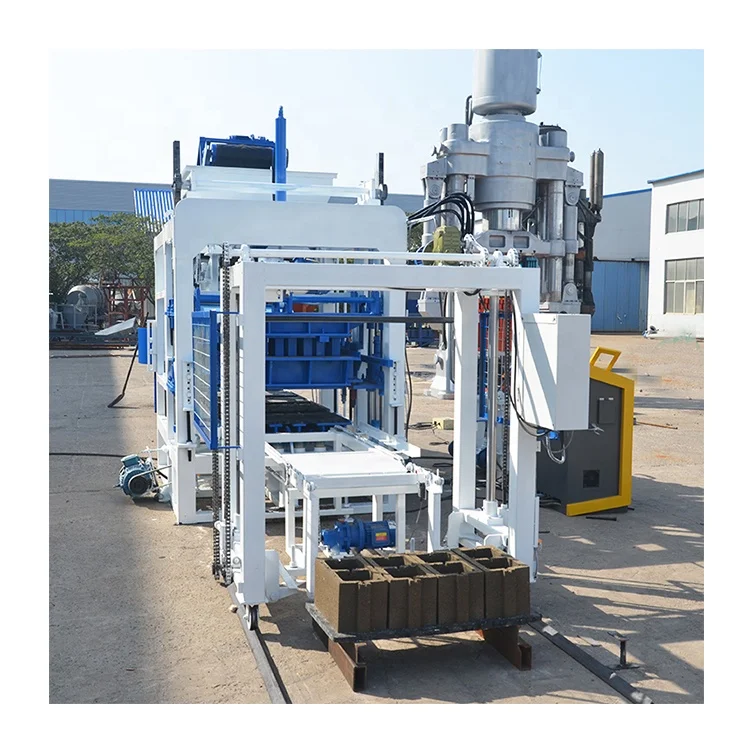
Matched System Approach — The QT4-15A stationary block making machine production line is specified with mixing, pallet feeding and stacking as one balanced layout rather than isolated machines that bottleneck each other.
Technical Specifications
| Parameter | Value |
|---|---|
| Model | QT4-15A |
| Product Type | Automatic Hydraulic Concrete Block Making Machine |
| Overall Dimensions (L×W×H) | 4100×1600×2600 mm |
| Rated Pressure | 16–21 MPa |
| Main Vibration Form | Platform Vibration |
| Vibration Frequency | 4200 r/min |
| Vibration Force | 55 kN |
| Pallet Size | 880×550 mm |
| Molding Cycle | 25–30 s (basis to be confirmed per block format and material) |
| Overall Power | 18.45 kW |
| Total Mass | 4 T |
| Demolding Method | Hydraulic |
| Factory Area Required | 300 m² |
| Control System | PLC (language configurable) |
| Assembly State | Stationary |
| Container Loading | 1×40HQ for basic equipment set |
| Certification | CE (confirmation per order) |
Application Suitability
| Application | Material or Output |
|---|---|
| Concrete hollow block production | Crushed stone, sand, cement, fly ash |
| Solid block manufacturing | Gravel, sand, cement blends |
| Paving block and colored paver runs | Fine aggregate with pigment additives |
| Interlocking block and curbstone | Standard concrete mix with local aggregate |
| On-site housing project supply | Crusher dust, slag, cement combinations |
Why Line Balance Matters More Than Press Speed Alone
A stationary block making machine production line only delivers rated output when every upstream and downstream station keeps pace with the press cycle.
I once watched a QT4-15 class press sit idle for twenty seconds every cycle because the pallet feeder could not return a board fast enough. The press itself was capable, but the line around it was undersized. Capacity calculations quoted in cycles per hour mean nothing when the mixer batch size does not match the hopper draw rate or the stacking station cannot clear cured boards before the next pallet arrives [NEED_CITE: line balancing principles in concrete product manufacturing].
When buyers focus only on the press specification, the pallet handling, curing rack movement and raw material feeding get treated as afterthoughts. The result is a line where the most expensive station spends half its shift waiting on the cheapest one.
How Each Station Connects to the Press Cycle
The QT4-15A molding cycle of 25–30 seconds sets the rhythm that every other station must follow. Raw material feeding must deliver a fresh batch to the mixer within that window, and the mixer discharge must replenish the press hopper before the current batch runs dry. If any station in this stationary block making machine production line falls behind, the press operator either waits or runs a short batch that produces underfilled moulds.
Pallet feeding operates on the same clock. A pallet must be positioned, the press completes its vibration and hydraulic compaction, the wet block on its pallet exits to the curing rack, and the next empty pallet slides in — all within one cycle. The stacking and curing rack handling system downstream must clear finished pallets at the same rate, or boards pile up at the press exit and force a stoppage.
Sizing the Supporting Equipment to Your Actual Output
Line capacity is not a single number. A hollow block format with four cavities per pallet produces a different daily count than a paving block layout with twelve units per board, even though the press cycles at the same rate. When we configure the supporting equipment for your stationary block making machine production line, the mixer capacity, conveyor speed and curing rack count are all calculated against the specific block format and pallets-per-cycle figure you intend to run [NEED_CITE: output calculation methods for block production plants].
The 880×550 mm pallet size on the QT4-15A determines how many boards your curing area can hold and what forklift capacity you need to move stacked racks. Choosing pallet material — bamboo, PVC or steel — affects both the vibration transfer during compaction and the pallet weight your handling crew or automated stacker must manage.
Reading the Specifications That Shape Daily Output
The 16–21 MPa rated pressure and 55 kN vibration force work together during compaction. Hydraulic pressure squeezes the mix from above while platform vibration at 4200 r/min settles aggregate particles into a dense matrix. If your local aggregate is heavier or more angular than standard sand — volcanic rock, for instance — the vibration force must be sufficient to fluidize that specific material, or cycle times stretch and block density drops.
The 18.45 kW overall power rating covers the press motor, hydraulic pump and vibration system. Your electrical supply must sustain this draw continuously through every cycle without voltage drop, which would weaken the hydraulic pressure mid-stroke. Voltage, frequency and phase must be confirmed before the control panel is wired at the factory [NEED_CITE: voltage and frequency standards by export market].
The 300 m² factory area requirement accounts for the press footprint, mixer station, pallet return path and a minimum curing rack zone. This figure does not include raw material storage or finished block dispatch space, both of which must be planned around your target daily output and local delivery schedules.
What Happens When Line Stations Are Mismatched
A mixer that batches too slowly forces the press into dry cycles where the hopper runs empty mid-pallet, producing blocks with inconsistent fill. An undersized curing rack area means wet boards have nowhere to go, and the operator starts stacking pallets on the floor where blocks crack before initial set. I have seen entire production days lost because the pallet return conveyor jammed and no spare boards were staged nearby.
These problems do not show up in a press-only quotation. They surface during the first week of operation, when the buyer realizes the line was quoted as a machine rather than as a system [NEED_CITE: common commissioning issues in block production lines].
Why Buyers Source the Full Line Here
Block machinery is our single focus, so the QT4-15A press, mould, pallet and handling equipment are specified as one matched system rather than assembled from separate suppliers who shift blame when stations do not synchronize.
Configuration starts from your actual mix design, local aggregate and target block format — not a catalogue default that assumes standard sand. The mould design covers the formats your market sells, with custom drawings available when your buyers request non-standard dimensions.
Automation level is selectable, so you can begin with manual pallet handling and add automatic stacking later as volume grows. Installation and commissioning include operator training at your site, and the wear parts and mould list is provided so your first replacement order is already planned before the machine ships.
Documentation & Verification
- Line layout drawing showing station spacing and pallet flow path for your site dimensions
- Capacity calculation sheet stating block format and pallets per cycle assumed
- Hydraulic and electrical schematic for your local maintenance team reference
- Voltage, frequency and PLC display language confirmation before production begins
- Factory test record run on your specified block format before dispatch
Installation, Commissioning & Support
- Foundation plan for the 4100×1600 mm press footprint with anchor bolt positions and curing slab requirements
- Dedicated circuit sizing for 18.45 kW continuous draw with voltage drop limits confirmed at your panel
- Press arrives dismantled in one 40HQ container with reassembly sequence documented step by step
- PLC parameters set on-site to match your mix design and target block density during commissioning runs
- Operator training covers mould changeover procedure and hydraulic pressure adjustment for different formats
- Wear parts list with mould wear indicators so replacement is planned before block dimensions drift out of tolerance
Preparing Your Line Inquiry
To configure the supporting equipment around the QT4-15A, share your target block formats and the daily volume you plan to run for each. Include your site dimensions and ceiling height so the curing rack layout fits your building, along with your local voltage and frequency so the control panel is wired correctly before the machine leaves the factory. If you already have a mixer, forklift or curing racks in place, note their specifications so the new stations interface with what you already own.
Frequently Asked Questions
Q: How is daily output calculated and which block format is the cycle time based on?
A: The 25–30 second molding cycle is a base figure that varies with block format, wall thickness and mix design. Daily output is calculated by multiplying pallets per hour by units per pallet, then applying a realistic uptime factor. We provide this calculation for each format you intend to produce, not a single headline number.
Q: What supporting equipment is included in the line quotation?
A: The quotation can cover raw material feeding, mixer, pallet feeder, stacking system and curing rack handling alongside the QT4-15A press. Each station is sized to match the press cycle so no station bottlenecks another. You choose which stations to include based on what equipment you already operate.
Q: How do pallet size and material affect my curing area and forklift?
A: The 880×550 mm pallet determines curing rack spacing and total board count needed for your target output. Pallet material — bamboo, PVC or steel — changes both vibration transfer during compaction and loaded weight your forklift must handle. We confirm pallet specification against your existing curing layout before production starts.
Q: What voltage and PLC language options are confirmed before shipment?
A: Voltage, frequency and phase are matched to your site supply, and the PLC display language is set to your operator preference before the control panel is wired. This avoids commissioning delays caused by rewiring or translating the interface after the machine arrives.
Q: How are cycle times balanced across stations so the press does not wait?
A: Each station — mixer discharge, pallet feed, stacking and curing rack movement — is timed against the QT4-15A press cycle during line layout. Conveyor speeds, batch sizes and rack shuttle intervals are set so material and pallets arrive within the molding window, keeping the press running continuously rather than idling between cycles.


