
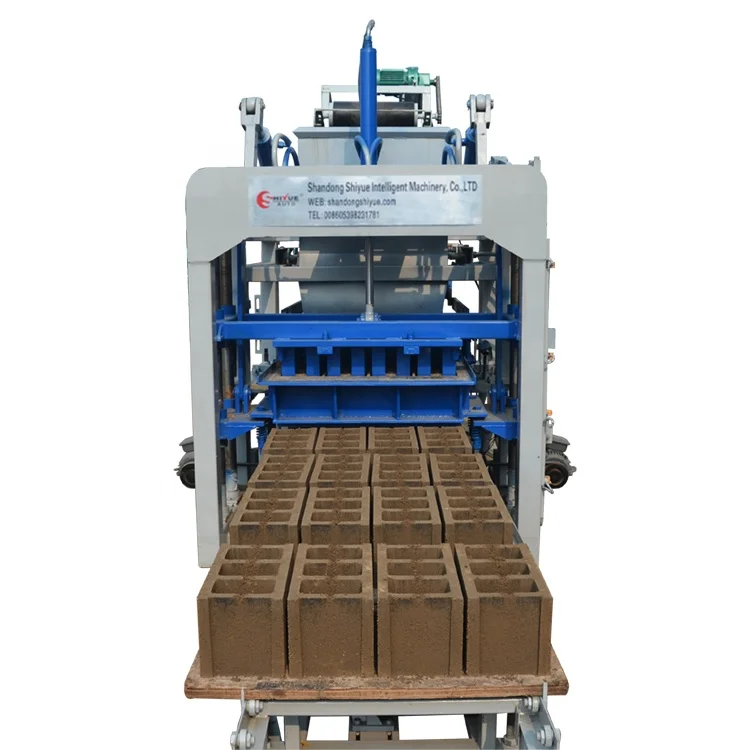
Matched System Design — every station from raw material feeding through curing is sized against the QT4-15 press cycle so the line runs without bottlenecks or idle time.
Technical Specifications
| Parameter | Value |
|---|---|
| Model | QT4-15 |
| Product Type | Automatic Hydraulic Block Making Machine |
| Overall Dimensions (L×W×H) | 7100×1600×2610 mm |
| Net Weight | 5800 kg |
| Rated Power | 27.5 kW |
| Voltage & Frequency | 380 V or configurable to buyer site supply |
| Control System | PLC (language confirmed before shipment) |
| Vibration Force | 60 kN |
| Hydraulic Pressure | 100 ton |
| Pallet Size | 1020×850×40 mm |
| Output Capacity (400×200×200 mm hollow block, 4 pcs/mould) | 960 pcs/h |
| Output Capacity (400×150×200 mm hollow block, 6 pcs/mould) | 1440 pcs/h |
| Output Capacity (225×112.5×53 mm solid brick, 16 pcs/mould) | 3840 pcs/h |
| Daily Output (400×200×200 mm hollow block) | 7680 pcs/day |
| Daily Output (400×150×200 mm hollow block) | 11520 pcs/day |
| Daily Output (225×112.5×53 mm solid brick) | 30720 pcs/day |
| Automation Level | Fully automatic |
| Standards | ISO 9001:2008, CE |
| Warranty | 1 year |
Application Suitability
| Application | Material or Output |
|---|---|
| Hollow block production for load-bearing walls | Crushed stone, sand, cement, and water mix |
| Solid brick manufacturing for masonry infill | Fine aggregate blended with Portland cement |
| Interlocking paver runs for walkways and yards | Coarse aggregate with pigment-added face mix |
| On-site production for housing project contractors | Locally sourced river sand and quarry dust |
| Expanded format range for existing block plants | Existing raw material feed with new mould sets |
What "Fully Automatic" Hides About Line Balance
A fast press cycle means nothing when upstream feeding or downstream pallet handling cannot keep up.
I have watched QT4-15 block making machine production lines where the press finished its cycle in seconds, only to sit idle while the pallet feeder cycled or the stacker completed its stroke. The quoted hourly capacity assumes every station in the line responds within the same window. When the mixer batch size is too small for two consecutive press cycles, or the pallet return conveyor runs slower than the press eject rate, the actual daily count drops well below the calculation sheet [NEED_CITE: line synchronization standards in block manufacturing]. Buyers sign off on a single throughput number without seeing how each station’s timing was derived.
Station Timing Across the Full Production Flow
The QT4-15 block making machine production line connects raw material batching, mixing, pallet feeding, pressing, and stacking into one continuous sequence. Each station must complete its task within the press cycle window. If the mixer discharges every forty seconds but the press cycles faster, the press waits. Line layout drawings must show the calculated timing at every transfer point, not just the press rating.
Pallet Circulation and Curing Area Coordination
Pallets leave the press carrying wet blocks and travel through the curing area before returning empty. The 1020×850×40 mm pallet size must match the curing rack spacing the buyer has planned or already built. A mismatch forces either a pallet replacement or a rack rebuild. The forklift fork width used in the curing yard also needs to align with the pallet dimensions so handling proceeds without custom attachments [NEED_CITE: pallet and curing rack compatibility guidelines].
Reading the Core Parameters
The 60 kN vibration force works together with the 100 ton hydraulic pressure to compact the concrete mix inside the mould cavity. Vibration settles the aggregate particles while hydraulic pressure locks them into position before the block cures. If the local aggregate is coarse or angular, the vibration force must be sufficient to achieve full compaction without leaving voids. The 27.5 kW rated power covers the hydraulic pump, vibration motor, and conveyor drives running simultaneously during peak load. Voltage must be confirmed against the buyer’s site transformer capacity and local frequency standard before the electrical panel is wired. The PLC control language is set during production so operators read prompts and alarms in their working language from the first day of commissioning.
The Cost of Undersized Supporting Stations
A mixer that batches too little concrete per cycle starves the press, and the operator ends up manually triggering extra batches to keep up. A pallet feeder with a slow return stroke adds idle seconds to every cycle, accumulating into thousands of lost blocks over a shift. When stacking is done by hand because the automatic stacker was left out of the quotation, labour costs rise and block damage increases from manual handling [NEED_CITE: manual versus automatic stacking impact on block breakage]. These gaps are not visible in the press specification sheet alone.
Why Source the Full Line Here
Block machinery is the single focus, so the press, moulds, pallets, and handling equipment are specified as one matched system rather than assembled from unrelated suppliers. Configuration starts from the buyer’s actual mix design and local aggregate, not a catalogue default. Mould design covers the formats the buyer’s market demands, including custom drawings when standard formats do not apply. Automation level is selectable, allowing a buyer to begin with semi-automatic pallet handling and add stacking and cubing later. Installation includes on-site commissioning with operator training so the line runs at calculated capacity from the first week.
Documentation & Verification
- Line layout drawing with capacity calculation stated per block format for each station
- Pallet specification sheet showing size, material, and load rating against curing rack spacing
- Hydraulic and electrical schematic for local maintenance tracing and component sourcing
- Voltage, frequency, and PLC display language confirmation recorded before production
- Factory test record documenting cycle timing across all stations before dispatch
- Mould drawing and format list showing every block type the line will produce
Installation, Commissioning & Support
- Foundation plan sized to the 7100×1600 mm press footprint and dynamic vibration load
- Dedicated power circuit rated for the 27.5 kW total draw at confirmed voltage and frequency
- Machine shipped in dismantled or assembled state per container loading plan
- First-run parameter setting covering vibration duration, hydraulic pressure, and feed volume per mould
- Operator training on PLC interface, mould change procedure, and daily maintenance checkpoints
- Wear parts list with hydraulic seals and mould liner part numbers for local reordering
Before You Send the Inquiry
Share the target block formats you plan to produce, the daily output you need per format, and the raw materials available at your site. Include your workshop dimensions, curing area layout, and existing forklift specifications so pallet and rack sizing can be verified. Confirm the local voltage and frequency supply along with the preferred PLC display language to avoid delays during commissioning.
Frequently Asked Questions
Q: How do I verify that every station in the line matches the QT4-15 press cycle time so the press is never left waiting?
A: Request a line layout document that states each station’s cycle time alongside the press cycle for your specific block format. The mixer discharge interval, pallet feeder stroke duration, and stacker cycle must each fall within the press timing window. If any station exceeds it, that station becomes the bottleneck and reduces actual daily output.
Q: What supporting equipment must be sized against the press output for my target block format?
A: Mixer batch volume must cover at least one full press cycle, the pallet feeder must return within the press cycle window, and the stacker must complete its stroke before the next pallet arrives. Each piece of equipment is sized using the cycle time for your chosen block format, not a generic line default.
Q: Can I start with semi-automatic pallet handling and upgrade to automatic stacking later without replacing the press?
A: Yes. The QT4-15 press is specified with an automation upgrade path. You can begin with manual or semi-automatic pallet handling and add automatic stacking and cubing modules later. The PLC control and hydraulic system are configured to accommodate the upgrade without press modification.
Q: How is the pallet size and material selected to match my curing area and the forklift I already own?
A: The 1020×850×40 mm pallet dimension is checked against your curing rack spacing and forklift fork width before the order is finalized. Material selection considers the block weight per pallet and the curing environment. A mismatch discovered after delivery forces either a pallet reorder or a rack rebuild, both of which delay production.



