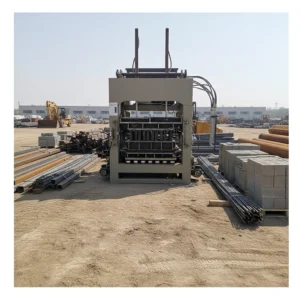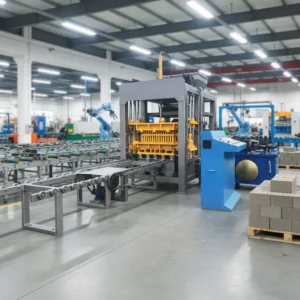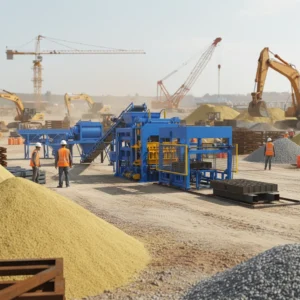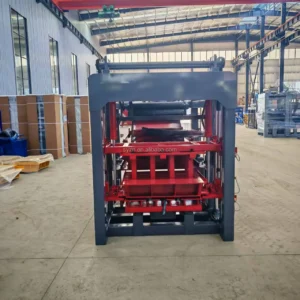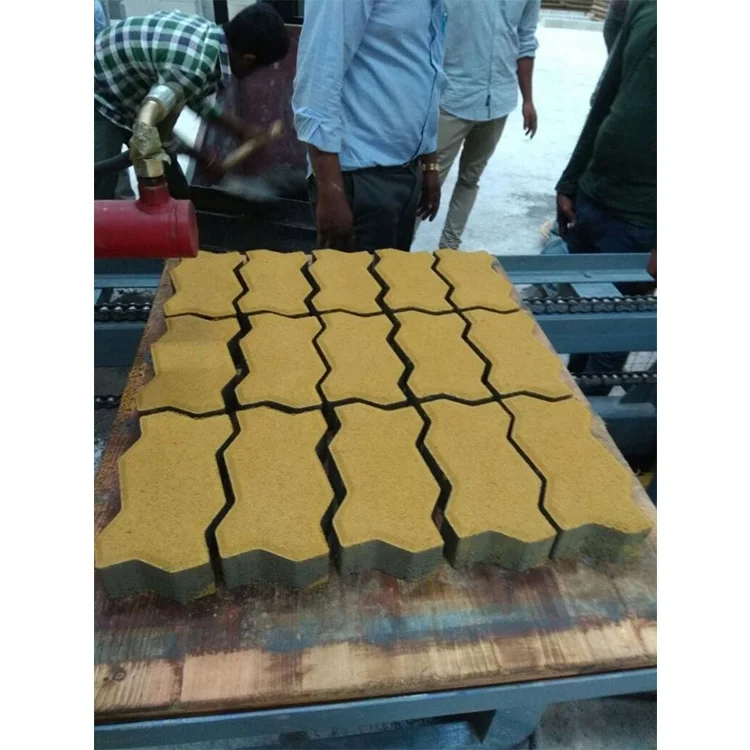
Coordinated Line Rhythm — Every station from raw material feeding to stacking is specified as a single matched system for the QT12-15, preventing cycle-time bottlenecks that leave the press idle.
Technical Specifications
| Parameter | Value |
|---|---|
| Model | QT12-15 |
| Product Type | Concrete Block Making Machine Line |
| Total Installed Power | 62 kW |
| Pallet Size | 1300 x 900 mm |
| Moulding Cycle | 15–30 seconds depending on block format |
| Vibration Type | Table vibration with dynamic and static table |
| Vibration Force | 120 kN |
| Voltage | Configurable to local industrial supply |
| Control System | PLC with customizable display language |
| Mould Compatibility | Custom-designed to buyer’s block drawings |
| Output Capacity | Varies by block format and material (basis to be confirmed) |
Application Suitability
| Application | Material or Output |
|---|---|
| Hollow block production | Crushed stone, cement, sand, fly ash blends |
| Solid block manufacturing | Dense aggregate mixes with standard cement ratios |
| Interlocking brick forming | Fine sand and cement with pigment additives |
| Paving block production | High-strength aggregate with low water-cement ratio |
| Porous brick and slope protection brick | Permeable aggregate blends for drainage applications |
What "Blocks per Hour" Leaves Out When Supporting Equipment Is Missing
A block making machine line production rate is only as fast as its slowest upstream station.
I spent four days on a plant floor in West Africa last year watching a high-capacity press sit idle for nearly a third of every shift. The mixer discharged too slowly, the pallet feeder jammed on warped boards, and cured stacks were dragged by hand because no cubing system was quoted. The press itself was rated for a respectable cycle, but the surrounding block making machine line production never reached that number. [NEED_CITE: line synchronization standards in concrete product manufacturing]
How Station Cycle Times Must Align
The QT12-15 press completes a moulding cycle in 15 to 30 seconds, but that figure only holds if the mixer discharges a full batch within the same window and the pallet feeder delivers a clean board before the press opens. When any upstream station lags, the press waits and block making machine line production drops proportionally. Line planning must therefore start from the press cycle and work outward to each supporting station.
Raw Material Feeding and Mixing as the First Bottleneck
A 360-degree rotating press-in arch breaker on the QT12-15 hopper prevents material bridging, keeping aggregate flow steady into the mixer. If the mixer is undersized for the press demand, the hopper runs dry mid-shift and operators begin hand-feeding, introducing inconsistency. Matching mixer batch volume to the press cycle is the first calculation in any line layout. [NEED_CITE: aggregate batching accuracy requirements for consistent block density]
Reading the Specifications That Actually Matter
The 1300 x 900 mm pallet size determines how many blocks form per cycle and must align with the curing rack dimensions and the forklift tine spacing already on site. The 120 kN vibration force, combined with hydraulic pressure, compresses the mix into the mould cavity; if the local aggregate is softer or more porous than assumed, vibration duration may need adjustment to reach target strength. Table vibration with frequency conversion allows fine-tuning without swapping mechanical components. Voltage configuration must be confirmed before the control cabinet is wired, as a 50 Hz versus 60 Hz mismatch changes motor speeds across every station simultaneously.
The Hidden Cost of Quoting the Press Alone
When pallet handling, stacking, and curing rack systems are left out of the initial quotation, buyers discover after arrival that freshly pressed blocks sit on the ground waiting for manual labor. Wet blocks deformed by hand stacking become unsellable, and the daily output figure quoted for the press alone never materializes. Retrofitting a stacker and pallet return conveyor later costs more in downtime and structural modification than including them in the original line scope. [NEED_CITE: post-installation retrofit costs in block plant expansions]
Why Sourcing the Line from One Coordinator Matters
Machine, mould, pallet, and handling equipment are specified together against the buyer’s actual mix design and local aggregate, not pulled from separate catalogues. The QT12-15 mould is designed to the buyer’s block drawings, so changeover time stays within a single shift rather than consuming it. Automation level is selectable — a buyer can start with manual pallet handling and add automatic stacking later without replacing the press. Factory testing runs the entire line as one system before shipment, verifying that cycle times match across every station. Installation support includes operator training on line-wide coordination, not just press operation.
Documentation & Verification
- Line layout showing cycle-time calculations for each station and assumed block format
- Machine specification sheet with pallet size, vibration force, and voltage confirmation
- Mould drawing matching buyer’s block dimensions and format list
- Hydraulic and electrical schematics for the full line, not the press alone
- Factory test record demonstrating coordinated operation across all stations
- Operation and maintenance manual covering every connected machine
Installation, Commissioning & Support
- Foundation plan sized for 62 kW total load with dedicated circuit for vibration motors
- Pallet size confirmation against existing curing racks and forklift capacity before dispatch
- Dismantling sequence documented so reassembly follows the same station order on site
- PLC display language and voltage verified at the control cabinet before first run
- Operator training covering mixer-to-press timing and pallet feeder adjustment
- Wear parts list including replaceable cloth platform plates and hydraulic seals
What to Include in Your Line Inquiry
Share the block formats your market actually sells, the daily volume you need to hit, and the local aggregate types available. Include your existing curing area dimensions and forklift specifications so pallet size can be matched. Confirm your site voltage, frequency, and preferred control language to avoid commissioning delays after the block making machine line production equipment arrives.
Frequently Asked Questions
Q: How are cycle times matched between the press and supporting equipment?
A: Each station is calculated against the QT12-15 moulding cycle of 15 to 30 seconds. The mixer batch volume, pallet feeder speed, and stacking interval are set so the press never waits for material or a clean board. The line layout document shows the assumed timing for each station.
Q: What supporting equipment is included beyond the press itself?
A: The line scope covers raw material feeding with arch breaker, mixer, pallet feeder, stacker, and curing rack handling. Each component is sized so its cycle matches the press, preventing the idle-press bottleneck that occurs when stations are sourced separately.
Q: How is pallet size selected to match my existing curing area?
A: The 1300 x 900 mm pallet dimension is confirmed against your curing rack spacing and forklift tine width before production. Choosing pallet size after the line is built forces costly rack modifications or leaves unusable curing space.
Q: What automation options exist from semi-automatic to fully automatic?
A: The QT12-15 line can start with manual pallet handling and add automatic stacking and cubing later. The PLC control system supports incremental upgrades without replacing the press or rewriting the base program logic.
Q: How is the mixer configured for my local raw materials?
A: Mixer batch size and discharge timing are set based on the aggregate density, moisture content, and cement ratio you provide. The 360-degree arch breaker prevents bridging with sticky or fine materials common in certain regions.