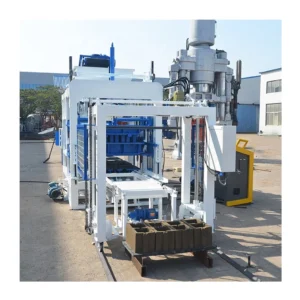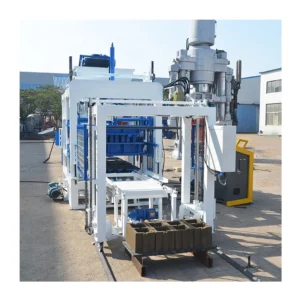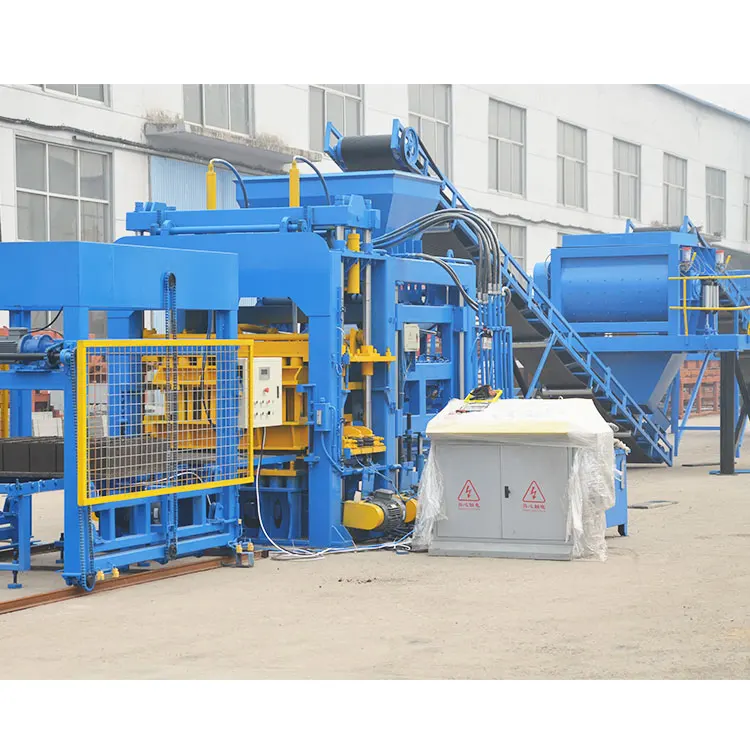
Matched Line Timing — Every station from the PL1200 batching machine through the JS500/JS750 mixer, 8-meter conveyor, and stacker is specified so the QT12-15 press is never left waiting between cycles.
Technical Specifications
| Parameter | Value |
|---|---|
| Product Type | Automatic Hydraulic Concrete Block Making Machine |
| Model | QT12-15 |
| Overall Dimensions (L×W×H) | 9350 × 2520 × 2950 mm |
| Rated Pressure | 21 MPa |
| Main Vibration Form | Platform Vibration |
| Vibration Frequency | 2800–4500 r/min |
| Vibration Acceleration | 15–20 g |
| Exciting Force | 120 kN |
| Fixed Brick Height Range | 50–200 mm |
| Pallet Size | 1350 × 850 mm |
| Molding Cycle | 15–25 s |
| Storage Hopper Volume | 0.4 m³ |
| Feeding Device Volume | 0.31 m³ |
| Total Power | 50.7 kW |
| Net Weight | 12000 kg |
| Control System | PLC controlled (mechanical hydraulic synthesis) |
| Frame Structure | Gantry frame type, super steel, shock resistant |
| Mould Material | Manganese steel, carburizing and quenching treatment |
| Block Compressive Strength | >15 MPa |
| Output – Hollow Block (390×190×190 mm) | 1720–2160 pcs/h, 13700–17200 pcs/day (8h) |
| Output – Porous Block (240×115×90 mm) | 5040–6300 pcs/h, 40300–50400 pcs/day (8h) |
| Output – Standard Block (240×115×53 mm) | 13100–14800 pcs/h, 105000–119000 pcs/day (8h) |
| Recommended Line Configuration | PL1200 batching machine, JS500 or JS750 mixer, 8 m conveyor belt, stacker |
| Voltage & Frequency | Configurable — confirm before production (basis to be confirmed) |
| PLC Display Language | Configurable — confirm before commissioning (basis to be confirmed) |
Application Suitability
| Application | Material or Output |
|---|---|
| Hollow concrete block production | Crushed stone, sand, cement, fly ash mixes for load-bearing walls |
| Paving block and interlock brick | High-density aggregate blends for driveways, walkways, and plazas |
| Porous block manufacturing | Lightweight aggregate and cement for thermal insulation walls |
| Standard solid block production | River sand, stone dust, and cement for general masonry |
| Fly ash block production | Fly ash, lime, gypsum, and aggregate blends for non-load-bearing partitions |
What "1720 Hollow Blocks per Hour" Leaves Out on a QT12-15 Block Making Machine Production Line
Cycle time is only half the equation — the entire upstream and downstream chain must match.
I have stood on shop floors in Southeast Asia watching a QT12-15 press sit idle for fifteen seconds per cycle because the JS500 mixer could not discharge fast enough. The press itself was capable, but the line was not. Buyers often compare machines on molding cycle alone and then discover that daily throughput falls well short of expectations once batching, mixing, conveyor travel, pallet return, and stacking are factored in. The gap between quoted capacity and real output almost always traces back to one station that was never sized against the others [NEED_CITE: line balancing principles in concrete block production].
Batching, Mixing, and Conveyor Timing
The QT12-15 block making machine production line pairs the press with a PL1200 batching machine and either a JS500 or JS750 twin-shaft mixer. The choice between the two mixers depends on the block format being run: hollow blocks demand a stiffer, drier mix that takes longer to blend, while porous blocks use a lighter aggregate charge that moves through a JS500 without bottleneck. The 8-meter conveyor belt must deliver each batch within the 15–25 second molding window so the hopper never runs dry mid-cycle.
Pallet Circulation and Stacking Coordination
Every pallet measures 1350 × 850 mm and must complete a full loop — feed, press, transfer to curing rack, return — before the next cycle begins. When the stacker cannot keep pace with the press output, wet blocks pile up at the transfer station and the operator is forced to hand-stack, which introduces breakage and slows the entire line. Specifying the stacker lift speed and rack capacity alongside the press cycle eliminates this bottleneck before the equipment is built.
Vibration and Pressure Tuned to Your Aggregate
Platform vibration operates at 2800–4500 r/min with 120 kN of exciting force, while the hydraulic system delivers 21 MPa of rated pressure. These two forces must be balanced against the buyer’s actual aggregate gradation and cement ratio. A coarse crushed-stone mix requires higher vibration amplitude to consolidate around the particles, whereas a fine sand-fly ash blend needs less vibration and more hydraulic squeeze to avoid segregation. I have seen operators crank both to maximum on every format, which accelerates mould wear and produces blocks with inconsistent density across the pallet [NEED_CITE: vibration-pressure interaction in concrete compaction].
Mould Height Range and Format Changeover
The 50–200 mm brick height range allows a single QT12-15 press to produce hollow blocks at 190 mm, standard bricks at 53 mm, and paving blocks anywhere in between. The gantry frame and shock-resistant steel structure absorb the repeated mould-change impacts. Manganese steel moulds with carburizing and quenching treatment hold their dimensions longer under abrasive aggregate, which matters when a plant runs three different formats in one shift and cannot afford to stop for dimension checks every hour.
The Cost of a Mismatched Station
A buyer once specified a JS500 mixer for a line that primarily produced 390×190×190 mm hollow blocks. The mixer discharge rate could not refill the 0.4 m³ storage hopper between cycles, so the press paused for several seconds each time. Over an eight-hour shift that pause accumulated into a significant output shortfall. The fix was either upgrading to the JS750 or accepting a lower daily target — both expensive lessons that a line-capacity calculation would have prevented [NEED_CITE: mixer sizing for concrete block lines].
Why Procure the Full Line Here
Block machinery is our single focus, so the QT12-15 press, mould, pallet, and handling equipment are specified as one matched system rather than assembled from separate suppliers. Configuration is set against the buyer’s actual mix design, local aggregate, and target block format, not a catalogue default. Mould design covers the formats the buyer’s market sells, with custom drawings accepted. Automation level is selectable, so a plant can start with manual pallet handling and add the stacker later. Installation support includes operator training on the specific PLC language confirmed before shipment [NEED_CITE: PLC language configuration for export markets].
Documentation & Verification
- Line layout and capacity calculation stating the block format assumed for each output figure
- Machine specification sheet with voltage, frequency, and PLC language confirmed in writing
- Mould drawing and format list covering every block height from 50 to 200 mm
- Pallet specification matched to curing rack dimensions and site forklift capacity
- Hydraulic and electrical schematic for on-site troubleshooting
- Factory test record run on the buyer’s target block format before dispatch
Installation, Commissioning & Support
- Foundation pad sized to the 9350 × 2520 mm footprint with anchor bolt plan provided
- Dedicated 50.7 kW power circuit with voltage and frequency confirmed before wiring
- Press arrives dismantled for container loading; reassembly supervised by our technician
- First-run parameter setting covers vibration frequency, hydraulic pressure, and cycle timing per format
- Operator training conducted in the confirmed PLC display language
- Wear parts list identifies every manganese steel mould insert and hydraulic seal by part number
What We Need to Size Your Line
Share the block formats you intend to produce, including dimensions and target daily volume for each. Let us know your local aggregate type, cement source, and available workshop dimensions including ceiling height for the curing racks. Confirm your site voltage, frequency, and preferred PLC display language so commissioning is not delayed after arrival.
Frequently Asked Questions
Q: How is line capacity calculated for each block format on the QT12-15?
A: Capacity is calculated per format using the molding cycle of 15–25 seconds and the number of cavities on the specific mould. The line layout document states the assumed block dimensions, pallet size of 1350 × 850 mm, and shift length so the daily output figure is transparent and comparable.
Q: How do upstream stations keep pace with the QT12-15 press cycle?
A: The PL1200 batching machine, JS500 or JS750 mixer, and 8-meter conveyor are timed so a fresh batch reaches the 0.4 m³ storage hopper before the press finishes its current cycle. We confirm the discharge rate against the shortest molding cycle in your format list before finalizing the quotation.
Q: What pallet size is specified and how does it match my curing area?
A: The standard pallet is 1350 × 850 mm. We ask for your curing rack spacing and forklift tine dimensions so the pallets slide straight onto existing racks without modification. Material choice — wood, bamboo, or composite — is confirmed based on your humidity and handling conditions.
Q: Is stacking and curing rack handling included in the line quotation?
A: The recommended stacker is listed alongside the press and mixer. We confirm whether automatic stacking or manual pallet handling fits your budget and labor availability, then include the chosen option as a line item so there are no unquoted stations left to source separately.
Q: What electrical details are confirmed before the QT12-15 ships?
A: Voltage, frequency, plug type, and PLC display language are confirmed in writing before production begins. This prevents the common delay where a machine arrives with a control screen in the wrong language or a motor wound for the wrong supply.