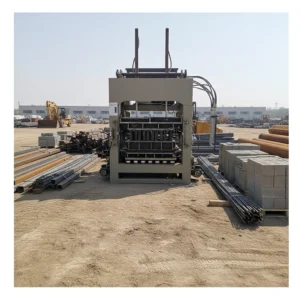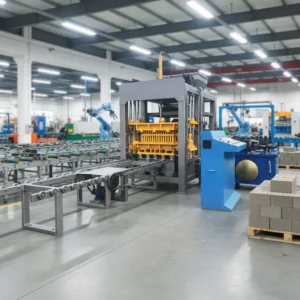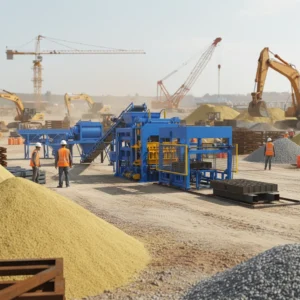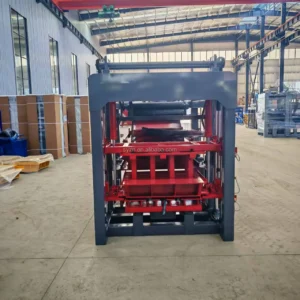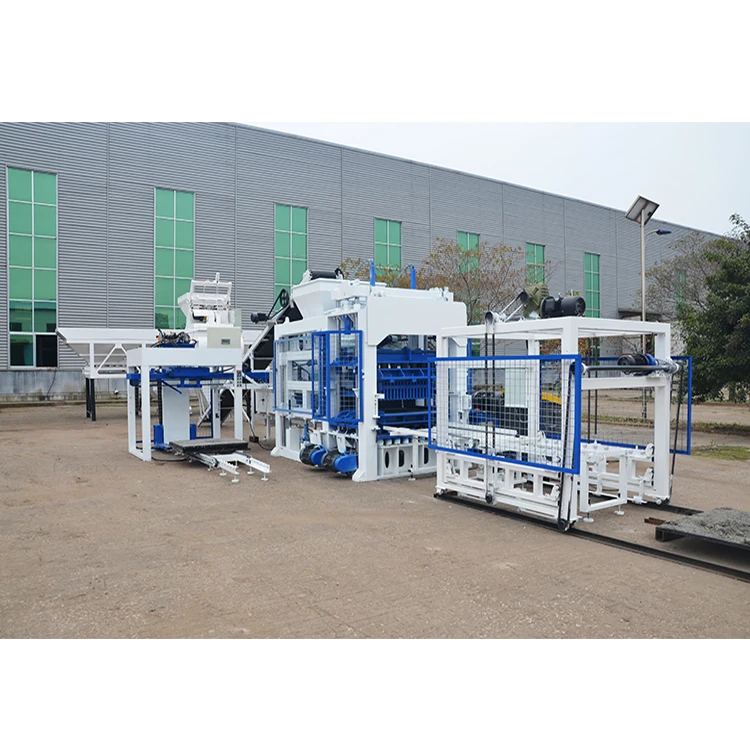
Complete Line Synchronization — Every station from raw material feeding through pallet handling and stacking is timed to the QT10-15 press cycle, preventing upstream starvation or downstream bottlenecks across continuous shifts.
Technical Specifications
| Parameter | Value |
|---|---|
| Product Type | Hydraulic Concrete Block Making Machine |
| Model | QT10-15 |
| Control System | PLC control cabinet |
| Hydraulic System | Independent integrated hydraulic station |
| Vibration Mode | Vertical station mode resonance, automatic FM-AM |
| Included Line Components | Pallet feed machine, block making machine, storage hopper, conveyor, hydraulic unit, PLC control cabinet |
| Mould Change | Simple replacement for multi-format production |
| Cycle Time (400×200×200mm hollow block) | 15–20s |
| Output Capacity (400×200×200mm, 10 pcs/mould) | 1,800–2,400 pcs/h; 14,400–19,200 pcs per 8hr shift |
| Cycle Time (400×150×200mm block) | 15–20s |
| Output Capacity (400×150×200mm, 12 pcs/mould) | 2,160–2,880 pcs/h; 17,280–23,040 pcs per 8hr shift |
| Cycle Time (240×115×53mm solid brick) | 15–20s |
| Output Capacity (240×115×53mm, 62 pcs/mould) | 8,928–11,160 pcs/h; 71,424–89,280 pcs per 8hr shift |
| Cycle Time (200×100×60mm paving block) | 20–25s |
| Output Capacity (200×100×60mm, 27 pcs/mould) | 5,184–6,480 pcs/h; 41,472–51,840 pcs per 8hr shift |
| Cycle Time (225×112.5×60mm interlocking brick) | 20–25s |
| Output Capacity (225×112.5×60mm, 24 pcs/mould) | 4,032–5,040 pcs/h; 32,256–40,320 pcs per 8hr shift |
| Automation Level | Automatic (with PLC control) |
| Warranty | 1 year for the whole machine (excluding spare parts) |
| Rated Power | (basis to be confirmed) |
| Voltage & Frequency | (basis to be confirmed against target market supply) |
| Overall Dimensions (L×W×H) | (basis to be confirmed) |
| Pallet Size | (basis to be confirmed) |
| Stacking Method | (basis to be confirmed) |
Application Suitability
| Application | Material or Output |
|---|---|
| Hollow block production plants | Crushed stone, sand, cement, fly ash aggregates |
| Paving block manufacturing for infrastructure | Granite dust, river sand, pigment, cement mixes |
| Solid brick output for housing projects | Local quarry aggregates, cement, water |
| Interlocking brick for slope and retaining walls | Graded aggregate, cement, optional oxide pigment |
| On-site production by construction contractors | Site-available aggregate blended with cement |
What "Pieces per Hour" Leaves Out in a QT10-15 Block Making Machine Production Line
The press cycle is only the starting point; the real output depends on every upstream and downstream station keeping pace.
Quoted capacity figures often assume an ideal cycle time with no waiting. In practice, if the mixer cannot deliver a fresh batch before the storage hopper empties, or the pallet feeder runs one position behind, the QT10-15 block making machine production line sits idle for seconds that add up to thousands of missing blocks over a shift. Line-level timing is where actual daily tonnage is won or lost [NEED_CITE: typical block plant throughput losses from station mismatch].
Station-by-Station Timing for Continuous Press Operation
The QT10-15 block making machine production line connects raw material feeding, mixing, storage hopper discharge, pallet feeding, pressing, and block exit into a single timed sequence. Each station must complete its task within the press cycle window — 15 to 20 seconds for standard hollow blocks — so the press never waits. When we lay out a line, we calculate the conveyor travel time from mixer to hopper against the batch cycle of the mixer itself, ensuring fresh material arrives before the hopper level drops below the sensor threshold.
Pallet Circulation as the Hidden Bottleneck
Pallets travel from the feed station into the press, out to the curing area, and back. If the return loop is longer than the press can tolerate, the pallet feed machine runs dry and the line stops. We map the pallet travel distance against the buyer’s curing rack layout and forklift route to confirm that pallet return speed matches the press demand at full cycle rate [NEED_CITE: pallet circulation calculations for block plant layout].
Matching Mixer Output to Hopper Demand
A mixer that produces one batch every three minutes may seem adequate, but when the storage hopper drains faster than it fills during a paving block run with a denser mix, the press operator watches the level sensor drop and hits pause. We specify mixer capacity and batch frequency against the heaviest mix design the buyer plans to run, not the lightest.
Specifying the Line Around Real Block Formats
Hydraulic pressure and vibration force determine block density, but only when the mix arrives consistently. The independent integrated hydraulic station on this press is isolated from host vibration and dust, which matters across long shifts where heat buildup in the oil can shift valve response times. The vertical station mode resonance with automatic FM-AM adjusts vibration frequency to match the material column height in the mould box, keeping compaction uniform from the first layer to the last. Mould swap between hollow block, solid brick, paving block, and interlocking brick formats is done by simple replacement, and the cycle time shifts accordingly — 15 to 20 seconds for hollow and solid formats, 20 to 25 seconds for pavers and interlocking bricks — so the entire line timing must be recalculated for each format the buyer intends to produce.
The Cost of Ignoring Line-Level Balance
A press that sits idle between cycles does not just lose output; it wastes the labour standing at the exit end waiting for blocks that never arrive, burns electricity on a hydraulic station running at standby pressure, and forces the curing crew to work in uneven bursts rather than a steady flow. Buyers who size only the press and treat everything else as optional extras often discover the gap between quoted and actual production during the first full shift [NEED_CITE: consequences of undersized supporting equipment in block plants].
Why Procurement Here Covers the Whole Line
Block machinery is our single focus, which means the QT10-15 is specified alongside its pallet feed machine, storage hopper, conveyor, hydraulic unit, and PLC cabinet as one matched set rather than assembled from separate suppliers. Configuration is set against the buyer’s actual mix design and local aggregate, not a catalogue default. Mould design covers the formats the buyer’s market actually sells, including custom drawings when a project calls for a non-standard profile. Automation level is selectable so a buyer can start with semi-automatic pallet handling and upgrade to full stacking later without replacing the press. Installation support includes operator training so the crew understands how each station affects the next.
Documentation & Verification
- Line layout drawing with capacity calculation stated per block format
- Machine specification sheet confirming PLC language and voltage for your market
- Mould drawing and format list with cycle time per product type
- Hydraulic and electrical schematic for local maintenance teams
- Factory test record on your chosen block format before dispatch
- Pallet specification sheet matched to your curing area and forklift capacity
Installation, Commissioning & Support
- Foundation plan referencing the QT10-15 footprint and vibration load points
- Electrical connection guide specifying the PLC cabinet voltage and frequency requirement
- Hydraulic station commissioning checklist with oil grade and pressure setting steps
- Pallet feed machine alignment procedure to prevent jamming at press entry
- Operator training covering mould change sequence and cycle time adjustment per format
- Wear parts list with reorder intervals for hydraulic seals and vibration springs
What We Need to Configure Your Line
To specify the QT10-15 block making machine production line for your project, share the block formats you plan to produce, your target daily output per format, the aggregate and cement available locally, and the curing area dimensions you have on site. Include your local voltage and frequency supply along with the preferred PLC display language so the control cabinet can be configured before dispatch.
Frequently Asked Questions
Q: How is line capacity calculated, and which block format is each figure based on?
A: Every capacity figure on this page is tied to a specific block dimension and mould cavity count. For example, 1,800–2,400 pieces per hour applies to 400×200×200mm hollow blocks at 10 per mould with a 15–20 second cycle. When you change format, cycle time and cavity count shift, so we recalculate per product.
Q: How do upstream stations need to be timed so the press is never starved?
A: The mixer batch cycle, conveyor travel time, and storage hopper volume must together deliver material faster than the press consumes it at its shortest cycle. We calculate this for your heaviest mix design so the hopper level never drops below the feed sensor threshold during continuous operation.
Q: What pallet size and material does this line require, and how does it relate to my curing area?
A: Pallet dimensions are chosen to match the mould footprint and the curing rack spacing you already have. We confirm pallet material — typically hardwood or composite — against your forklift load capacity and the humidity conditions in your curing zone before the line ships.
Q: Which automation level is right for my plant?
A: The QT10-15 supports automatic PLC-controlled operation with options ranging from manual pallet handling at the exit to fully automatic stacking and cubing. We recommend starting with the level your workforce can maintain reliably, with an upgrade path that adds automation without replacing the press.
Q: What documentation is provided for line installation and operator training?
A: You receive a line layout with per-format capacity calculations, hydraulic and electrical schematics, a mould drawing and format list, a factory test record on your chosen product, and an operation manual covering mould change and cycle adjustment procedures.