
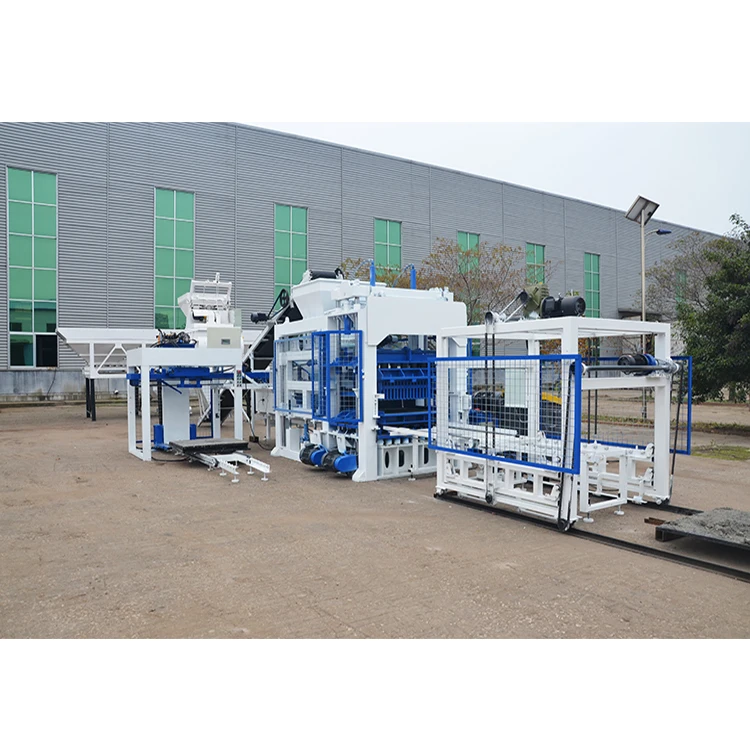
Integrated Line Engineering — The QT10-15 automatic block making machine is specified as the press within a matched production line where feeding, mixing, pallet handling, stacking and curing stations are sized to the same cycle time.
Technical Specifications
| Parameter | Value |
|---|---|
| Model | QT10-15 |
| Product Type | Automatic Block Making Machine |
| Moulding Cycle | 15-20s (hollow/solid blocks), 20-25s (paving blocks) |
| Output Capacity (400×200×200mm hollow block, 10 pcs/mould) | 1800-2400 pcs/h |
| Output Capacity (400×150×200mm hollow block, 12 pcs/mould) | 2160-2880 pcs/h |
| Output Capacity (240×115×53mm solid brick, 62 pcs/mould) | 8928-11160 pcs/h |
| Output Capacity (200×100×60mm paving block, 27 pcs/mould) | 5184-6480 pcs/h |
| Output Capacity (225×112.5×60mm interlocking brick, 24 pcs/mould) | 4032-5040 pcs/h |
| 8-hour Output (400×200×200mm hollow block) | 14400-19200 pcs |
| 8-hour Output (400×150×200mm hollow block) | 17280-23040 pcs |
| 8-hour Output (240×115×53mm solid brick) | 71424-89280 pcs |
| 8-hour Output (200×100×60mm paving block) | 41472-51840 pcs |
| 8-hour Output (225×112.5×60mm interlocking brick) | 32256-40320 pcs |
| Control System | PLC control cabinet |
| Hydraulic System | Independent integrated hydraulic station (isolated from host vibration and dust) |
| Machine Components | Pallet feed machine, block making machine, storage hopper, conveyor, hydraulic unit, PLC control cabinet |
| Mould Change System | Quick mould replacement for multi-format production |
| Vibration Type | Vertical station mode resonance with automatic FM-AM |
| Automation Level | Automatic |
| Warranty | 1 year (excluding spare parts) |
| Rated Power | basis to be confirmed |
| Voltage & Frequency | basis to be confirmed |
| Overall Dimensions (L×W×H) | basis to be confirmed |
| Pallet Size | basis to be confirmed |
| Hydraulic Pressure | basis to be confirmed |
| Vibration Force | basis to be confirmed |
Application Suitability
| Application | Material or Output |
|---|---|
| Hollow block production for load-bearing and partition walls | Crushed stone, sand, cement, fly ash aggregates |
| Solid brick production for masonry and infill | River sand, stone dust, cement blends |
| Paving block production for roads, walkways and plazas | Coarse aggregate, cement, pigment additives |
| Interlocking brick production for retaining walls and slopes | Graded aggregate, cement, mineral oxides |
| Multicellular brick production for thermal insulation | Lightweight aggregate, perlite, cement |
What "1800 Blocks per Hour" Actually Means on the Floor
A press cycle means nothing when upstream mixers and downstream stackers cannot keep pace.
I once visited a plant where the press was rated for a 15-second cycle but the pallet return system was two seconds slower per loop. Over an eight-hour shift that gap compounded into nearly an hour of idle press time. The owner had paid for a high-capacity QT10-15 automatic block making machine production line yet was running well below its real potential. This mismatch happens more often than buyers expect because quotations frequently list the press in isolation, leaving pallet feeding, stacking and curing as afterthoughts [NEED_CITE: common causes of throughput loss in block production lines].
Matching Every Station to the 15-Second Press Cycle
The QT10-15 automatic block making machine completes a hollow block cycle in 15 to 20 seconds, which sets the tempo for every other station on the line. The storage hopper must release a measured batch into the mould box within that window, the conveyor must deliver fresh mix without surge or starvation, and the pallet feed machine must place a clean pallet before the press descends. When any one of these stations lags, the PLC holds the press in a wait state and throughput drops. Line planning starts from the press cycle outward, not from a catalogue list of standalone machines.
Pallet Return and Curing: Where Throughput Quietly Disappears
After the press releases a cured block onto its pallet, that pallet must travel to the stacking station, be lifted onto a curing rack, and eventually return empty to the feed end. If the curing rack handling system is undersized, pallets queue on the floor and the press stops. I have walked through yards where hundreds of pallets sat waiting for a single forklift because the rack system was never part of the original quotation [NEED_CITE: pallet circulation and curing area planning for block plants]. The QT10-15 line configuration addresses this by specifying pallet quantity, rack capacity and return conveyor speed against the same cycle calculation that governs the press itself.
Reading the Numbers Behind Block Strength and Density
Vertical station mode resonance with automatic FM-AM adjustment means the vibration frequency and amplitude shift to match the mass of material inside the mould box. A dense paving block mix absorbs energy differently from a lightweight hollow block mix, so fixed-frequency vibration leaves one format under-compacted and the other over-stressed. The independent hydraulic station sits away from the vibration zone, which keeps seals and valves free of the cement dust that typically shortens their service life. Quick mould replacement lets a plant switch between hollow, solid, paving and interlocking formats without losing an entire shift to retooling.
The Cost of Treating the Press as a Standalone Purchase
When a buyer orders the press without confirming pallet size, the pallets may not fit the curing racks already on site or the forklift tines in the yard. When voltage and PLC display language are not confirmed before shipment, commissioning stalls while transformers are sourced and control panels are reprogrammed. These delays are not equipment failures — they are specification gaps that surface only after the crate is opened. I always insist on a full line layout drawing before a QT10-15 automatic block making machine leaves the factory, because a press without a matched line is simply an expensive piece of iron sitting still [NEED_CITE: typical commissioning delays caused by unconfirmed utility specifications].
Why Buyers Plan Their Line Here
Block machinery is the sole focus of our engineering work, so the press, moulds, pallets and handling equipment are specified as one system rather than assembled from separate vendors. Line configuration starts from the buyer’s actual mix design and local aggregate, not a default catalogue recipe. Mould design covers the formats the buyer’s market actually sells, with custom drawings available for non-standard sizes. Automation level is selectable, allowing a plant to begin with semi-automatic pallet handling and add stacking or cubing later. Installation support includes operator training on the specific PLC interface and cycle parameters shipped with each line.
Documentation & Verification
- Line layout and capacity calculation stating the block format assumed at every station
- Machine specification sheet covering press, hydraulic unit and PLC cabinet
- Mould drawing and format list matching your target product range
- Pallet specification sized to your curing yard and existing forklift
- Hydraulic and electrical schematic for the complete line, not the press alone
- Factory test record run on your chosen block format before dispatch
Installation, Commissioning & Support
- Foundation plan drawn to the QT10-15 overall dimensions and vibration load
- Dedicated power circuit sized to the confirmed rated power and voltage
- Machine shipped in dismantled modules with labelled reassembly points
- PLC language and control parameters set before the first production run
- Operator training on mould change, cycle adjustment and fault diagnostics
- Wear parts and mould maintenance list with recommended replacement intervals
What We Need to Size Your Line
To build a cycle-matched layout around the QT10-15, share your target block formats with dimensions, your planned daily output per format, and the raw materials available locally including aggregate grading. Let us know your site voltage, frequency and preferred PLC display language, along with the curing yard area and any existing forklifts or handling equipment the line must interface with.
Frequently Asked Questions
Q: How do upstream stations match the QT10-15 cycle time to prevent press idle time?
A: We calculate the conveyor speed, hopper discharge rate and mixer batch size against the 15-to-25-second moulding cycle so material arrives before the press calls for it. Each station motor is specified to complete its task within the press window, and the PLC monitors station readiness before initiating the next press stroke.
Q: What is included in the line quotation besides the press?
A: The quotation covers the pallet feed machine, storage hopper, conveyor, hydraulic unit and PLC control cabinet. Stacking, curing rack handling and cubing stations are added based on your automation preference. Every included station is listed with its cycle contribution so you can verify the line is complete before production begins.
Q: How is pallet size chosen for my curing yard?
A: We ask for your curing area dimensions and forklift specifications before finalising pallet size and material. Pallets must fit the rack spacing, stack height and forklift tines already on site. Choosing pallet size after the press arrives is the most common cause of curing bottlenecks we encounter.
Q: Can the line use my local aggregate instead of a standard mix?
A: Yes. Configuration begins with your local aggregate grading, cement type and available admixtures. Vibration frequency and hydraulic pressure are then adjusted to suit that specific mix, ensuring block strength meets your market standard without forcing a material change.
Q: What site conditions are needed before the QT10-15 arrives?
A: We provide a foundation drawing showing load points and anchor positions, along with power and water requirements based on the confirmed line configuration. The curing yard must be levelled and drained, and pallet storage space calculated against your target daily output before commissioning starts.



