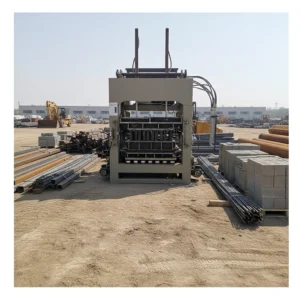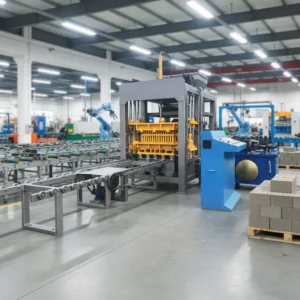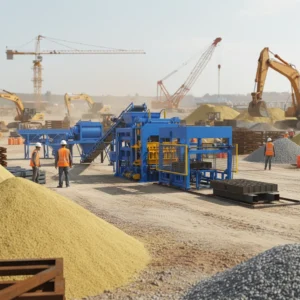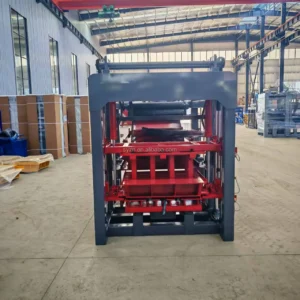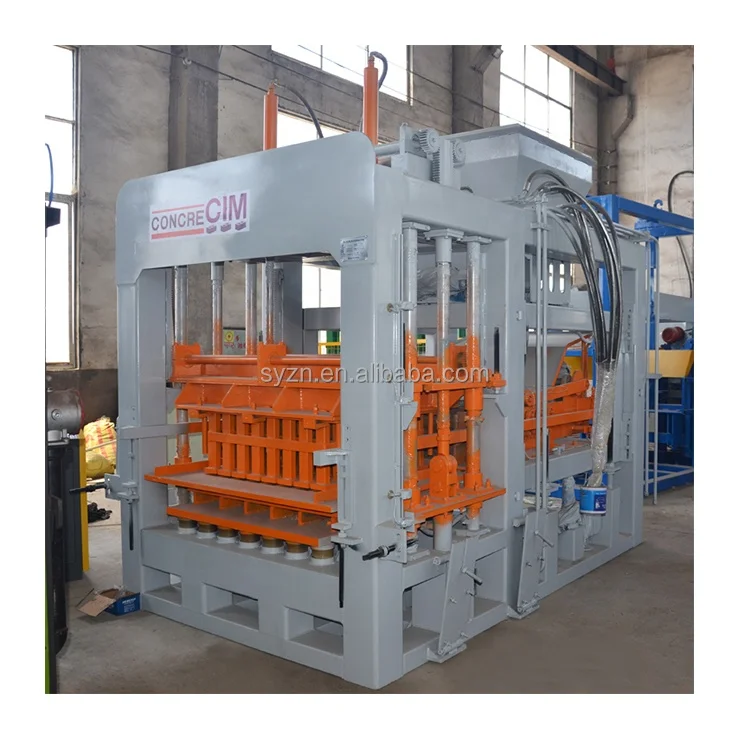
Matched System Configuration — the QT10-15 is specified not as a standalone press but as the centre of a synchronised block production line, where every supporting station is timed to match the press cycle so no equipment is left idle between formats.
Technical Specifications
| Parameter | Value |
|---|---|
| Model | QT10-15 |
| Product Type | Automatic Hydraulic Block Making Machine |
| Control System | PLC control cabinet |
| Hydraulic System | Independent integrated hydraulic station |
| Vibration Mode | Vertical station mode resonance, automatic FM-AM |
| Mould Change | Simple replacement of mould for multi-format production |
| Output Capacity (400×200×200mm hollow block) | 1,800–2,400 pcs/hour, 14,400–19,200 pcs/8hr |
| Output Capacity (400×150×200mm hollow block) | 2,160–2,880 pcs/hour, 17,280–23,040 pcs/8hr |
| Output Capacity (240×115×53mm solid brick) | 8,928–11,160 pcs/hour, 71,424–89,280 pcs/8hr |
| Output Capacity (200×100×60mm paving block) | 5,184–6,480 pcs/hour, 41,472–51,840 pcs/8hr |
| Output Capacity (225×112.5×60mm paving block) | 4,032–5,040 pcs/hour, 32,256–40,320 pcs/8hr |
| Cycle Time (400×200×200mm / 400×150×200mm / 240×115×53mm) | 15–20s |
| Cycle Time (200×100×60mm / 225×112.5×60mm) | 20–25s |
| Qty per Mould (400×200×200mm) | 10 pcs |
| Qty per Mould (400×150×200mm) | 12 pcs |
| Qty per Mould (240×115×53mm) | 62 pcs |
| Qty per Mould (200×100×60mm) | 27 pcs |
| Qty per Mould (225×112.5×60mm) | 24 pcs |
| Automation Level | Automatic (basis not stated in source — confirm stacking, pallet handling and cubing scope) |
| Component List | Pallet feed machine, block making machine, storage hopper, conveyor, hydraulic unit, PLC control cabinet |
| Warranty | 1 year for whole machine (excluding spare parts) |
Application Suitability
| Application | Material or Output |
|---|---|
| Hollow block production plants | Crushed stone, sand, cement and fly ash mixes for 400×200×200mm and 400×150×200mm formats |
| Paving block manufacturing | High-density concrete mixes for 200×100×60mm and 225×112.5×60mm interlocking and standard pavers |
| Solid brick production for construction | Standard brick mixes for 240×115×53mm clay-substitute or concrete bricks |
| On-site block production for housing projects | Local aggregate and cement blends for hollow and solid formats at project locations |
| Format expansion for existing concrete product plants | Multi-format changeover across hollow, solid, paving and interlocking brick on a single press |
Why Quoted Capacity Numbers Mean Nothing Without the Line Around Them
A block press can only produce as fast as the slowest station feeding or handling its output.
When buyers evaluate an automatic block making machine production line, the first number they compare is hourly capacity. What that number rarely states is which block format it assumes, what pallet handling method is included, or whether stacking and curing equipment are part of the quotation at all. I have seen plants where the press sat idle for seconds between cycles because the pallet feeder could not keep up, or where freshly pressed blocks were stacked by hand because no automatic stacker was specified — effectively cutting real daily output well below the brochure figure. [NEED_CITE: block production line bottleneck causes and throughput gaps]
How the Stations Connect Around the QT10-15
The QT10-15 sits at the centre of a sequence that begins with raw material feeding and mixing, continues through pallet feeding into the press, and ends with block stacking and curing rack handling. Each station has its own cycle time. If the conveyor delivers mixed material faster than the storage hopper can meter it, the press waits. If the pallet feed machine cannot position a fresh pallet before the press completes its cycle, the press waits again. The PLC control cabinet on the QT10-15 coordinates these stations as one automatic block making machine production line rather than a collection of independent machines, so the press is never left idle between cycles.
Balancing Cycle Times Across Every Format
Different block formats demand different cycle times — hollow blocks at 15–20 seconds, paving blocks at 20–25 seconds on the QT10-15. When a plant switches from hollow blocks to pavers, the mixer, conveyor and pallet feeder must all adjust their timing accordingly. The PLC control cabinet manages this transition so that supporting equipment does not become a bottleneck after a mould change. [NEED_CITE: PLC coordination of multi-format block production lines] Without this synchronisation, the format flexibility that justified the investment in multiple moulds is lost to dead time between stations.
Reading the Specifications With Production Reality in Mind
The independent integrated hydraulic station on the QT10-15 is isolated from host vibration and dust. In practice, this means hydraulic pressure remains stable across long shifts where dust and vibration would otherwise degrade valve response and seal life. The vertical station mode resonance vibration system uses automatic FM-AM adjustment, which matches vibration frequency and amplitude to the specific mould format in use — critical because hollow blocks require different compaction energy than dense paving blocks. The mould replacement system allows multi-format production on a single press, but the real value depends on how quickly the line can resume synchronised operation after a change, which is where PLC-coordinated station timing matters most. Pallet size, which is not stated in the current specification, must be confirmed against the buyer’s existing curing area and forklift capacity to avoid a mismatch that stalls the curing end of the line.
The Hidden Cost of an Incomplete Line Quotation
When pallet handling, stacking and curing are excluded from a quotation, the buyer inherits those tasks manually. Hand-stacking freshly pressed blocks is slow, labour-intensive and inconsistent — blocks that sit too long before curing develop uneven strength. [NEED_CITE: concrete block curing delays and strength variation] A pallet specification chosen without regard to the buyer’s existing forklift or curing rack dimensions means pallets cannot be moved efficiently once blocks are pressed. The result is a press that technically meets its cycle time but a plant that never reaches its quoted daily throughput because everything downstream of the press is the bottleneck.
Why This Line Approach Works
Block machinery is our single focus, which means the QT10-15 press, its moulds, pallets and handling equipment are specified as one matched system rather than assembled from separate suppliers. Configuration is set against the buyer’s actual mix design, local aggregate and target block format — not a catalogue default that may not suit locally available materials. Mould design covers the formats the buyer’s market actually sells, including custom drawings when standard formats do not match local demand. Automation level is selectable, so a buyer can begin with semi-automatic pallet handling and add automatic stacking and cubing later as production volume grows. Installation includes operator training on the PLC control cabinet and hydraulic station so the line runs at its intended rhythm from the first shift.
Documentation & Verification
- Line layout and capacity calculation stating the block format assumed for each output figure
- Machine specification sheet covering hydraulic pressure, vibration force and pallet size confirmation
- Mould drawing and format list for every block type included in the order
- Hydraulic and electrical schematic for the QT10-15 press and supporting stations
- Voltage, frequency and PLC display language confirmation before production begins
- Factory test record showing cycle times on the buyer’s specified block format before dispatch
Installation, Commissioning & Support
- Foundation requirements mapped to the QT10-15 overall dimensions and vibration isolation needs
- Dedicated electrical circuit sized to the rated power of the press and all supporting stations
- Machine dismantled for container shipment and reassembled on-site with alignment verification
- PLC control cabinet commissioned with the buyer’s confirmed voltage, frequency and display language
- Operator training covering mould change procedure, cycle time adjustment and emergency stop sequences
- Wear parts and mould list provided with recommended replacement intervals for hydraulic and vibration components
What We Need to Build Your Line
To configure the QT10-15 within a complete automatic block making machine production line that actually reaches its quoted output, we need to know your target block formats and daily volume by format, your local raw materials and mix design, and the dimensions of your existing curing area and forklift capacity. Confirming your site voltage, frequency and preferred PLC display language before production prevents commissioning delays after the line arrives.
Frequently Asked Questions
Q: How is the capacity figure for the QT10-15 calculated, and which block format does each output number assume?
A: Each capacity figure is tied to a specific block format and mould cavity count. For example, 1,800–2,400 pieces per hour assumes the 400×200×200mm hollow block at 10 pieces per mould with a 15–20 second cycle time. Different formats have different per-mould quantities and cycle times, so daily throughput must be calculated against the buyer’s actual product mix, not a single headline number.
Q: Which supporting equipment stations are included in the line quotation, and which are optional?
A: The standard component list includes the pallet feed machine, storage hopper, conveyor, hydraulic unit and PLC control cabinet alongside the press itself. Automatic stacking, curing rack handling and cubing systems are configurable based on the buyer’s automation level choice. We confirm the exact scope of each station during the line layout stage so nothing is left to manual handling by default.
Q: How are cycle times balanced across the mixer, conveyor, pallet feeder and press?
A: The PLC control cabinet coordinates timing across all stations so material delivery and pallet positioning match the press cycle for each block format. When switching between hollow blocks at 15–20 seconds and paving blocks at 20–25 seconds, the supporting stations adjust their feed rate accordingly, preventing the press from idling between cycles.
Q: Can the line be configured for semi-automatic operation now and upgraded later?
A: Yes. The QT10-15 supports selectable automation levels. A buyer can start with manual pallet handling and semi-automatic stacking, then add automatic stacking and cubing stations as production volume increases, without replacing the press or PLC control cabinet.
Q: What voltage, frequency and PLC language options are available, and how are they confirmed before shipment?
A: Voltage, frequency and PLC display language are confirmed during the quotation stage and documented in writing before production begins. This prevents commissioning delays caused by electrical mismatches or unreadable control interfaces after the automatic block making machine production line arrives at the buyer’s site.