
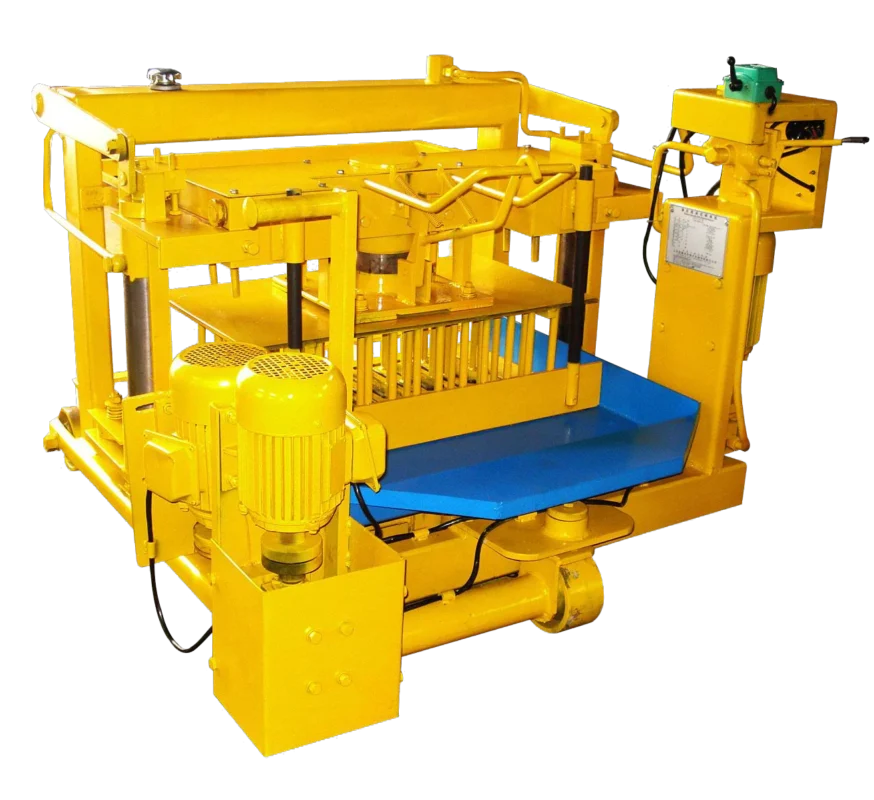
Matched System Configuration — the mixer, feed rate, and curing area are specified together with the QMY4-30 so the 30-second cycle is sustained without material starvation or idle press time.
Technical Specifications
| Parameter | Value |
|---|---|
| Model | QMY4-30 |
| Product Type | Mobile Egg-Laying Concrete Block Making Machine |
| Rated Power | 5 kW |
| Voltage & Frequency | Configurable to site supply (confirm with buyer) |
| Control System | Manual operation |
| Overall Dimensions (L×W×H) | 1200 × 1200 × 1100 mm |
| Net Weight | 950 kg |
| Output Capacity | 480 pcs/h (basis: 400×200×200 mm hollow block, 4 pcs/mould) |
| Output Capacity | 600 pcs/h (basis: 400×150×200 mm hollow block, 5 pcs/mould) |
| Output Capacity | 840 pcs/h (basis: 400×100×200 mm hollow block, 7 pcs/mould) |
| Output Capacity (8-hour shift) | 3840 / 4800 / 6720 pcs (basis: 400×200×200 / 400×150×200 / 400×100×200 mm hollow block) |
| Cycle Time | 30 seconds |
| Mould Format | Changeable for hollow block and solid brick |
| Pallet Size | Not applicable (egg-laying / mobile type) |
| Automation Level | Manual / small-scale mobile |
| Raw Materials | Cement, sand, crushed stones, slag |
| Warranty | Five-year guarantee |
Application Suitability
| Application | Material or Output |
|---|---|
| On-site building projects | Hollow blocks laid directly on compacted ground without pallet infrastructure |
| First-stage block enterprises | Hollow block and solid brick from locally sourced cement, sand, and crushed stone |
| Remote housing developments | Production adjacent to the build site, avoiding long-distance transport of heavy masonry |
| Contractor-owned supply | Daily output matched to a single crew’s laying speed, eliminating external supplier dependency |
What "Pieces per Hour" Leaves Out When Sizing a Mobile Block Machine Production Line
A cycle-time figure only holds if the mixer and material feed can keep pace with the press.
A mobile egg-laying block machine removes the pallet return loop and curing-rack stations from the line, but it does not remove the need for continuous raw material supply. I have watched contractors lose an entire shift because a mixer sized for a smaller machine could not feed a 30-second cycle, leaving the press standing idle between batches. When we quote a mobile block machine production line, the capacity calculation must state which block format the number assumes and pair the press with a mixer that delivers a fresh batch within that same window [NEED_CITE: mixer batch sizing relative to press cycle time in egg-laying block operations].
Mixer-to-Press Synchronization Around a 30-Second Cycle
The QMY4-30 completes one mould cycle every 30 seconds regardless of the hollow block format loaded. That tempo demands a mixer capable of discharging a homogenous batch in well under a minute, accounting for loading and discharge dead time. If the mixer is undersized, the operator waits — and a mobile block machine production line rated at 480 pieces per hour on a 400×200×200 mm hollow block drops to whatever the mixer can actually sustain. Matching the mixer drum volume and discharge gate to the press hopper is a line-level decision, not a press-level one.
Ground Preparation and Curing-Area Layout
An egg-laying machine deposits blocks directly onto the floor, which means the ground surface becomes part of the production line. A compacted, level concrete slab prevents block corner damage during the laying pass and provides the flat reference the machine needs to travel straight. The curing area must be sized for the full shift output — on a 400×200×200 mm hollow block run, that means floor space for 3,840 blocks before they are moved to secondary stacking. Planning that footprint before the machine arrives prevents a bottleneck that no amount of press speed can fix [NEED_CITE: floor curing area requirements for mobile egg-laying block machines in tropical and arid climates].
Reading the Power and Weight Specs for Remote Sites
At 5 kW total rated power, the QMY4-30 can run from a portable generator, which matters when grid supply is absent or unreliable on a project site. The generator must be sized to handle motor starting current, not just running load — a detail that causes commissioning delays when overlooked. The 950 kg net weight and 1200 × 1200 × 1100 mm footprint mean the machine can be repositioned by a small forklift or even a block-and-lever crew as production moves across a large site, keeping transport distance between the press and the laying area short.
The Cost of Ignoring Line-Level Matching
When the mixer, ground slab, or curing area is an afterthought, the mobile block machine production line underperforms against its quoted capacity — and the buyer blames the press. Blocks laid on soft or uneven ground crack at the base before curing begins, creating waste that no machine adjustment can correct. An undersized generator that trips mid-cycle damages the motor winding over time, leading to failures that appear random but trace back to the original power calculation. These are line-integration failures, and they surface within the first week of operation [NEED_CITE: common commissioning failures in mobile block production on remote construction sites].
Why Source the Surrounding Line from the Same Supplier
Block machinery as a single focus means the mixer, feed arrangement, and curing plan are specified against the QMY4-30’s actual cycle time, not a generic catalogue figure. Configuration is set against the buyer’s local aggregate and target block format, so the mix design does not need reworking after arrival. Mould supply covers the formats the buyer’s market actually sells, including custom drawings when standard sizes do not match. The automation level is selectable — a buyer can start with this manual mobile unit and move to a semi-automatic stationary line later without replacing the entire supporting infrastructure. Installation support and operator training ensure the line runs at its rated tempo from the first shift.
Documentation & Verification
- Line layout drawing with capacity stated per block format, not a single headline number
- Machine specification sheet confirming power, dimensions, and cycle time
- Mould drawing and format list for every hollow block and solid brick size ordered
- Voltage and frequency confirmation document matching the buyer’s site or generator supply
- Factory test record on the buyer’s specified block format before dispatch
- Operation and maintenance manual with wear parts and mould replacement schedule
Installation, Commissioning & Support
- Compacted concrete slab required as ground surface for egg-laying travel and block curing
- 5 kW power supply with dedicated circuit and generator starting-current headroom confirmed
- Machine shipped fully assembled in plywood packing; no on-site mechanical assembly needed
- Mould changeover demonstrated on-site with the buyer’s operator during commissioning
- Five-year warranty covering structural and mechanical components from date of arrival
- Wear parts list with reorder intervals based on the buyer’s local aggregate abrasiveness
What We Need to Size Your Line
To match the mixer and curing layout to your actual production target, share the block formats you intend to sell and the daily volume each format requires. Confirm the voltage and frequency available at your site, or the generator model if grid power is not an option. A sample of your local sand and aggregate lets us verify the mix design before the machine leaves the factory.
Frequently Asked Questions
Q: How do I verify real daily output for the block format my market buys?
A: Each capacity figure assumes a specific block size and mould cavity count — for example, 480 pieces per hour on a 400×200×200 mm hollow block with four cavities per mould. Request a line layout that states the output per format you actually produce, so your daily planning uses the correct number rather than a headline maximum.
Q: What mixer capacity keeps the 30-second cycle running without interruption?
A: The mixer must discharge a full batch into the press hopper within the cycle window, allowing for loading and discharge time. A mixer drum volume matched to one mould cycle plus a small buffer prevents the operator from waiting between cycles, which is the most common cause of actual output falling below rated capacity.
Q: What ground preparation does an egg-laying machine need on site?
A: A compacted, level concrete slab serves as both the travel surface for the machine and the initial curing bed for freshly laid blocks. The slab must extend far enough to hold the full shift output before blocks are moved to secondary stacking, preventing handling damage during the critical early curing period.
Q: How does generator sizing work for a 5 kW machine on a remote site?
A: The generator must supply the motor starting surge, which exceeds the 5 kW running load. Undersizing causes voltage dip and circuit trips that damage motor windings over time. Confirm the generator rating with the motor starting-current specification before commissioning begins on site.
Q: How many block formats can one QMY4-30 cover in a single shift?
A: The mould is changeable between hollow block and solid brick formats, but each change requires a stop. Plan the shift around one or two formats to maintain output tempo, and request the mould-change procedure and estimated time so you can schedule format switches during natural breaks in the production run.


